
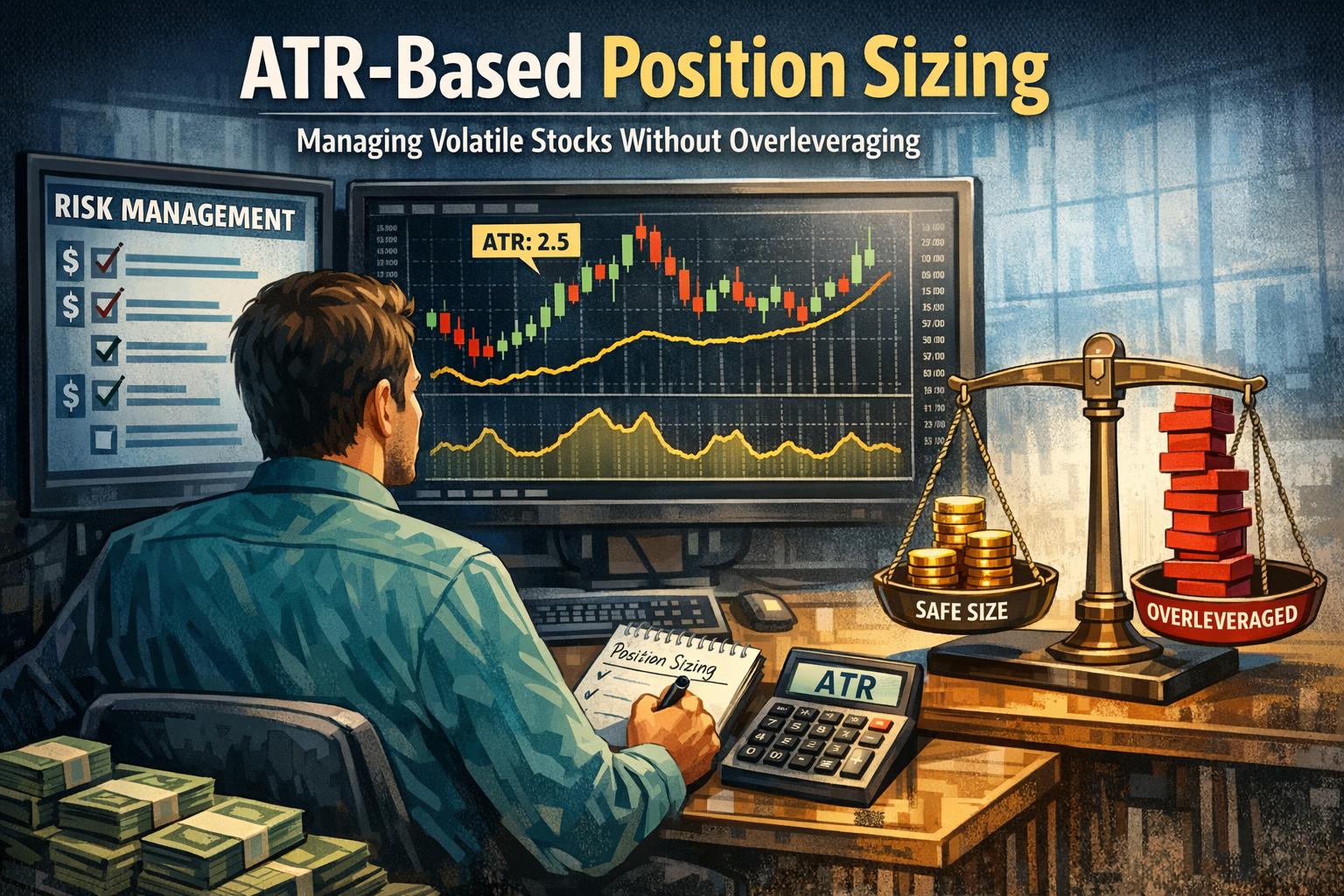
Understanding ATR-Based Position Sizing
The Average True Range (ATR) is a technical analysis indicator designed to measure the volatility of a financial instrument. Unlike indicators that attempt to forecast price direction, the ATR focuses exclusively on the magnitude of price movement. This distinction makes it particularly valuable for risk management and position sizing. By aligning trade size with market volatility, ATR-based position sizing provides a structured framework for managing exposure across different instruments and market conditions.
Financial markets exhibit changing volatility regimes. Periods of relative stability may be followed by substantial price swings. Traders who use a fixed position size without regard to volatility risk overexposure during volatile periods and underexposure during quieter phases. ATR-based position sizing addresses this imbalance by adjusting trade size according to current market conditions. This method is especially relevant when trading volatile equities, leveraged exchange-traded products, commodities, or cryptocurrencies.
The Basics of ATR
The ATR indicator was introduced by J. Welles Wilder in 1978 in his book New Concepts in Technical Trading Systems. Although originally developed for commodities markets, ATR has since been widely adopted across equities, futures, foreign exchange, and digital assets. Its adaptability stems from its universal focus on price range rather than direction.
ATR does not indicate whether the market is trending upward or downward. Instead, it measures the degree of price fluctuation over a defined number of periods. This makes it a non-directional volatility measure. A rising ATR indicates expanding price ranges and increased volatility, while a declining ATR signals contracting price movement and reduced volatility.
Calculating ATR
The ATR is derived from the concept of True Range (TR). True Range expands on the traditional daily range by factoring in price gaps between sessions. For each period, True Range is defined as the greatest of the following three calculations:
- Current High minus Current Low
- Absolute value of Current High minus Previous Close
- Absolute value of Current Low minus Previous Close
This approach ensures that overnight gaps and limit moves are incorporated into volatility measurement. In markets where gaps are common, using the simple high-low range would underestimate actual volatility. True Range captures these additional price movements.
The Average True Range is then computed as a moving average of the True Range values over a specified number of periods. The commonly used default setting is 14 periods. Wilder originally applied a smoothing technique similar to an exponential moving average. However, modern charting platforms may use either Wilder’s smoothing method or a standard exponential moving average while maintaining equivalent smoothing effects.
Interpreting ATR Values
An ATR reading must be evaluated in context. A stock priced at $20 with an ATR of $2 behaves differently from a stock priced at $200 with the same ATR value. Therefore, some traders use ATR as a percentage of price to facilitate cross-asset comparisons.
Key interpretive principles include:
- High ATR: Indicates heightened volatility and potentially larger price swings.
- Low ATR: Indicates reduced volatility and narrower trading ranges.
- Rising ATR: Suggests expanding price movement and potential trend acceleration.
- Falling ATR: Suggests decreasing movement and possible market consolidation.
ATR does not imply trade direction. It must be combined with entry and exit criteria based on other analysis methods, such as trend identification, support and resistance levels, or systematic trading rules.
Volatility and Risk Management
Volatility directly influences trading risk. When volatility increases, price swings widen. For a given position size, greater swings translate into larger unrealized gains and losses. Without adjustments to position size, volatilities that increase beyond normal expectations can distort risk exposure.
Volatile instruments often attract traders due to their capacity for rapid price movement. However, substantial moves in either direction increase the probability of large losses if position sizing remains static. Therefore, integrating a volatility-based sizing model such as ATR provides a mechanism to standardize risk exposure across trades.
Risk management integrates three primary elements:
- Entry criteria
- Stop-loss placement
- Position size
ATR is typically applied to the latter two components. It can define stop distance and subsequently determine appropriate position size.
Position Sizing with ATR
Position sizing determines the number of shares, contracts, or units to purchase or sell in a trade. ATR-based sizing links position size directly to the asset’s volatility. Instead of purchasing a fixed number of shares in each trade, the trader adjusts share quantity based on market conditions.
This method ensures that each trade carries approximately the same predefined capital risk, regardless of instrument volatility. The approach is systematic and reduces subjective guesswork in determining trade exposure.
Core Concepts Behind ATR Position Sizing
ATR-based position sizing relies on several principles:
- Capital risk per trade should be defined before entering a position.
- Stop-loss distance should reflect current volatility.
- Position size should be derived from the relationship between the risk amount and stop distance.
For example, if volatility doubles but stop placement remains proportionally adjusted, position size must decrease to maintain constant risk exposure.
Steps for ATR-Based Position Sizing
1. Determine the ATR Value
Retrieve the current ATR value from a trading platform. The standard setting of 14 periods is common, but shorter settings (such as 7 periods) may reflect more recent volatility, while longer settings (such as 20 or 30 periods) provide smoother, more stable readings.
2. Define the Risk Per Trade
Establish the maximum capital amount to risk on a single trade. Many traders use a fixed percentage of account equity, typically between 1% and 2%. For example, in a $100,000 account, a 1% risk tolerance equates to $1,000 per trade.
3. Determine Stop-Loss Distance
Stop-loss placement often uses a multiple of the ATR. Common multiples include 1x, 1.5x, or 2x ATR. If ATR equals $3 and the trader selects a 2x multiple, the stop-loss distance becomes $6 from the entry point.
4. Calculate Position Size
The basic formula for position size is:
Position Size = Capital at Risk / Stop-Loss Distance
If capital at risk is $1,000 and stop-loss distance is $6, the position size equals:
$1,000 ÷ $6 = 166 shares (rounded down for conservatism)
This ensures that, if the stop loss is triggered, the loss does not exceed the predefined $1,000 limit.
Application to Volatile Instruments
Volatile names often display wide daily ranges and frequent price gaps. Without volatility-based sizing, traders may inadvertently assume excessive exposure. ATR-based methods adapt position size downward during periods of increased volatility.
Consider two stocks:
- Stock A with ATR of $1
- Stock B with ATR of $5
If both trades risk $1,000 with a 2x ATR stop, the stop distance for Stock A would be $2, while for Stock B it would be $10. Consequently, position size in Stock B would be significantly smaller. This ensures equivalent dollar risk despite differing volatility profiles.
Advantages of ATR-Based Position Sizing
1. Standardized Risk Management
By maintaining constant risk per trade, the method helps preserve capital during streaks of losses. It prevents disproportionate losses resulting from unusually volatile periods.
2. Adaptability to Market Conditions
Volatility tends to cluster. ATR-based sizing automatically reduces exposure during turbulent conditions and increases exposure when markets stabilize.
3. Cross-Asset Consistency
Traders operating across equities, futures, and foreign exchange markets can apply ATR-based models uniformly, provided contract specifications and leverage adjustments are integrated into calculations.
4. Systematic Implementation
The formulaic nature of ATR sizing supports rule-based trading systems. It reduces discretionary variability and enhances consistency in execution.
Advanced Considerations
Using ATR with Trailing Stops
ATR can also support trailing stop methodology. For example, a trade may use a 2x ATR trailing stop that adjusts upward as price advances. This allows stop levels to expand or contract in alignment with volatility.
Adjusting for Changing Account Equity
Because risk per trade is calculated as a percentage of account equity, position sizes evolve dynamically as capital grows or declines. This approach compounds gains while reducing exposure after losses.
ATR and Leverage
In leveraged instruments such as futures or margin accounts, the effective exposure exceeds the capital deployed. When applying ATR-based sizing, traders must incorporate contract multipliers and margin requirements into calculations to ensure actual dollar risk matches intended limits.
Limitations of ATR-Based Sizing
Lagging Nature of ATR
ATR is derived from historical price data. Sudden volatility spikes may not be fully captured until after they occur. Therefore, extreme market events can exceed anticipated stop distances.
Volatility Compression Before Breakouts
Low ATR readings may precede significant breakouts. During these compressed periods, ATR-based sizing may increase position size due to smaller stop distances. If a breakout involves a rapid adverse move, this can increase risk exposure.
Not Directional
ATR does not provide entry signals. It should be integrated with broader analytical frameworks including trend analysis, volume assessment, and macroeconomic considerations.
Portfolio-Level Risk Control
While ATR governs individual trade risk, broader portfolio management requires monitoring:
- Total exposure across correlated positions
- Sector concentration
- Aggregate portfolio drawdown thresholds
Multiple positions in highly correlated volatile names can amplify effective risk beyond individual trade calculations. Position sizing should account for correlation and diversification principles.
Practical Implementation Guidelines
Data Consistency
Ensure ATR calculations use consistent timeframes aligned with trading strategy. Swing traders often use daily ATR, while intraday traders may rely on hourly or shorter-period ATR readings.
Periodic Review
Volatility regimes shift over time. Periodic backtesting and review of ATR multipliers can help maintain alignment between strategy performance and current market conditions.
Risk Discipline
ATR-based position sizing is effective only if stop-loss orders are respected. Deviating from predefined stops undermines the mathematical symmetry of the approach.
Conclusion
ATR-based position sizing provides a structured and volatility-adjusted framework for managing trading exposure. By linking stop-loss distance and trade size to measurable market volatility, traders can standardize risk across instruments with differing characteristics. The technique promotes consistency, adaptability, and disciplined capital allocation.
Although ATR is not a predictive indicator, its integration into a comprehensive risk management system supports long-term capital preservation. When combined with sound trading methodologies, diversification principles, and adherence to predefined risk thresholds, ATR-based position sizing can contribute to a systematic and sustainable trading process.