
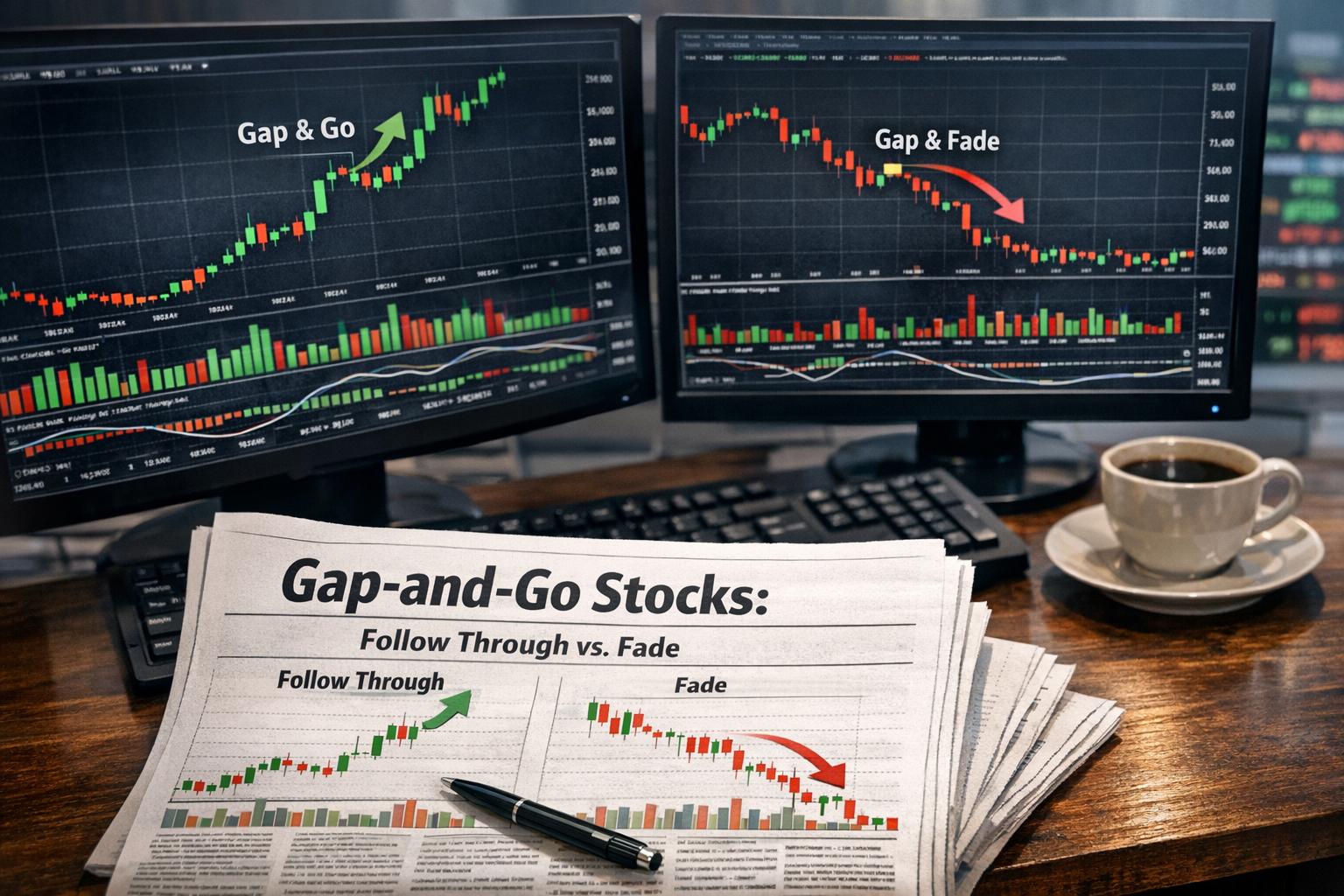
Understanding Gap-and-Go Stocks
In active equity trading, a gap-and-go strategy is a method that tries to profit from a stock that opens substantially above or below its prior day’s closing price, then continues moving in the same direction. It’s most often discussed in day-trading circles because the trades typically start and end within the same session. The basic idea sounds simple: if the stock “jumps” at the open, there’s a reason—and sometimes that reason keeps pushing after the opening bell.
But the market doesn’t care about your confidence level. It cares about whether the initial imbalance between supply and demand has enough fuel to last beyond the first few minutes. That’s why gap-and-go trading is less about guessing and more about deciding—using price structure, volume, and context—whether a gap is likely to continue or fade.
Price gaps happen across markets and timeframes, but morning gaps in equities are especially relevant. Exchanges close overnight, news accumulates, then trading resumes with prices adjusting quickly to reflect what happened while you were sleeping. The chart usually shows this as a discontinuity: a gap between the prior close and the opening print. Whether that adjustment is followed by continuation or reversal is the real question.
Market Structure and Why Gaps Occur
Equities trade during defined hours—commonly 9:30 a.m. to 4:00 p.m. Eastern Time in the U.S. During the overnight stretch, regular liquidity thins out and official price discovery pauses. Meanwhile, the world keeps spinning: earnings are released, macroeconomic numbers drop, regulatory decisions hit the wires, and sector leaders can drag everything else along for the ride.
When the primary session reopens, participants reposition based on the latest information. If big institutions and informed traders adjust their valuations quickly, the opening auction can produce a large price shift. If enough buy orders come in at once, the stock may open above the prior close; if selling overwhelms, it may open below.
This price discontinuity shows up on charts because there’s no trading bridge between the previous close and the first regular-session print. In practice, the gap magnitude often reflects how the market reassessed the stock’s value based on new inputs. Still, the magnitude alone doesn’t tell you whether price will keep pushing intraday. Two gaps can look similar and behave completely differently depending on liquidity, float, participation, and broader market conditions.
Types of Morning Gaps
Morning gaps generally fall into two straightforward categories:
1. Gap Up: The stock opens higher than it closed the prior day. This often indicates aggressive buying interest and a positive repricing based on new information.
2. Gap Down: The stock opens lower than the prior day close. This typically reflects heavier selling pressure and a negative reassessment.
Technically minded traders also describe gaps by “behavioral role” within chart patterns, such as breakaway gaps, continuation gaps, exhaustion gaps, and common gaps.
– Breakaway gaps occur when price leaves a well-defined range or established structure, often suggesting a change in trend.
– Continuation gaps form within an ongoing move and imply momentum is still working.
– Exhaustion gaps appear when a trend starts to run out of steam, often preceding reversals.
– Common gaps happen without strong catalysts and frequently get filled.
Gap-and-go setups usually try to focus on breakaway and continuation-type gaps—basically the gaps most likely to become “real trading moves” instead of quick chart blips.
Core Principles of the Gap-and-Go Strategy
The gap-and-go strategy rests on a simple behavioral model: a strong directional price shift at the open can create a feedback loop. When the stock opens up (or down) and continues pushing, momentum traders pile in. That demand or supply can broaden the move—at least long enough for day-traders to act.
In most gap-and-go playbooks, execution happens early—often within the first hour after the open. Some traders narrow it further to the first 5 to 30 minutes, when volatility is highest and the market is still deciding whether the gap will become a trend or disappear.
To keep the strategy from turning into “vibes trading,” many practitioners combine a small set of structural conditions:
- A measurable percentage gap relative to the prior close
- Pre-market activity that is meaningfully above average
- A clear catalyst that can justify repricing
- Price holding above (or below) key pre-market reference levels
Traders also watch pre-market highs and lows. These can become the first legitimate “support” or “resistance” once the regular session starts, because the market often treats them as a reference grid.
When Gaps Follow Through
Not every gap gets follow-through. Many gaps reverse quickly, filling part or all of the discontinuity. So traders look for confirmation. Follow-through is more likely when several factors line up.
Strong Catalyst: Earnings surprises, raised or lowered guidance, regulatory approvals, mergers, major sector upgrades/downgrades, or macroeconomic developments can all change valuation. If the catalyst is credible and institutions reposition based on it, the order imbalance can persist beyond the opening auction.
High Relative Volume: Volume matters because it tells you whether the move has participation behind it. Traders often look for volume above typical levels for that stock (and for that time of day). If early-session volume is strong and continues, it suggests broad buy or sell interest rather than a thin-spread “pop.”
Because institutions manage a large portion of market volume, their involvement tends to make continuation more realistic. A gap driven mostly by lightweight flows can peter out fast.
Market Trend Alignment: A gap up during a broadly bullish market environment has a better chance of continuing than a gap up against a risk-off tape. Similarly, a gap down occurring when the broader market is already under pressure may find buyers less willing to step in.
This doesn’t mean “always trade with the trend.” It means that countertrend moves typically face more friction from the crowd.
Float and Liquidity Considerations: Stocks with smaller public floats can move more sharply because fewer shares are available to absorb demand. That can help generate a gap-and-go move that “runs.” It also raises the risk that liquidity dries up and price whipsaws.
Larger-cap names are usually more orderly. They can still trend on a gap, but they often require more sustained volume to keep going in a clean way.
Holding Key Levels: One of the most practical tells is how price behaves after the opening push. If the stock opens and then consolidates near the top of the opening range (in a gap up scenario) rather than immediately retracing toward the prior close, it can indicate buyers are absorbing supply. That behavior often precedes another expansion.
Opening Range Dynamics
The opening range—commonly the high and low of the first 5, 15, or 30 minutes—becomes a reference line for many active traders. It effectively captures the market’s earliest consensus about price value before momentum either catches fire or burns out.
– In a gap up, a breakout above the opening range high on strong volume can confirm continuation.
– In a gap down, a breakdown below the opening range low on strong volume can confirm continuation.
False breakouts are common, though. They often happen when volume fades or when the broader market acts differently than expected. That’s why some traders don’t rush the moment price ticks past the opening range high; they wait for consolidation and re-acceptance, which is basically the market saying, “Yeah, we meant it.”
When Gaps Fade
Gap fading happens when price reverses direction and retracts toward the previous session’s closing price. When the price returns all the way to the prior close, traders call it “filling the gap.” (In practice, many partial fades happen too, which can still matter a lot for traders.)
Several conditions make fades more likely:
Lack of Substantive News: If the gap comes from speculation, low-credibility headlines, or broad market noise rather than company-specific developments, early enthusiasm can dissolve quickly. Without a real driver, the stock often migrates back toward a more realistic value.
Extended Technical Conditions: If the stock gaps up after multiple consecutive strong sessions, it may attract profit-taking. Oscillators like the Relative Strength Index (RSI) can contribute to this behavior; if RSI is stretched, traders who bought earlier may lock in gains right when the stock looks impressive again.
Low Early Volume: Volume that never materializes is a yellow flag. A visible gap with thin intraday participation suggests that the move may not have institutional sponsorship. Retail flows alone can move price briefly, but they struggle to sustain an orderly trend.
Higher Timeframe Resistance: If the gap pushes price directly into a major daily or weekly resistance level, selling interest tends to increase. People who bought near that level previously may exit, adding supply right where the stock is trying to go.
Broader Market Reversal: A technically strong setup can still fade if new macro information flips the broader risk environment. When indices change tone, individual stocks often get dragged along, for better or worse.
Many traders treat fading as a separate strategy. They wait for confirmation like a breakdown below early support in a gap up scenario, or rejection below resistance in a gap down case.
Volume Analysis in Depth
Volume is one of the most important variables in gap trading. But “volume” doesn’t just mean the raw number of shares traded; it means how current trading compares to what’s typical.
That’s why traders prefer relative volume: current volume divided by historical average volume for the same time window (or the same trading profile). Relative measures are more meaningful because different stocks have different baseline liquidity.
Common volume observations include:
- Acceleration of volume into breakouts (a sign demand is expanding)
- Volume contraction during consolidations (a sign the move is pausing rather than dying)
- Climactic spikes (sometimes a sign the market is burning through available participants fast)
A continuation move usually requires steady participation throughout the morning. If volume spikes hard at the open and then falls off quickly, the market may have already absorbed the initial imbalance. In that scenario, the stock can drift, retrace, or chop until something else changes.
If you’ve traded gaps before, you’ve probably seen the pattern: it screams for 10 minutes, then suddenly it can’t get momentum back. That’s not always “bad,” but it often means your entry timing needs to be less hopeful and more evidence-based.
Technical Tools and Indicators
Price and volume do most of the talking, but many traders still use additional technical analysis tools to support decisions. The trick is not to let indicators drive the trade blindly. They’re more useful as secondary confirmation—especially when volatility and spreads can make raw price action confusing.
Moving Averages: Intraday moving averages such as 9-period and 20-period exponential moving averages can help identify short-term direction. When price is holding above those averages after a gap up, it suggests bulls have control and dips may get bought. If price continually tags below the short intraday averages, continuation confidence weakens.
On higher timeframes, the 50-day and 200-day moving averages often function as widely watched support/resistance zones. A gap up that runs into the 200-day area, for example, may face heavier selling because lots of traders expect it.
Relative Strength Index (RSI): RSI above 70 or below 30 is often described as overbought/oversold. In strong trends, RSI may stay elevated or depressed longer than you’d expect. For gap-and-go traders, RSI is typically more useful for spotting extremes and potential exhaustion rather than acting as a strict buy/sell signal.
VWAP (Volume Weighted Average Price): VWAP matters because it approximates the average execution price weighted by volume. Many institutional traders treat VWAP as a fairness line. In a gap up day, holding above VWAP can indicate sustained institutional support. Losing VWAP and failing to reclaim it can indicate weakness—particularly if the opening move fails to expand.
In a gap down scenario, trading below VWAP and rejecting attempts to reclaim it can support the bearish continuation thesis.
MACD (Moving Average Convergence Divergence): MACD can add supportive context through crossovers or histogram trends. Since it’s a moving-average-based indicator, it has lag, so it typically won’t tell you the gap move is happening in the first few minutes. It’s better as a supporting view, not a trigger.
Indicators are tools, not fortune tellers. The more you treat them like “weighing factors” alongside price structure and event context, the less you get surprised.
Risk Management Considerations
Gap trading can produce big intraday moves, and that can be fun right up until it isn’t. Volatility increases at the open, spreads can widen, and price can move faster than you can comfortably think. Risk management is what keeps a bad day from turning into a permanent one.
Position sizing: Many traders reduce size during very high-volatility gap days. A smaller position helps keep emotional decision-making from wrecking the trade.
Stops and invalidation levels: Stops vary by style, but common references include pre-market lows/highs, opening range levels, and predefined percentage loss thresholds.
Possible stop placement ideas include:
- Below the pre-market low (for long positions)
- Below the opening range low
- At a fixed percentage loss threshold
The goal isn’t to make the stop “perfect.” It’s to make sure your thesis fails when price does something that contradicts it.
Profit targets: Profit-taking approaches vary with liquidity and volatility. Some traders use prior daily resistance/support as targets. Others use measured moves: for example, projecting a move equal to the initial range expansion. Trailing stops are also used when price trends cleanly after the open.
Slippage: Slippage is real in lower-liquidity securities, especially when the bid-ask spread is wide. Your stop might get triggered at a worse price than you expected. That’s one reason some traders prefer higher-liquidity names for gap-and-go—less drama with fills, more predictable execution.
A personal note from real trading life: I’ve watched a stock “barely” break your stop level by pennies and still clip you for a bigger-than-expected loss because spreads widened during the move. That’s not market manipulation—it’s just math. Your risk plan should assume friction exists.
Time-of-Day Effects
Volatility usually peaks near the open and again near the close. The first hour tends to concentrate both order imbalance and decision-making. By contrast, midday trade activity often quiets down: ranges narrow, volume drops, and price becomes more mean-reverting.
For gap-and-go traders, the most actionable window is often the first 30 to 90 minutes. That’s when the market most actively “checks” whether the gap has continuation characteristics. If price shows no directional resolution later in the morning—no consistent pattern of higher highs / higher lows in a gap up, or lower lows / lower highs in a gap down—continuation probability often declines.
That said, markets are unpredictable. A gap that doesn’t trend early can still explode later if new information emerges mid-day (another headline, revised macro expectations, a sudden analyst note) or if the broader market shifts momentum.
So the trade might not follow through at 9:40 a.m., but it might show up at 2:15 p.m. The difference is that “gap-and-go” often implies you’re acting early. If you wait too long without new catalysts, you may be holding a different strategy than you think you are.
Differences Between Large-Cap and Small-Cap Gaps
Not all gaps trade the same. Capitalization level changes liquidity, spread behavior, and how institutions participate.
Large-cap gaps: Large-cap stocks generally have deeper liquidity, tighter spreads, and more stable price increments. Continuation moves may be smaller in percentage terms compared to small caps, but they often still offer meaningful absolute movement. The trading process tends to be cleaner: less random wickiness, easier execution, and more consistent order book behavior.
Small-cap gaps: Small caps can produce larger intraday percentages, especially when float is limited. That sounds great until you remember you’re trading a name where fewer shares exist to absorb demand changes. Small caps often experience wider bid-ask spreads and can face sudden reversals. Halts due to volatility are also more likely in some environments, which is a whole separate type of “fun.”
Institutional participation also differs. Large-cap gaps have a better chance of attracting broad institutional attention, which supports continuation when the move is real. Small caps can still trend, but they may trend on different mechanics—more retail influence, more liquidity swings, and sharper momentum bursts.
In practice: if you’re new to gap-and-go, large caps can be more forgiving. If you can handle the execution risk, small caps can pay—but you’ll need discipline.
Psychological and Behavioral Factors
Gap trading isn’t just math; it’s crowd behavior. A gap-and-go move often draws participants into a storyline: “This should go.” If enough people act on that belief, price tends to follow.
Several behavioral forces come up repeatedly:
Fear of missing out (FOMO): When price opens and quickly moves in one direction, traders who didn’t get in early may chase. That demand/supply can create the momentum traders need to keep the trend going.
Short covering: In a gap up situation, short sellers may be forced to cover. That adds incremental buying pressure, which can accelerate the move. In a gap down scenario, margin calls or risk reductions can intensify selling pressure.
Forced liquidation: Leveraged traders sometimes get squeezed by price movement against their positions. When liquidity is thin, liquidation can become the driver rather than the catalyst.
Short-interest levels and borrow rates can add context—particularly if a gap direction seems consistent with potential covering. Still, don’t treat positioning data like a trigger. Behavioral reactions are probabilistic. You can estimate odds, but you can’t command them.
Data Review and Performance Evaluation
The gap-and-go strategy improves when you review outcomes. If you only trade the days you “feel good about,” you’ll miss the patterns that actually matter—because markets don’t care about your mood.
Systematic traders often keep gap logs across different market cycles. Common metrics include:
- Gap percentage magnitude
- Time to high or low of day
- Percentage of gaps that fill within the same session
- Volume relative to 30-day averages
Reviewing historical outcomes under different volatility regimes helps you refine entry criteria. For example, you might notice that continuation is most common after gaps with strong volume and clear catalysts, but reversals spike when gaps happen during broader index pullbacks.
You can also separate results by scenario type: breakaway vs continuation, and gap up vs gap down. The market often behaves differently depending on the direction and on whether the stock is already extended.
At the end of the day, evaluation turns “smart intuition” into a repeatable process. It also exposes the days where you force trades that your own rules told you to avoid. Those days tend to stand out in your P&L for the wrong reasons.
Common Gap-and-Go Mistakes
Even careful traders make predictable errors. It’s useful to know what these usually are:
Trading the gap without verifying participation: A gap can look dramatic, but if relative volume is weak, you’re trading a story without witnesses.
Ignoring the broader tape: If the index is reversing hard, individual continuation moves can lose their footing. You don’t need to demand perfect correlation—just don’t ignore obvious conflict.
Entering too late after a fading attempt: Some traders wait for confirmation and accidentally buy after the move has already failed. Confirmation matters, but so does “where in the day” and “how price is behaving now.”
Using stops that don’t match the thesis: A stop based on a random percentage can be wrong for a specific setup. Better stops align with structural invalidation, like pre-market breaks or opening range failures.
Overtrading: Gap days can create multiple signals in a single name, and momentum traders sometimes feel compelled to act on every shift. Overtrading usually means more small losses that pile up—like crumbs you’ll trip over later.
Mistakes aren’t always fatal. But the ones that show up repeatedly are usually fixable, which is the good news.
Putting It All Together: A Practical Checklist
A gap-and-go trade usually becomes sensible when the conditions match up quickly. Here’s how many traders conceptualize it, without pretending there’s a magic formula hidden in the chart.
First, confirm the gap is a meaningful repricing event. Look for a catalyst that explains the move and check whether the stock has the liquidity profile to support intraday continuation.
Second, verify participation. Is pre-market activity stronger than usual? Does early regular-session volume show up quickly and hold near breakout attempts rather than disappearing?
Third, watch price structure after the open. Does price hold key reference levels such as pre-market highs/lows or VWAP (when you use it)? Does it respect the opening range, or does it immediately retrace?
Fourth, align the setup with broader market conditions. You don’t need the index to be bullish in every gap up trade, but it shouldn’t be actively fighting your direction.
Finally, execute with a stop that invalidates your thesis and use profit logic that fits the day’s volatility. If you’re trading a fast mover, waiting for a perfect target can turn a clean trade into a messy one.
Conclusion
The gap-and-go strategy focuses on price discontinuities at the start of the trading session, then tries to profit from continuation in the same direction. A gap is the market’s initial repricing event—but continuation depends on whether there’s enough fuel behind it.
Gaps tend to follow through when catalysts are credible, relative volume supports the move, market direction aligns, key structural levels hold, and liquidity allows price to trend instead of just spiking. When participation is weak or the catalyst isn’t substantive, gaps more often retrace toward the prior close and fade back into yesterday’s price.
In practice, differentiating continuation from fade requires combining price action, volume analysis, technical references like the opening range and VWAP, and awareness of broader market conditions. And just as importantly, gap-and-go trading depends on risk management: position sizing, realistic stops, accounting for slippage, and consistent review of results.
When approached systematically rather than impulsively, gap trading can operate as a defined intraday methodology inside a broader trading framework.