
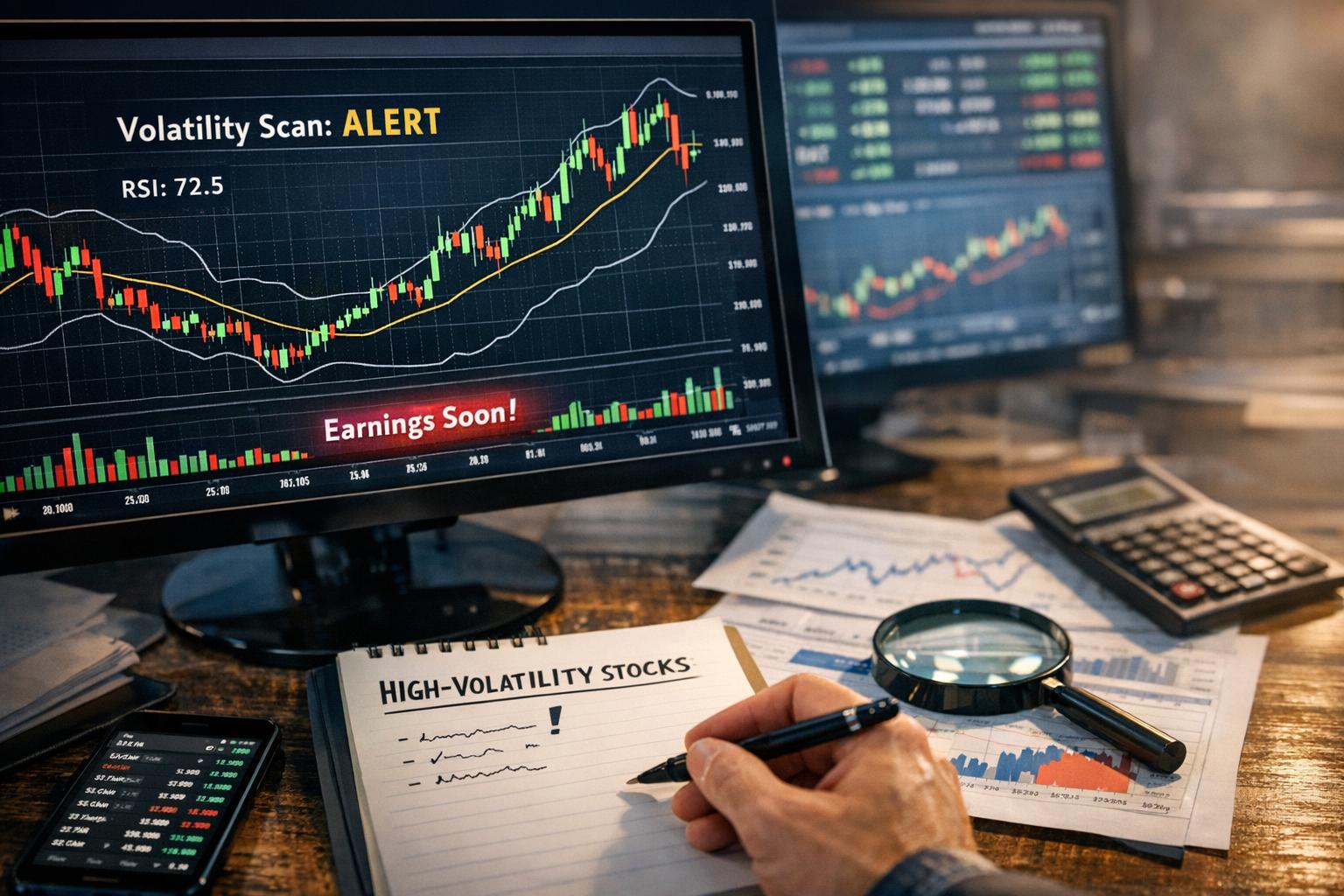
Understanding Volatility
In finance, volatility is the measure of how much a security’s price tends to move around over time. You can think of it as the stock’s “wiggle room.” Some stocks barely twitch; others swing like they’re trying to win an award for dramatic acting. In practical terms, volatility describes the degree of rapid increases or decreases in price, usually over short periods.
High-volatility stocks are the ones most likely to make investors sit up straighter—sometimes for profits, sometimes for regret. If you’ve ever watched a chart where the price jumps up or down hard within a day (and then repeats the stunt the next day), you’ve met volatility in the wild. For investors, the appeal is simple: rapid price movement can create trading and return opportunities. The catch is just as simple: the same movement that can produce gains can also cause losses fast.
This article focuses on how to identify high-volatility stocks, how to interpret the main indicators people use, and how to manage the risk without throwing your portfolio into a blender. (No judgment—people have tried.)
What Volatility Really Means (Beyond the Definition)
Volatility isn’t just “big price swings.” The concept has a few layers that matter when you’re evaluating stocks:
1) Magnitude
How large are the price changes relative to the stock’s usual behavior?
2) Speed
How quickly do those changes happen? A slow drift over months is different from a sudden spike within hours.
3) Predictability
Some volatility is “expected” because the market knows the stock is sensitive to news, earnings, or macro events. Other volatility appears out of nowhere and is harder to plan for.
A useful mental model is to treat volatility as a mix of market expectations plus uncertainty. When uncertainty rises, volatility often rises too. And because markets feed on uncertainty, volatility tends to cluster—once a stock starts moving violently, it can keep doing so until new information settles the issue.
Why Investors Pay Attention to Volatility
Investors don’t study volatility just because it’s interesting (though it is). They care because volatility affects:
1. Position sizing
If a stock swings widely, your “comfortable” position size usually needs to be smaller. Otherwise, normal daily moves can knock you out emotionally or financially.
2. Options pricing
Options are priced partly based on expected volatility. That means implied volatility can signal how much the market expects large moves in the near future.
3. Risk and return behavior
Two stocks can have the same long-term average return but very different risk profiles. Volatility helps describe that risk profile in numeric terms.
4. Trading opportunities
If volatility is high and liquidity is decent, traders often find more entry and exit points. But more points also means more chances to be wrong quickly, so don’t confuse “more opportunity” with “more forgiveness.”
Monitoring Market Indicators
One effective approach to identifying high-volatility stocks involves monitoring key market indicators. Indicators are useful because they summarize behavior that might otherwise be hard to spot. They don’t guarantee anything, but they help you spot candidates that are likely to move.
A quick note: no single indicator tells the full story. High volatility can be driven by liquidity changes, news cycles, sector dynamics, or company-specific events. Usually you want multiple signals aligning, not just one lonely metric waving from across the screen.
1. Beta Value: The beta value of a stock measures how sensitive its price movements are compared to the overall market. A beta greater than 1 suggests the stock has historically moved more than the market—often interpreted as “more volatile.”
However, beta comes with baggage. It’s based on past returns, and “past behavior” doesn’t always repeat. A company can mature, change strategy, or shift into a different risk profile. Also, beta can look high simply because the stock had a noisy period historically, not necessarily because it will remain that way.
If you use beta, treat it as a starting clue, not a verdict.
2. Implied Volatility: Unlike beta, implied volatility is forward-looking and comes from the options market. The options market reflects what traders expect about future price movement over a specific time horizon. High implied volatility generally indicates the market expects the security to move a lot.
Implied volatility is often quoted for different maturities (like 30 days, 90 days, and so on). That timing matters. If implied volatility spikes for near-term options, you may be watching a short-term catalyst (earnings, a regulatory decision, a product launch). If it stays elevated across longer maturities, expectations may be more structural—like a sector under stress.
It also helps to remember that implied volatility can rise even if the stock hasn’t moved much yet. In those situations, the “move” might be anticipated, not already realized.
3. Trading Volume: Trading volume indicates how many shares (or contracts) are changing hands. Spikes in trading volume can act as a signal that something is happening: new buyers and sellers are stepping in, and consensus may be shifting.
Higher volume often correlates with higher volatility because active trading tends to accompany repricing. Sometimes volume rises before the biggest move; sometimes it rises afterward as more participants pile in. In both cases, a volume jump is worth treating as a “watch closely” signal, especially when it appears around news, earnings, guidance updates, or major market events.
Qualitative Factors
Volatility is not solely a math problem. It can be driven by events and human behavior—meaning news flow, investor psychology, and corporate actions. Quantitative indicators may hint at volatility, but qualitative factors explain the “why” behind the movement.
Mergers and Acquisitions: News about potential mergers or acquisitions can cause a stock to swing because investors react to new information and then speculate about outcomes. In rumor-driven periods, uncertainty is high, so price movement can get wild. Even when deals don’t close, the trading around the announcement can still generate volatility.
Regulatory Changes: Government actions can reshape costs, timelines, and profitability assumptions for sectors. When regulators change rules—environmental standards, industry oversight, licensing requirements—markets adjust expectations rapidly. For example, environmental regulations can push up compliance costs for energy firms, and that change can show up quickly in stock prices.
Earnings Announcements: Earnings reports often act like a volatility trigger. Investors build expectations before the release, and then the reported results can force a repricing. If earnings show upside surprises or downside disappointments compared to consensus, the stock can jump or drop sharply—sometimes in the same trading session. Guidance matters too: “what we expect next quarter” often moves stocks even more than the results themselves.
These qualitative drivers are why high-volatility stocks tend to cluster around specific calendar events. If you’ve ever noticed that volatility looks calm until earnings week and then turns into a roller coaster afterward, you’ve seen the mechanism at work.
How to Tell If Volatility Is “Event-Driven” or “Structural”
This distinction matters for both traders and longer-term investors.
Event-driven volatility tends to be tied to a specific catalyst (earnings, a court decision, a contract award). Once the event passes, volatility often mean-reverts—prices may still move, but usually less violently.
Structural volatility is more tied to the company’s business model or the market conditions around it—like ongoing financial distress risk, heavy dependence on volatile commodity prices, or a sector that stays sensitive to macro changes. In those cases, volatility can persist longer because the uncertainty doesn’t go away quickly.
You can often spot which category you’re dealing with by asking: “What information would need to happen for volatility to calm down?” If the answer is “not much,” volatility is probably structural. If the answer is tied to a single upcoming event, it’s likely event-driven.
Using Technology and Tools
Manual watching is fine until it becomes exhausting. Technology can help you identify candidates faster, especially when volatility shows up in multiple metrics at once.
Stock Screeners: Stock screeners let investors filter stocks based on chosen criteria. Common filters include beta, average true range (if the screener offers it), implied volatility, trading volume changes, and recent price movement. Screeners are especially useful when you build a process instead of relying on memory.
But remember: screeners only narrow the field based on your selected criteria. If your criteria are too broad, you’ll find plenty of “noisy” stocks that don’t fit your goal. If your criteria are too narrow, you may miss opportunities. A balanced approach wins more often than an overly clever one.
Algorithmic Trading Software: Some investors use algorithmic tools to analyze large data sets and identify high-volatility behavior patterns. Algorithms can monitor price changes, liquidity metrics, options activity, and news signals. They may also manage execution based on spreads and market conditions.
This approach can be powerful, but it isn’t magic. Algorithms still need inputs that make sense, and they still carry risk if the model assumptions fail. In practice, many investors treat algorithmic tools as assistants rather than autopilots.
News Aggregators: Keeping informed of the latest developments matters because many volatility events are driven by information flow. News aggregators collect headlines and updates about companies and markets. They help you stay aware of catalysts that might not be reflected immediately in your historical volatility metrics.
If you’ve ever missed an earnings date and got surprised by a gap move, you already know why this matters. Volatility is often time-sensitive; the calendar matters.
Options Data as a “Volatility Radar”
If you trade options (or even if you just watch them), implied volatility and related options metrics can function like a radar for expected movement.
– When implied volatility rises sharply ahead of an event, the market expects bigger price swings.
– When implied volatility falls after the event, the market may be pricing in less future uncertainty.
– When realized volatility (historical movement) and implied volatility diverge, there can be opportunities—though not without risk and not without careful checking.
Some investors also look at the “skew” between call and put implied volatilities. That skew reflects perceived downside risk and can hint at how markets are positioning around bad-case scenarios.
Risk Management Considerations
High-volatility stocks can offer the chance for outsized returns, but they also increase the odds of uncomfortable drawdowns. The math of volatility is not forgiving. If you size positions too aggressively, you may get stopped out or forced to exit at the wrong time—usually the time when the stock is behaving exactly as expected.
The goal of risk management isn’t to remove risk. It’s to manage how risk affects your portfolio.
Diversification: Diversifying helps reduce the risk tied to any single high-volatility stock. If one stock moves violently against you due to a company-specific issue, the impact on the entire portfolio may be smaller. Diversification can be across sectors, strategies, and asset classes.
One caution: “diversified” doesn’t mean “immune.” If your holdings all share the same risk drivers (like interest-rate sensitivity or commodity exposure), they can still move together during market stress.
Stop-Loss Orders: Stop-loss orders can limit losses by automatically selling if a stock hits a predetermined price. This can help control downside risk and prevent a small problem from becoming a big one.
However, in high-volatility stocks, stop-loss orders can also backfire. Rapid price moves can trigger stops and cause you to exit at a temporary low, only for the stock to rebound later. Some traders use stop-losses based on volatility levels or wider thresholds to account for normal noise. Others prefer position sizing and time-based exits over hard stop orders.
In short: stop-loss orders are a tool. They should match the stock’s behavior, not fight it like a stubborn cap at a windy ballpark.
Position Sizing: The Often-Ignored Superpower
Many investors study volatility metrics but still oversize the position because the chart looks tempting. Position sizing is where volatility planning becomes real.
A simple approach is to reduce share size when volatility is higher. You can use volatility-related measures (like average percentage moves) as a guide for how much the stock might move in a typical period. If a stock can reasonably swing 3–5% daily, your position should reflect the likelihood that you’ll experience that swing while still being able to hold or execute your plan.
If that sounded a lot like common sense, it is. It’s just not always followed when excitement kicks in.
Liquidity Matters More Than People Think
High volatility with low liquidity is a rough combo. If spreads are wide or market depth is thin, you may face slippage—getting a worse execution price than expected. That can turn a “good” trade setup into a disappointing outcome simply due to execution quality.
Before you commit capital to a volatile name, check:
– Trading volume stability (not just spikes)
– Bid-ask spreads (and whether they widen significantly during news)
– Historical behavior around earnings (did the stock gap and stay there?)
Even if a stock looks volatile on paper, actual tradability determines whether you can act on that volatility.
Common Patterns in High-Volatility Stocks
If you spend enough time watching volatile names, you start to notice patterns. These patterns aren’t rules, but they can help with expectations.
1. Catalyst-driven spikes
The stock often moves hardest around events and less between events.
2. Increased correlation during market stress
When the market gets shaky, many stocks start moving together, even if their business models differ. That can increase portfolio risk beyond what you expected from individual stock analysis.
3. Volatility clustering
After big moves, volatility often stays elevated. That means traders can’t assume a “quiet period” right after a spike.
4. Options activity precedes price moves
Sometimes options traders reprice uncertainty before the stock’s price fully reacts. That can be a time-saving clue.
Practical Examples: How Investors Use Volatility in Real Life
It’s helpful to look at a few realistic scenarios to see how these concepts come together.
Example 1: Earnings week trade planning
An investor screens for stocks with rising implied volatility and elevated trading volume ahead of earnings. Beta is higher than 1, signaling market sensitivity. The investor then sizes the position smaller than usual to account for wider day-to-day movement. A stop-loss is used carefully, or the investor uses a predefined exit plan because they know gaps might occur at the open.
Example 2: Regulatory headline risk
A sector-specific stock shows increased realized volatility over the last month. It also has options implied volatility moving upward, hinting at expected future movement. The investor monitors news alerts for regulatory updates and avoids placing aggressive trades right before major regulatory milestones. When the rule change becomes clear, volatility often compresses—at least compared to the uncertainty period leading up to it.
Example 3: Deal rumor volatility
A targeted stock suddenly attracts attention after a rumor surfaces. Trading volume increases sharply, and implied volatility jumps on near-term options. The stock’s chart looks chaotic, but the investor recognizes the volatility as event-linked rather than structural. They wait for confirmation or for the rumor to fade, keeping position size conservative because outcomes are uncertain.
These examples aren’t guarantees, but they show how investors connect indicators, events, and execution decisions.
Limitations and Misinterpretations to Watch For
Volatility is useful, but people misuse it all the time—sometimes in ways that are completely understandable. If you’ve ever heard someone say “high volatility means high profit,” you’ve met the misunderstanding.
1. High volatility doesn’t automatically mean high return
It means movement risk is high. Return outcomes depend on direction, timing, valuation, and whether your trade plan matches the market’s expectations.
2. Implied volatility can stay high even when the stock goes nowhere
This can occur if uncertainty remains elevated or if the market expects volatility but direction is unclear. Options can price uncertainty without requiring an immediate large directional move.
3. Beta averages can hide recent regime changes
A stock’s risk behavior may change after a strategic shift, restructuring, or leadership change. Beta based on older data can mislead if the stock’s underlying drivers have changed.
4. Volume spikes can be misleading
Some volume spikes come from short-term speculation that fades without a long tail. It’s not automatically “institutional accumulation” or “big money incoming.”
A good rule is to treat volatility metrics as a map, not the territory. You still need to confirm what’s happening in the news and in the order flow feel of the stock.
Building a Simple Process to Identify High-Volatility Stocks
You don’t need a spreadsheet the size of a small novel. You do need consistency. A basic workflow might look like this:
1) Use a stock screener to find candidates with known volatility signals (beta, implied volatility availability, volume changes, or recent price range).
2) Verify context: check for upcoming catalysts such as earnings, major meetings, or regulatory deadlines.
3) Look at liquidity and spreads to see whether you can actually trade or monitor effectively.
4) Decide your risk plan before you enter—position size first, then the rest.
5) Track how realized volatility behaves after the event. If volatility compresses quickly, you might be dealing with event-driven risk. If it stays high, structural drivers might be in play.
This process helps you avoid the classic mistake: getting excited about volatility and skipping the “does this match my plan?” part.
Risk Controls for Different Investor Types
Not everyone approaches high-volatility stocks the same way. The right risk controls depend on whether you’re trading short-term, investing longer-term, or using options as a hedge.
Short-term traders
They often focus on near-term implied volatility, liquidity, execution quality, and tight risk rules. Time-based exits are common because markets can reverse quickly.
Long-term investors
They usually care more about whether high volatility stems from uncertainty that is likely to resolve (like a cycle) versus ongoing business instability. They might accept volatility but still control exposure through position sizing and diversification.
Options-oriented investors
They pay close attention to implied vs. realized volatility, option skews, and expiration timing. They might use volatility strategies that benefit from changes in implied volatility, not just stock direction.
No matter which bucket you’re in, volatility should never be treated as a free lunch.
When High-Volatility Stocks Make Sense
High-volatility stocks can be appropriate when you have:
– A clear catalyst timeline or a business reason to expect repricing
– Liquidity adequate for your execution needs
– A risk plan that matches the expected price movement
– Realistic expectations about how long volatility might last
They may not make sense when you’re relying on hope instead of analysis. The market has plenty of ways to humble wishful thinking.
Closing Thoughts on Identifying Volatility
Volatility is a reliable indicator of uncertainty and price movement potential. The trick is using it correctly: combining quantitative metrics like beta, implied volatility, and trading volume with qualitative awareness around earnings, regulation, and corporate actions. Then, once you identify likely high-volatility candidates, you manage risk through diversification and thoughtful exit planning.
If you want to go further, talking with a financial advisor can help you translate volatility signals into a strategy that fits your risk tolerance and goals. Volatility doesn’t judge your personality, but your portfolio consequences will.