
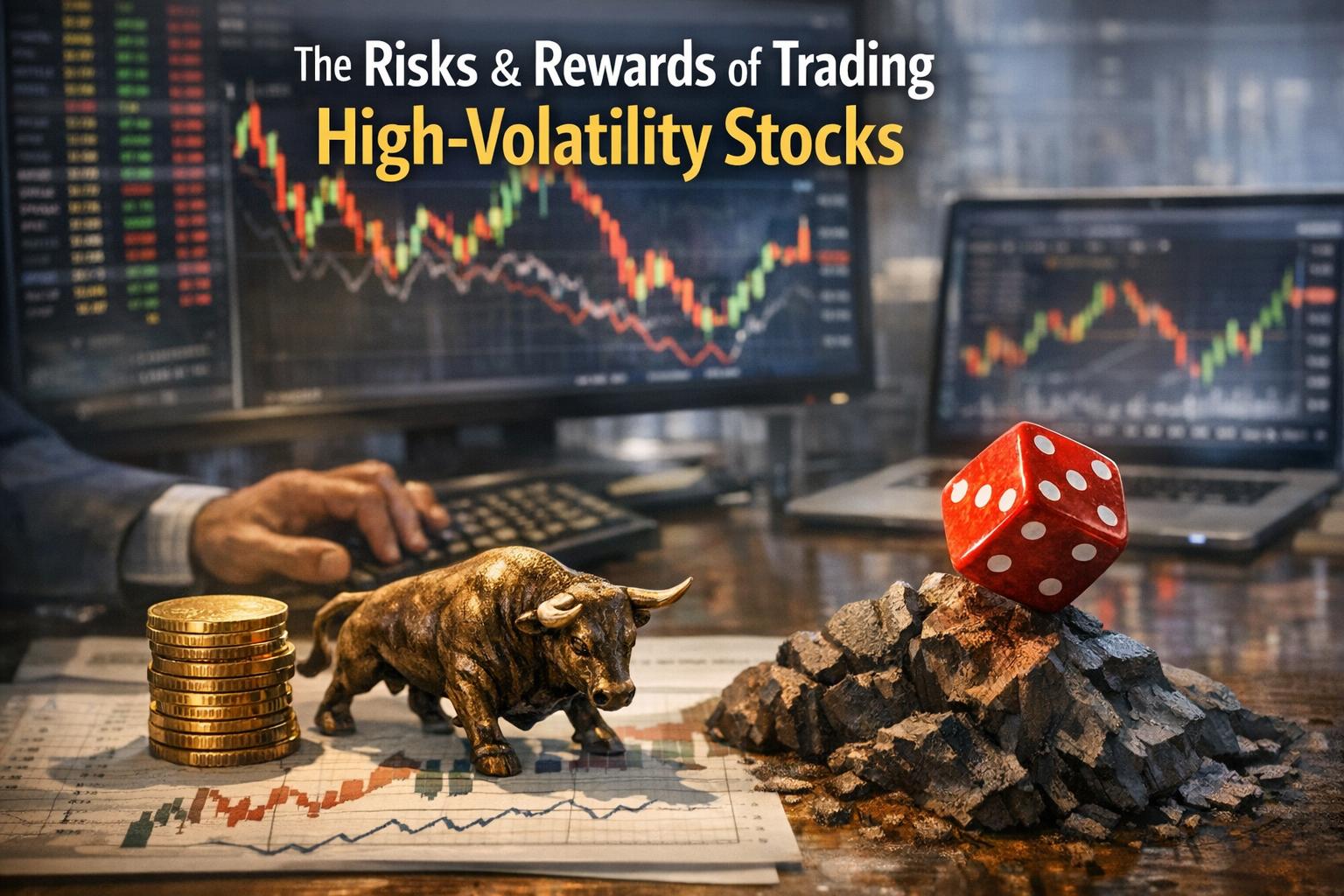
The Nature of High-Volatility Stocks
Trading high-volatility stocks means you’re working with securities that move fast—sometimes up, sometimes down, and often before you’ve finished your coffee. The defining feature is simple: these stocks experience rapid and relatively large price swings over short timeframes. That motion can be impressive, but it also introduces a particular set of risks and decision pressures that don’t show up as strongly with slower, steadier stocks.
High-volatility stocks often cluster in specific categories: companies early in their growth phase, firms tied closely to new product cycles, and sectors where public sentiment can swing hard. Technology and biotechnology sometimes fit this pattern, but the cause isn’t limited to “innovative industries.” It’s usually about uncertainty—whether uncertainty comes from earnings expectations, regulatory outcomes, product adoption, funding needs, or competition.
For many traders, the appeal is obvious: when a stock moves a lot, there’s “more room” for profit if you can time entries and exits. For investors who follow longer-term fundamentals, the situation changes: volatility may still exist, but the strategy and time horizon determine whether that movement becomes a manageable feature or a painful problem.
To use volatility instead of getting used by it, you need to understand where it comes from, what it does to your portfolio behavior, and how to manage it without turning every trade into a stressful guessing game.
What “High Volatility” Actually Means (And Why It Matters)
Volatility describes how much the price of a stock varies from day to day. In practical trading terms, high volatility means bigger swings, tighter time windows for decisions, and a higher probability that your position will go against you quickly—sometimes before your thesis has time to play out.
There are a few common ways traders think about volatility:
- Historical price swings: How wide the price has moved over a recent period.
- Implied volatility: Often inferred from options prices. This can hint that the market expects larger moves ahead.
- Liquidity and spreads: A stock can be volatile, but if it also has poor liquidity, your real execution outcomes may be worse than the chart looks.
Notice the last item. Two stocks can both look volatile, but if one has tight spreads and better liquidity, you can often enter and exit closer to the “ideal” prices shown on your platform. The other stock may slip, widen spreads, or cause slippage—turning small mistakes into larger losses.
Common Causes of High Stock Volatility
Volatility rarely appears out of nowhere. It often reflects a specific type of uncertainty, and once you learn to identify that uncertainty, the stock becomes easier to interpret—even when it keeps running wild.
1) Earnings expectations that change fast
For companies where markets fixate on quarterly performance, small changes in guidance can trigger big repricing. If investors think results might be above or below expectations, even modest “beats” or “misses” can lead to exaggerated reactions because the stock has a lot riding on the next report.
Example pattern: a biotech company with a pipeline milestone misses timing by a week. News hits, traders react, and the stock whips around as people reprice probability outcomes.
2) Strategic changes and corporate events
Spinoffs, mergers, major restructuring, management changes, and big partnership announcements can all make a stock more volatile. Some events are inherently uncertain—because the “real” impact takes time—so traders price the future on limited information.
Even when news is positive, markets may interpret it differently. For instance, a company might announce a restructuring that investors view as both a risk and a path to better profitability. That “mixed interpretation” tends to keep prices moving.
3) Sector-specific sentiment and thematic trading
Stocks tied to popular themes—like AI infrastructure, renewable energy, or specific healthcare sub-sectors—can become volatile because traders chase momentum. When sentiment flips, prices can follow quickly. Volatility here isn’t only about company performance; it’s also about crowd behavior.
When a sector gets hot, buyers show up in volume. When the heat cools, the same volume can exit in a hurry. That’s volatility you can feel even without reading every corporate filing.
4) External triggers: rates, politics, macro data
Sometimes it’s not the company at all. Interest rates influence growth-stock valuations, and macroeconomic reports can shift capital flows across entire sectors. Political developments and regulatory actions can also hit sectors with heavy compliance risk—healthcare, finance-adjacent industries, energy, and defense-related systems.
When macro factors hit, even a fundamentally solid company can get repriced because the discount rate changes or sector expectations shift.
5) Liquidity, float size, and trading mechanics
Low float stocks and thinly traded names can show dramatic moves. If fewer shares exist in the hands of active traders, or if order books are shallow, then normal buying and selling pressure can create outsized price changes. That’s not “fundamental volatility,” but it still affects your trading results.
This is why you should always look beyond the chart. A stock can be volatile because it’s truly uncertain—or because the market microstructure makes it seem more dramatic than it “should” be.
Risks Associated with Trading High-Volatility Stocks
High-volatility stocks can present considerable financial risks. The sudden price fluctuations can lead to substantial financial losses if the market moves in an unexpected direction. Investors must be prepared for potential downturns and should only trade with funds they can afford to lose. This aspect underscores the unpredictable nature of these stocks, where gains and losses can occur in rapid succession.
Price risk: your entry is not the end of the story
With volatile stocks, your entry price matters—but so does what happens next. A stock can hit your target intraday and then reverse before you exit. Or it can never “respect” your planned levels because the market is moving too fast. Even experienced traders get caught by rapid reversals.
Because high-volatility stocks can swing widely, a trade can go from “not worried” to “too late” quickly, unless you use clear risk controls.
Emotional strain: the stock starts driving your decisions
Another risk involves emotional strain. The constant price swings may cause stress and lead to impulsive decision-making. Traders should be vigilant and maintain a disciplined approach to avoid succumbing to emotional buying or selling. This emotional volatility can often be as challenging as financial losses, requiring traders to stay calm and stick to their investment strategies even during turbulent times.
In real life, this often looks like staring at candles too long, moving stop-loss levels “just enough” to avoid the shakeout, and then watching the stock keep moving without you. Volatile markets reward discipline more than intuition.
Information risk: noise, rumors, and exaggerated headlines
There’s also the potential for market manipulation. High-volatility stocks are susceptible to being influenced by false information or exaggerated news, often leading to rapid price changes that may not reflect the company’s actual value. In such cases, traders must be cautious about the sources of their information and should always verify news from credible channels. Market manipulation can sometimes lead to inflated stock prices, resulting in bubbles that eventually burst, leaving traders with significant losses.
This doesn’t mean every move is manipulation. But it does mean you should treat sudden rallies or dumps with suspicion—especially if the price movement doesn’t align with verifiable events like earnings releases, filings, or confirmed corporate actions.
Execution risk: spreads and slippage get expensive
High volatility often comes with tighter or wider spreads depending on the name, but for many volatile stocks—especially smaller ones—liquidity may not keep up. That creates execution problems. You might place a limit order at a price that looks good, only to find it doesn’t fill. Or you might trade market orders during a fast move and get a worse fill than expected.
When volatility is high, execution quality becomes part of your strategy. Ignoring it is like “rolling dice” without admitting you’re doing it.
Opportunity cost: volatility can keep you busy without paying
A less talked-about risk is opportunity cost. If your trading capital repeatedly gets trapped in stop-outs or slow reversals, you spend time managing positions that never develop into a real opportunity. Sometimes the best trade is no trade—especially in markets where noise dominates signal.
Rewards of Trading High-Volatility Stocks
For investors willing to manage these risks, trading high-volatility stocks can offer significant rewards. The primary advantage is the potential for high returns. Rapid price movements can turn small investments into substantial profits in a short time, given the right market conditions. Investors with a keen eye for market trends and the ability to make fast, informed decisions can leverage volatility to their advantage.
1) Profit potential scales with movement
Most active trading strategies depend on price movement. High-volatility stocks naturally create that movement. If you can identify momentum shifts or temporary dislocations, the stock’s own behavior can provide the “fuel” for profits.
This is why traders who like charts often like volatile names: the chart has answers more often than on slow days.
2) Frequent setups for active traders
Such stocks also provide opportunities for active traders to capitalize on daily or even hourly price movements. Traders employing strategies like day trading or swing trading might find these stocks particularly appealing due to their frequent and pronounced market action. This active engagement offers traders numerous trading opportunities throughout the day, potentially leading to gains from the ability to accurately predict market directions.
That said, frequency cuts both ways. More setups also mean more chances to make mistakes. The best traders don’t just “trade more.” They trade with rules about when to stop, when to hold, and when to avoid.
3) Learning value: you build risk instincts fast
Additionally, high-volatility stocks can serve as an exciting component of a diverse portfolio, offering experiences and lessons in risk management and market dynamics. By including these stocks in a broader investment strategy, traders can benefit from the dual potential for excitement and significant returns, while still maintaining exposure to other, more stable investments.
If you’ve ever managed risk on a calm market, you already know it’s easier. High-volatility stocks teach urgency and clarity—useful skills if you intend to trade other instruments later.
4) Hedge behavior and correlations (sometimes helpful)
Volatile stocks can also help with hedging behavior depending on correlations. For example, some sectors may react differently to macro news than others. If you manage exposure carefully, volatility can help you balance the overall portfolio rather than just “take more risk.”
This requires monitoring, not guessing. Still, it’s worth noting that volatility doesn’t always equal pure chaos; sometimes it adds perspective to risk exposure across asset classes.
Strategies to Mitigate Risks
To successfully navigate the risky waters of high-volatility stocks, traders should employ sound strategies. One reason many traders get hurt is that they treat volatility like a thing you can “outsmart” rather than like a condition you must control.
Here are practical approaches you can apply consistently.
Use strict stop-loss orders (and honor them)
One such approach is setting strict stop-loss orders to limit potential losses. This practice involves selling the stock if it drops to a predetermined price, thereby preventing further financial damage. It acts as a safeguard, enabling traders to predefine acceptable levels of risk and ensuring that they do not hold onto losing positions longer than necessary.
In high-volatility names, stop-loss placement matters. If you set stops too tight, normal price noise knocks you out. If you set them too wide, the position can become damage-heavy. The solution isn’t “pick a number and pray.” The solution is to align stop distance with the stock’s typical movement and your timeframe.
A common mistake: using the same stop width for a stock that moves 3% per day and a stock that moves 20% per day. The chart might look similar, but the behavior isn’t. Your risk model should reflect that.
Position sizing: treat volatility like a volume knob
Stop-loss orders help, but sizing often determines whether you survive long enough to benefit from winning trades. For high-volatility stocks, sizing should generally reduce risk per trade. Many traders do this instinctively, but it helps to make it explicit.
For example, if a stock can move sharply against you within minutes, then your maximum loss should be small enough that you can still trade confidently afterward. If one loss ruins your next week, your sizing is too aggressive.
Conduct thorough research and analysis
Another key strategy is conducting thorough research and analysis. Traders should scrutinize the driving factors behind a stock’s volatility, such as company news, earnings reports, or industry trends, to make more informed decisions. Understanding the reasons for volatility allows investors to anticipate possible price movements and react appropriately.
Research doesn’t only mean reading filings (though those matter). It also includes understanding the “market story.” Ask: what is the market currently expecting, and what would disprove that expectation? Volatility tends to spike when expectations are crowded or when the market lacks clear information.
Build a simple “event calendar” for volatile names
A big chunk of volatility comes from known dates: earnings reports, FDA decisions, investor conferences, major economic releases, and regulatory announcements. A simple calendar can prevent accidental trading during times when your usual stop logic won’t hold.
Example: if you hold a position through an earnings report, your stop-loss order may not protect you fully if the gap opens beyond your stop. That’s not the stop’s fault; it’s just how markets behave around major events.
So if you trade around events, either reduce position size and accept gaps, or avoid holding through certain dates. Both approaches can be valid. What’s not valid is pretending event risk doesn’t exist.
Diversify to spread risk
It’s also advisable to maintain a diversified portfolio to spread risk. By not putting all financial resources into high-volatility stocks, traders can cushion potential losses with more stable investments. Diversification not only helps in distributing risk but also opens up multiple avenues for gains across different market conditions.
Diversification doesn’t mean buying five volatile stocks that all react to the same macro theme. It means spreading risk across different drivers. One approach: mix volatile names with more stable holdings, and also vary the catalysts—some trade on company performance, others trade on different sector influences.
Set rules for trade frequency and “no-trade” days
Regular activity is helpful for some traders, but forced trading is a great way to hemorrhage money. Many volatile environments produce plenty of noise, especially around the open or during major news windows. If your rules don’t say anything about when to slow down, you’ll start trading every twitch in the chart.
Try this: define in advance what market conditions justify a trade and what conditions don’t. If conditions don’t meet your criteria, step aside. That’s not laziness; it’s risk management with better branding.
Review trades and adjust based on outcomes
Moreover, engaging in regular market review sessions and adjusting strategies based on current insights can further mitigate risks. Being informed about macroeconomic factors, such as interest rates and geopolitical issues, plays a critical role in anticipating market trends. Investors should also be willing to adapt, continuously learning from past trades and refining their approach based on experience and feedback from the market.
Reviewing isn’t just about “what did I get wrong.” It’s also about what your strategy expects versus what actually happened. Did you enter before confirmation? Were your stops placed correctly? Did you follow your thesis, or did price action drag you into a new narrative?
Use volatility-aware tools (without turning them into a religion)
Some traders use measures like average true range (ATR), moving average bands, or options-implied volatility to calibrate expectations. These tools can help you set more realistic targets and stops, especially for swing trading.
The danger is overcomplication. If you can’t explain how the tool affects your actual decision, it’s too complex. You don’t need an advanced degree; you need consistent discipline and an honest risk plan.
Risk Management Framework for High-Volatility Trading
If you want a practical way to approach high-volatility trading, build it like a checklist. Not the “tick every box” kind, but the “know what matters most” kind.
1) Decide your timeframe before you choose the stock
Short-term traders and longer-term investors look at volatility differently. If you’re planning to hold for days or weeks, you can sometimes tolerate daily swings as long as your thesis remains intact. If you’re day trading, volatility dictates tighter execution rules and clearer exits.
Match your approach to your intention. Otherwise, you’ll end up arguing with your own plan all day.
2) Predefine your max loss per trade
Serious traders don’t ask, “Will I lose?” They ask, “What’s the maximum loss I can take and still sleep at night?”
Define a number you will not exceed, then place stops and size positions accordingly. High volatility means losses can come quickly, so the system needs to work even under stress.
3) Plan your exit before you enter
Exit planning sometimes gets skipped because traders focus on entry timing. In reality, exits determine your long-term results. Decide where you’ll take profit, where you’ll cut back, and whether you’ll use partial exits.
For volatile stocks, partial exits can reduce emotional pressure. If the stock runs hard and you take some profit early, you’re less likely to watch a winner turn into a regret.
4) Watch liquidity and execution quality
Before you trade, check the liquidity profile: average volume, spread, and how easily you can fill your orders. A strategy that looks profitable on paper can fail in real markets if fills are consistently bad.
In very volatile names, the order book can change fast. You may need to use limit orders rather than market orders, or reduce order size to improve fills.
5) Understand event risk and gap behavior
Stops don’t fully protect you through gaps. If you hold a position through earnings, regulatory decisions, or major announcements, gap risk enters the picture. Gap risk means the opening price can be far from the previous close—so your stop triggers at the next available price, not the exact level you selected.
You have three choices: reduce size, avoid holding through events, or accept that stop protection is partial. Either way, be honest about what can happen.
How to Identify High-Volatility Stocks Without Guessing
If you want to trade volatility, you still need to identify it systematically. “This stock looks wild today” isn’t a method—it’s just a mood.
Look for volatility signals in basic data
You don’t need to be a quant to spot volatility traits. Start with:
- Large average daily range compared to similar stocks
- Frequent gaps or strong intraday reversals
- High sensitivity to news (price reacts dramatically to headlines)
- Trends in volume, especially around events
Then confirm liquidity. A high-volatility chart with excellent liquidity is a different trading animal than a high-volatility chart with thin trading.
Map price movement to real catalysts
A helpful habit: every time the stock makes a big move, ask what caused it. Over time, you’ll notice patterns: moves around earnings, moves after regulatory headlines, moves in response to sector news. When you can connect movement to catalysts, you reduce the guesswork.
If the stock moves wildly without any identifiable catalyst, take extra care. That behavior can be rumor-driven, flow-driven, or manipulation-adjacent. It doesn’t automatically mean “danger,” but it does mean “treat with respect and verify.”
Use watchlists rather than impulse trades
Many traders build watchlists and scan them for setups rather than jumping into trades instantly. For volatile stocks, this reduces impulsive entries. You’re letting information catch up to price—rather than letting price bully you into clicking buy.
Trading Tactics That Work Better in Volatile Markets
High-volatility stocks can support many styles, but the ones that succeed usually match volatility behavior rather than fighting it.
Momentum strategies: ride the move, not the wish
Some traders follow momentum setups—buying breakouts with confirmation and selling breakdowns or trailing stops. In volatile markets, momentum can persist longer than expected, especially when news trends or sector sentiment stays consistent.
The risk is chasing exhausted moves. So momentum tactics work best when you build exit rules and avoid holding blindly after the move shows signs of weakening.
Mean reversion: only when the market conditions make sense
Other traders look for temporary overreactions. In volatile stocks, price sometimes snaps back toward prior levels after an emotional headline. Mean reversion can work—but it’s risky when the underlying uncertainty remains unresolved.
If the catalyst causing the move still hasn’t changed, the “bounce” might never come. So mean reversion works best when you can explain why the move should normalize.
Range trading: useful if the stock trades in bands
Some volatile stocks don’t trend continuously. They chop in ranges, bouncing between support and resistance. In those cases, range trading can be viable, especially for swing traders who don’t need the big move.
Again, confirmation matters. If the range breaks, the strategy should shift or stop.
Options-based approaches: extra caution, extra complexity
Options can sometimes help control risk—especially when you limit downside using defined-risk strategies. But options also introduce additional variables: implied volatility, time decay, and contract liquidity.
If you’re not already comfortable with options, it usually pays to start with stock trading and only add options later once you can explain how the trade thesis affects option pricing.
Common Mistakes People Make With High-Volatility Stocks
Even traders who are competent in calmer conditions can stumble in high volatility. Here are a few classic problems:
Confusing volatility with opportunity
Volatility creates movement, but movement doesn’t always create profit. You still need an edge: better timing, better information, or a better risk plan.
Ignoring liquidity
If a stock has wide spreads or inconsistent fills, your actual entry and exit quality can differ massively from the backtest or the chart. That can turn a “good” trade into a mediocre one.
Using stops that are too tight
Some traders set stops based on emotion (“I’ll just lose 2%”) rather than on the stock’s typical movement. Tight stops on volatile names get hit by normal noise and create repeated losses.
Holding through events without a plan
Earnings and regulatory decisions can cause gaps. If you hold anyway, size accordingly and understand that stops may not work as expected.
Switching strategies mid-trade
High volatility tempts traders into reinterpreting the chart. “It should come back” becomes a justification, not a strategy. Your plan needs to survive being wrong in the short term.
Building a Balanced Portfolio Around Volatile Names
Not every traders’ goal is to go all-in on volatility. Many people want to include volatile stocks for growth potential while keeping the overall portfolio stable enough to handle drawdowns. The trick is to define what “stable” means for you and then size accordingly.
Use stable holdings to reduce stress
A stable base portfolio can help you avoid impulsive selling when volatility spikes. It also makes it easier to stick to your rules because you’re not treating every dip as a disaster.
Limit concentration in high-volatility positions
Even if a stock is a great candidate, concentration risk remains. A single volatile position can dominate your results if it’s too large relative to your portfolio.
Many traders set a maximum percentage per position and then cap the total percentage exposed to high volatility. That prevents a cluster of “bad luck entries” during one chaotic period from damaging everything at once.
Review correlation, not only performance
Two volatile stocks can both look strong in certain periods, but they might fail together when the same macro factor hits. If you’re mixing volatile names, check how they move relative to your other holdings and relative to each other.
This matters because diversification works best when risks aren’t all triggered by the same event.
Conclusion
While trading high-volatility stocks carries inherent risks, it can also provide substantial rewards for informed and disciplined investors. By understanding the stock’s nature, analyzing the drivers behind its movement, and employing risk mitigation strategies, traders can capitalize on opportunities while minimizing potential losses. Balancing confidence with caution matters here—because in volatile markets, bold without structure tends to become expensive fast.
For more insights on managing portfolio risks effectively, consider exploring trusted financial advisory services or educational resources to enhance your trading acumen. Continuous learning and adaptation are vital in the ever-evolving financial markets. As the market continues to react to new information—whether it’s earnings, regulation, or macroeconomic shifts—building a resilient approach helps you stay in control, even when the price action tries to steal the steering wheel.