
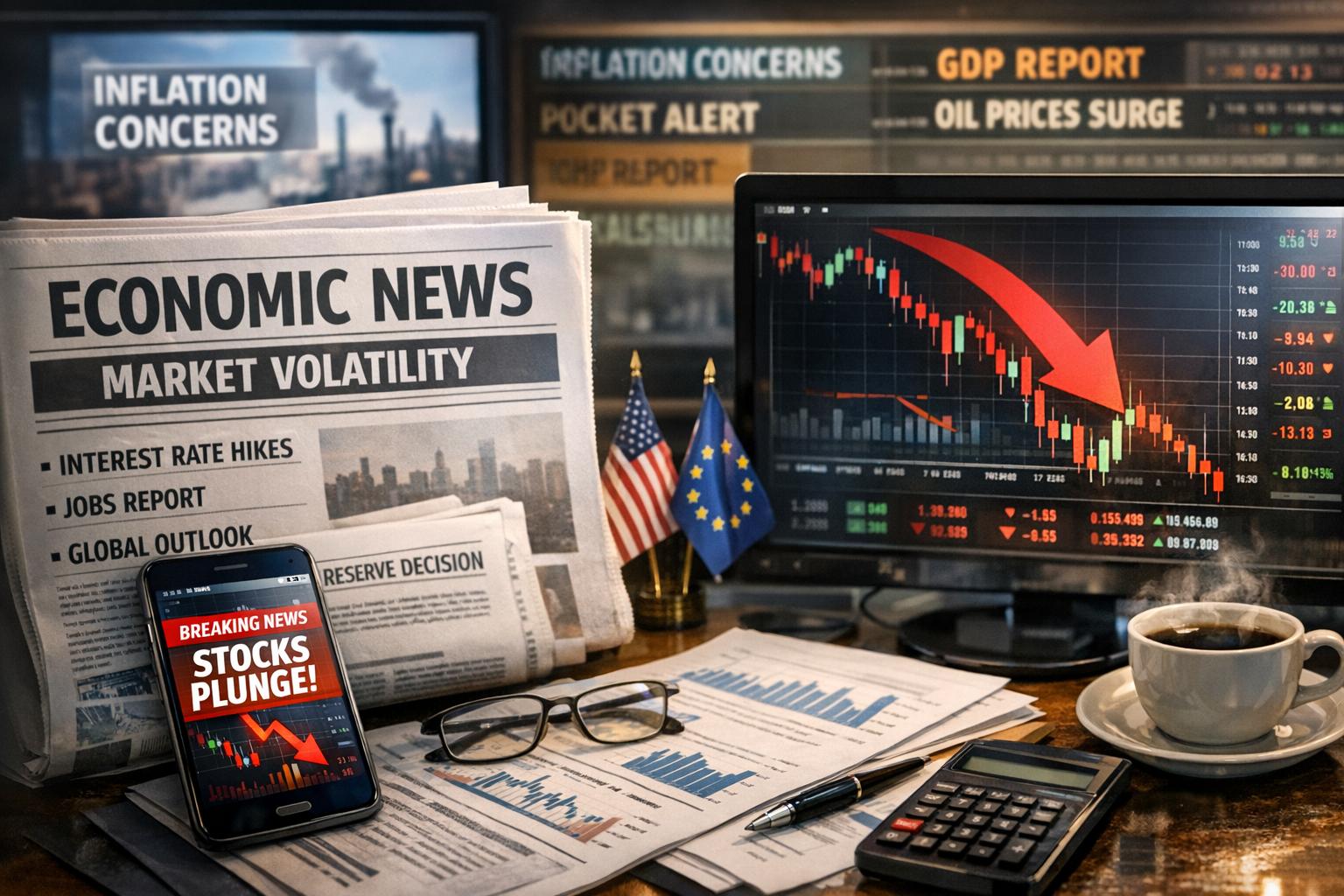
The Influence of News on Stock Volatility
The stock market doesn’t trade in a vacuum. Prices move because investors update what they think the future will look like, and news is one of the fastest ways to force that update. A headline can change expectations about profits, borrowing costs, regulation, competition, consumer demand, and even the rough odds of “things going wrong.”
That’s why stock volatility—how much prices swing over time—often spikes when news hits. Not every rumor moves markets equally, of course. Volatility depends on what’s being reported, how unexpected it is, who it affects, and how much of the market was already positioned for the outcome. Still, the basic mechanism is consistent: news alters beliefs, beliefs alter trading behavior, and trading behavior shows up as price movement.
If you’ve ever watched a stock jump on earnings only to give it back the next day, you’ve already seen this in action. Sometimes it isn’t the news itself—it’s the surprise level and the market’s reaction to what the news implies.
Types of News Impacting Stocks
News is broad, but it clusters into a few categories that matter for volatility. Investors typically react through two channels: information content (is this genuinely new?) and interpretation (how big is it, and for whom?).
Corporate News
Corporate announcements tend to hit the specific company’s stock first, but they can also spill over into competitors, suppliers, and the broader sector.
Earnings reports: Earnings are the classic volatility trigger. Markets care not just about earnings per share, but also guidance, margins, revenue growth, cash flow, and management tone. When results beat expectations, buyers tend to move in quickly. When results miss or management warns about future weakness, sellers often respond just as fast. The difference is that “miss” news can also reprice risk—investors may begin to think the company’s future path is materially worse, not just slightly disappointing.
Leadership changes: CEO or CFO changes are rarely neutral. A credible, competent successor can calm investors; an abrupt departure can raise uncertainty about strategy and execution. Even when the change is routine, markets may react because leadership affects decisions—capital allocation, risk appetite, and how aggressively a firm responds to competition.
Mergers and acquisitions: M&A announcements can swing both the target and the acquirer. A deal implies valuation decisions, integration costs, and potential synergy timelines. Markets also scrutinize whether the price paid makes sense. If investors think the acquisition is overpriced or strategically messy, volatility increases because traders try to reprice the probability of successful integration.
Product updates, lawsuits, and regulatory actions: A new product launch can create optimism about demand. A major lawsuit can introduce uncertainty about liability. Regulatory developments—especially for industries with heavy oversight—can rapidly alter the expected cost structure, timeline, or even whether a business model remains viable.
A practical way to think about corporate news: it changes the distribution of outcomes for a company. When that distribution widens quickly, volatility rises.
Macroeconomic News
Macro news is the “gravity” behind market-wide volatility. Even if a specific company is doing fine, investors might adjust discount rates, sector expectations, and broad risk appetite when they learn something new about inflation, growth, jobs, or liquidity.
Inflation and consumer pricing: Inflation affects everything from wage costs to pricing power to central bank policy. A hotter-than-expected inflation print can trigger a “higher for longer” narrative, pushing yields up and pressuring valuations—especially for stocks whose future profits rely heavily on long-term discounting.
Employment data: Payroll numbers, unemployment rates, and wages influence assumptions about consumer strength. Strong employment can support revenue expectations across many industries. Weak employment can create recession fears, which typically increases volatility because investors start pricing a wider range of scenarios.
GDP growth and activity indicators: GDP releases and related data help confirm whether the economy is expanding or slowing. But markets also react to revisions and trend changes—so a data point that looks merely “good” can still produce volatility if it contradicts expectations or breaks a trend.
Interest rate expectations: Macro data often acts like a steering wheel for expectations about central bank policy, which is why the same company can trade differently depending on the macro backdrop. In practice, sector performance can rotate quickly when markets reprice “what rates will do next.”
Geopolitical News
Geopolitical events are volatility multipliers. They add uncertainty in a way markets find hard to model. A war, election outcome, trade restriction, or diplomatic breakdown can affect energy prices, shipping routes, supply chain integrity, commodity costs, and regulatory priorities. Markets dislike uncertainty, and geopolitical news often arrives with it.
Elections and policy shifts: Even when economic policy is expected to be broadly similar, markets react to perceived risk—tax policy, spending levels, regulation, industrial policy, and trade stance. If an election resolves uncertainty, volatility can drop. If it increases uncertainty, volatility can climb.
Conflicts and sanctions: Sanctions can restrict sales, complicate payments, and force companies to reroute supply chains. Conflicts can disrupt shipping and production. Commodity markets often move first, and equity valuations follow.
Trade policy changes: Tariffs and trade agreements can reshape demand patterns, input costs, and competitive advantage. A tariff on key inputs, for example, can hit margins quickly. Markets then swing as traders update what’s “possible” for companies in the impacted supply chain.
Geopolitical news tends to create volatility because it affects the probability of adverse outcomes, not just the average outcome.
The Role of Economic Events
Economic events are some of the most closely watched market triggers. Think central bank meetings, interest rate announcements, and major fiscal policy updates. Investors don’t just look at the headline decision—they look at the language, the projections, and the credibility of future policy paths.
Interest Rates
Interest rates influence stock prices mainly through two mechanisms.
First, they change discount rates. When yields rise, the present value of future cash flows falls. That can weigh on valuation multiples, especially for growth-oriented companies whose earnings depend more on the far future.
Second, rates affect borrowing costs and demand. Higher rates mean loans are more expensive for both businesses and consumers. If borrowing slows, investment can drop, and consumer spending can cool—both of which can hurt earnings.
Central bank guidance can be more volatile than the rate itself. If investors think expectations have been “underpriced,” a decision that seems small may still cause large moves because it changes expectations about subsequent policy.
Employment Data
Employment is often treated as a real-time indicator of economic momentum. Strong employment typically supports demand, while weak employment can signal weakening demand before it shows up in earnings.
But it’s not just whether jobs grew or shrank—it also matters what kind of jobs they were (wage growth, participation rates, hours worked) and whether unemployment trends are worsening. Markets can also react to revisions. In other words, a “good” headline can still be market-moving if the last few numbers are revised downward.
When employment data changes expectations for growth, it also changes expectations for inflation. That feeds right into bond yields and equity valuations, which is why employment reports often show up as major volatility drivers.
Interplay Between News and Economic Events
News doesn’t impact stock prices in isolation. It overlaps, confirms, contradicts, or complicates other information flows. That overlap can either amplify volatility or soften it.
“Good news” can still lead to volatility. Suppose a company posts strong earnings, but the macro data that day signals weakening demand or higher inflation. Investors might say, “Sure, they beat this quarter, but what about the next few?” In that case, the strong company-specific results can be partially overshadowed by macro pressure.
“Bad news” can be discounted if macro looks supportive. Conversely, a company might miss earnings, but if broader economic indicators suggest stable growth and interest rates may remain contained, investors may interpret the miss as temporary. This can reduce downside pressure relative to what you’d see in a less supportive macro environment.
Expectations matter as much as outcomes. One of the most common market reactions is less about what happened, and more about how surprising it was. If the market expected rate hikes, a hawkish statement by itself may cause less volatility than if it breaks a calm consensus. Similarly, guidance that matches expectations may produce modest price movement compared to guidance that shifts the perceived risk and timeline.
Timing and sequencing can create “double punches.” If a company releases earnings right before a major macro event, volatility may combine. Traders might reposition based on both inputs, and price swings can look larger than the individual pieces would suggest. This is one reason you’ll often see intraday volatility spikes around scheduled releases.
In practice, investors treat markets like a constantly updating prediction machine. News provides fresh inputs; economic events adjust the “model” of future conditions. When the inputs and model shift together, volatility tends to be higher. When news aligns with existing expectations, volatility tends to be lower.
How News Translates Into Volatility (The Mechanics)
At a high level, volatility is what happens when the market revises its beliefs quickly. But it helps to know what that revision looks like in trading terms.
Expectation revisions and repricing
Stock prices are forward-looking. When news suggests changes in expected profits, cash flows, or risks, investors reprice shares. The speed of repricing depends on how fast information spreads and how uncertain the interpretation is. High uncertainty and high surprise usually mean traders disagree more, which increases buy-sell friction and price swings.
Earnings surprises are a good example. A company can beat earnings, but guidance may carry risk—say, margin pressure, demand softness, or cost inflation. The market then has to decide whether the beat is sustainable.
Liquidity, order flow, and “forced” trading
Volatility isn’t only about beliefs. It’s also influenced by market microstructure—how orders arrive and how easily positions can be adjusted. On heavy news days, trading volume may rise, but liquidity can also fragment between different participant groups.
Some traders respond with algorithmic strategies that react to news-driven signals (like swaps markets moving, yield spikes, or volatility indices trending). Others rebalance portfolios under risk constraints. Those mechanical effects can increase the magnitude of price movement, even when the underlying “news impact” wouldn’t logically require a huge repricing.
Volatility feedback loops
Volatility affects trading itself. When volatility rises, risk models may demand lower position sizes, which can create additional selling pressure. Options markets also price volatility expectations; those changes feed back into hedging activity. The net effect is that initial volatility spikes can become self-reinforcing for a short period, especially around big scheduled events.
This is one reason why news-driven moves sometimes overshoot early, then stabilize later once uncertainty clears.
What Kinds of News Create the Biggest Price Swings?
Not all news is equal. Some items are naturally volatility-friendly, because they change valuations, affect multiple sectors, or introduce ambiguity into the future.
Uncertainty-heavy announcements
News that adds uncertainty—regulatory enforcement, geopolitical escalation, major litigation—often causes sharper swings because investors can’t easily forecast outcomes. Uncertainty widens the range of possible future cash flows, and markets hate wide ranges.
Guidance changes and forward-looking statements
A company’s past results are important, but guidance shapes future revenue, margin, and capital needs. When guidance changes unexpectedly, it forces an update to models used for valuation.
Data that shifts central bank expectations
Macro releases that influence interest rate expectations (inflation, jobs, growth) tend to move both equities and bonds. When rates move fast, equity valuations often adjust quickly. That’s why you’ll often see sharp market moves around central bank decisions and major economic reports.
Cross-asset shocks
News may begin in commodities or bonds and then spread to equities. For example, an energy shock can increase inflation expectations, push yields up, and pressure equity valuations—particularly for sectors sensitive to input costs. These cross-asset effects can amplify volatility because multiple belief systems are updated at once.
The Investor’s View: Reading News Without Getting Played
News can be useful, but it can also be noisy. The trick is to separate information from theater. Investors who only chase headlines often end up trading “emotion,” not fundamentals.
Check whether the news was expected
A simple method is to compare the headline to consensus expectations. If the market already priced in the outcome, the impact may be smaller. If the news surprises the market, volatility can rise dramatically.
This doesn’t mean consensus is always right—it just means expectations were already moving.
Look for the “second-order” effect
Many headlines create first-order reactions (stock up because profit beat). But the second-order effect can matter more (why did profit improve—temporary factors or real margin durability? what does it imply for the next quarters?).
When interpreting corporate news, pay attention to:
– guidance and demand signals
– margins and cost structure
– cash flow quality, not just earnings
When interpreting macro news:
– what it implies for inflation and central bank policy
– whether it changes the growth narrative versus just adding noise
Don’t ignore positioning
Markets don’t just respond to news; they respond to how traders are positioned for news. When many participants are on one side of a trade, the market can move further if the outcome contradicts expectations. This can create exaggerated volatility even if the fundamental change is not enormous.
In plain terms: if everyone is crowded into the same bet, price can jump more than you’d think.
Be aware of the time horizon
News effects often differ by time horizon.
– Short-term: narrative, hedging, and trading flows dominate.
– Medium-term: guidance, demand trends, and financing conditions dominate.
– Long-term: profitability, capital allocation, and structural business conditions dominate.
A headline might cause big movement today but fade later if the underlying drivers were temporary. Or the opposite: a small headline can set off a repricing that plays out over months.
Real-World Examples of News-Driven Volatility
Not using specific tickers here (since people tend to get attached and start arguing in the comments), but the patterns are consistent.
Earnings day: the “beat, but…” effect
A company beats earnings expectations, so the stock opens higher. Then the market digests guidance—maybe management expects slower growth or higher costs. Traders then sell not because the quarter was bad, but because the future might be. This is a classic volatility pattern: price moves quickly, reverses partially, then stabilizes depending on how confidence balances out.
Central bank decision: the statement matters more than the vote
Sometimes the rate decision is broadly expected, and the headline headline doesn’t matter much. The market then focuses on wording about inflation, labor markets, or future policy. Small wording changes can move bond yields sharply. Once yields swing, equities—especially rate-sensitive segments—respond with volatility.
If you’ve ever watched a stock drop on “no change,” you’ve seen this mechanism. Markets trade expectations, and the statement changes expectations.
Geopolitical shock: correlations break the “normal” way
In calmer periods, sector correlations might be relatively stable. A geopolitical event can break those relationships: oil-sensitive sectors might spike while exporters or importers move in unusual patterns based on currency, supply routes, and sanctions risk. That shifting correlation structure tends to increase volatility because portfolio managers and risk models must rebalance quickly.
How to Use News to Manage Risk (Practical Approaches)
You don’t need to pretend you’re a full-time news analyst. But you do need a process. Otherwise, the market will give you a reminder that volatility is not a personal insult, it’s just how prices behave.
Build a simple event calendar habit
Scheduled releases—earnings dates, economic reports, central bank meetings—are high-impact information events. If you plan for them, you’re less likely to panic during normal volatility spikes.
This is especially relevant for:
– holding positions through scheduled earnings
– holding rate-sensitive assets during major macro releases
– using options around known event windows
Use volatility-aware positioning
If you’re investing without leverage, volatility can still matter. Large swings can shake your discipline. Some people hedge with options; others adjust position size ahead of major events. Either way, you’re trying to reduce the chance that a sudden headline forces a bad decision.
Separate “investing thesis” from “news reaction”
A common failure mode is letting a single headline rewrite your thesis. That might happen with corporate scandals, but it can also happen with temporary macro shocks. Try to ask: does the news change the long-term economics of the business, or is it a one-off?
If it’s the former, you reassess. If it’s the latter, you watch rather than react instantly.
Track price action, but don’t worship it
Price volatility can tell you uncertainty is rising. But it can’t tell you whether the uncertainty is rational or just traders running hot. Use price movement as a signal of changing expectations, and then corroborate with the news content and subsequent data.
How Markets Learn: The News Cycle and Its Effects
News-driven volatility often follows a pattern:
1) the initial report hits and spreads quickly
2) the first interpretation dominates
3) additional context arrives (guidance details, analyst notes, data revisions)
4) the market revises again
The highest volatility often occurs in the early stage, before enough information becomes available. That’s also why markets may move in one direction immediately, then partially reverse as better understanding arrives.
In other words: the initial headline is usually only the first draft of reality.
Common Myths About News and Volatility
“Market overreacts to everything.”
Sometimes it does. But sometimes markets react correctly and the move looks exaggerated because expectations were very tightly clustered. If a small piece of information truly changes the probability of an adverse scenario, volatility should rise—even if the change sounds minor.
“Only bad news creates volatility.”
Good news can create volatility too. Surprising upgrades may lead to rapid buying, and rapid buying can be met by profit-taking once the initial shock wears off. Also, “good news” can expose new risks (pace of growth, sustainability of margins), which can trigger selling even on an initially positive headline.
“Volatility means the stock is irrational.”
Volatility often indicates uncertainty, disagreement, or changing macro conditions. Those are rational responses to new information. Irrational behavior can happen, sure, but volatility is usually the market doing something: repricing, hedging, or rebalancing.
Conclusion
Understanding the influence of news on stock volatility is essential if you want to make sense of price action that feels, at times, like it’s powered by caffeine. News changes expectations about profits, risks, interest rates, and policy direction. Those expectations drive trading behavior, which shows up as volatility—often quickly and sometimes violently.
The real value comes from learning how different news types interact. Corporate announcements can be amplified or muted by macro conditions. Geopolitical events can shift risk across sectors at once. Interest rate expectations link economic releases to equity valuations in a way that feels almost mechanical when the bond market is moving fast.
If you want to stay useful in this environment, treat news as input—not as verdict. Develop a process for assessing surprise, interpreting second-order effects, and considering your time horizon. Then use that process to manage risk: by planning around event dates, adjusting position sizing, and avoiding knee-jerk reactions that ignore your original thesis.
Markets will always react to new information. The challenge isn’t eliminating volatility. It’s recognizing why it’s happening and making decisions that don’t assume the next headline will be kinder than the last.
For further reading on stock market trends and strategies, visit this resource from the U.S. Securities and Exchange Commission.