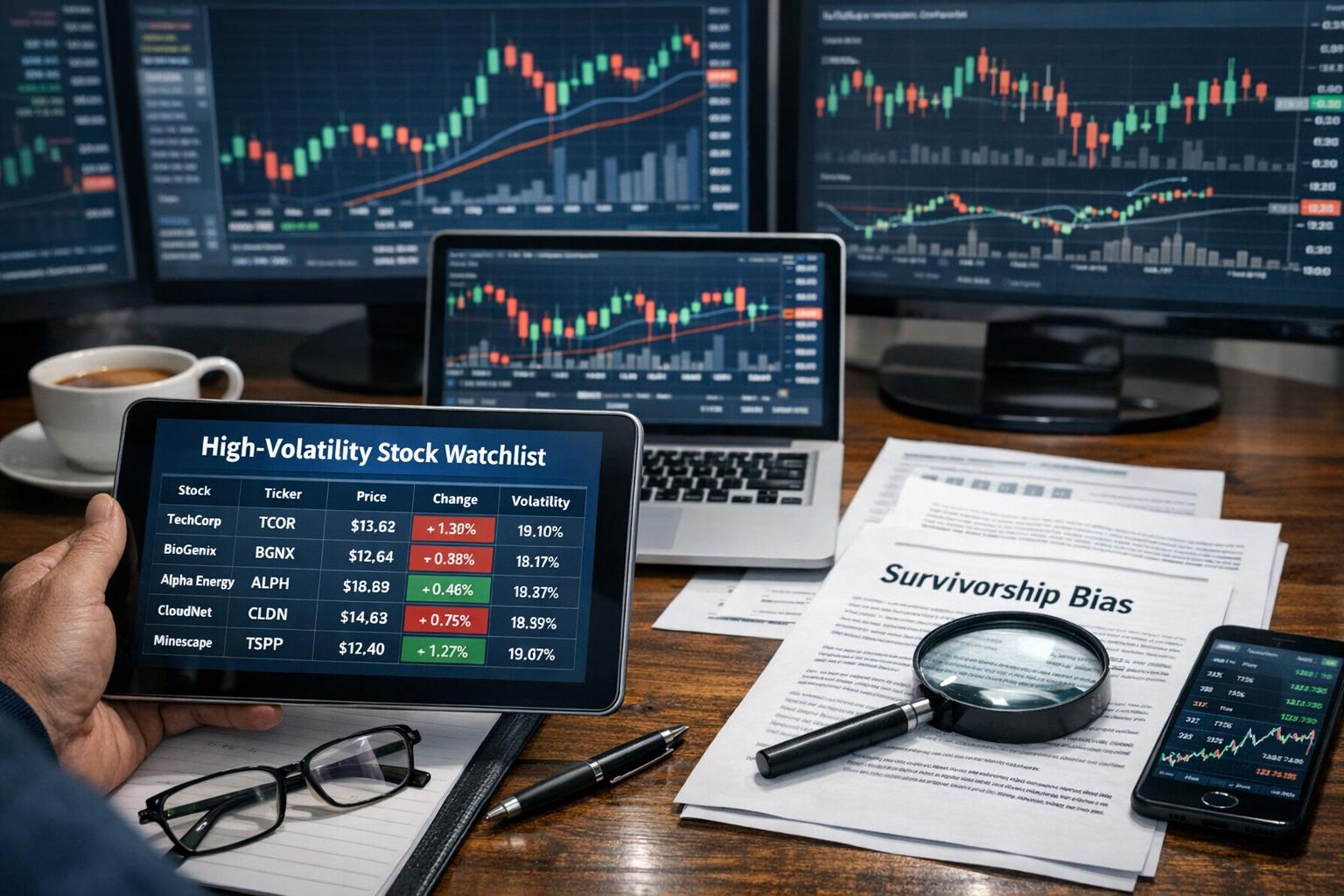
High-volatility stock watchlists: how to build, maintain, and avoid survivorship bias

Understanding High-Volatility Stocks

High-volatility stocks tend to move faster and farther than the average stock. Their prices can spike on good news, grind lower on bad news, or whip around simply because traders can’t resist a good shake-up. For investors, that behavior can be attractive: higher volatility often means the potential for higher returns—if you’re willing to accept the possibility of painful drawdowns.

But the “potential” part matters. High-volatility stocks don’t hand out rewards politely. They test patience, risk tolerance, and the ability to act without panic. That’s why a sensible approach starts with building a structured watchlist. A watchlist isn’t glamorous, but it keeps you from making decisions based on whatever headline you happened to read at 11:43 p.m.

This article walks through how to identify high-volatility stocks, how to maintain a watchlist that stays relevant, and how to avoid analysis traps—especially survivorship bias, which sounds fancy, but basically means you can accidentally ignore the losers and only study the survivors. (Markets rarely care about our bias. They just keep moving.)

What “High-Volatility” Actually Means

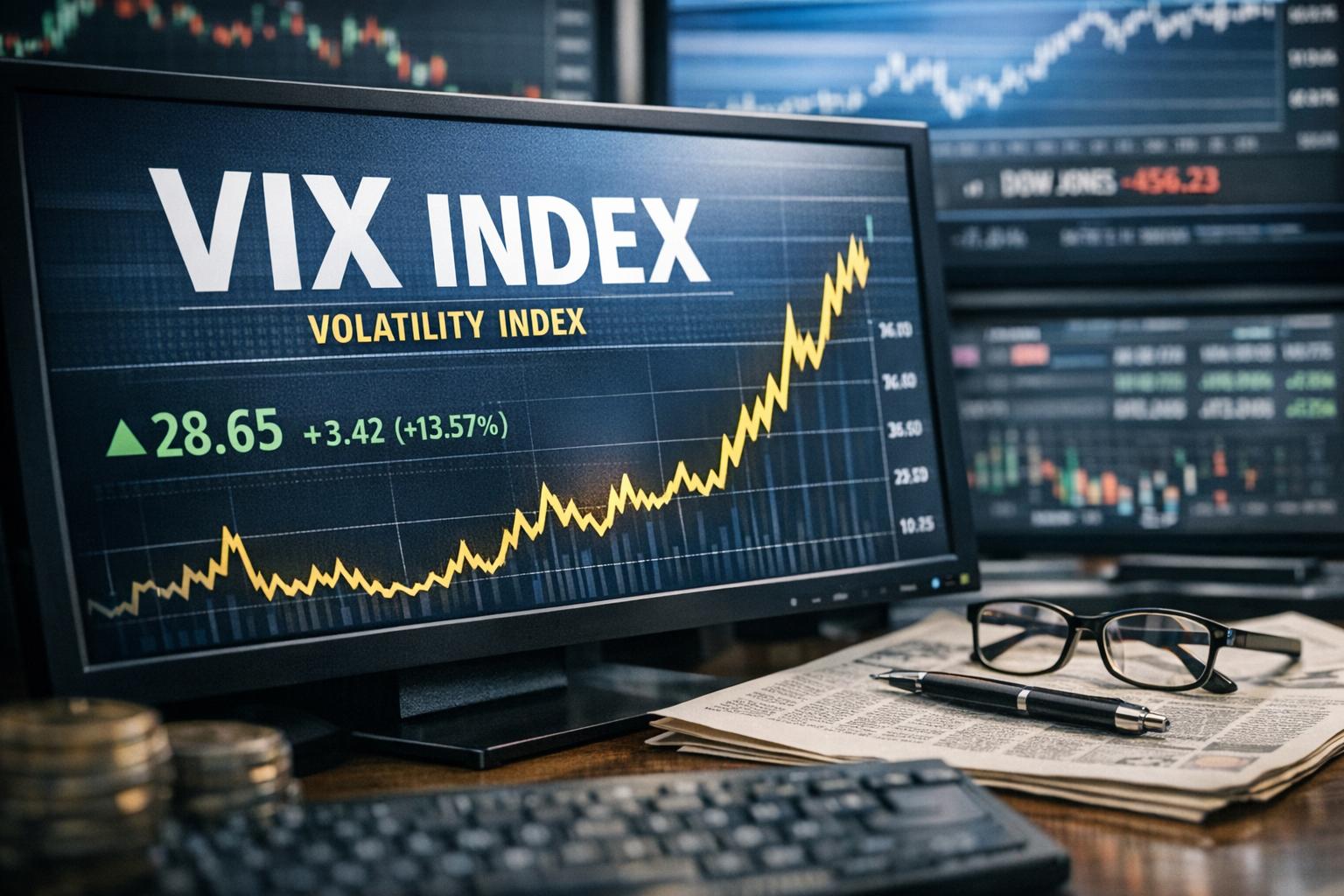
Volatility usually refers to how much a stock’s price fluctuates over time. You’ll see it measured with a few common tools:

Beta compares a stock’s price movement to the broader market (often the S&P 500). A beta above 1 generally suggests the stock has moved more than the market. A beta below 1 suggests it moves less. Beta isn’t perfect, but it’s a decent starting point for “speed and swing” relative to the market.

Historical price volatility measures how widely prices have varied during a set period, often expressed as an annualized statistic. This can capture sudden swings that beta might smooth over.

Volume and liquidity signals also matter. A stock can be volatile because it has real demand (and quick reactions), or it can be volatile because it’s thinly traded and spreads are wide. For most investors, thin liquidity creates extra friction and makes execution harder during fast moves.

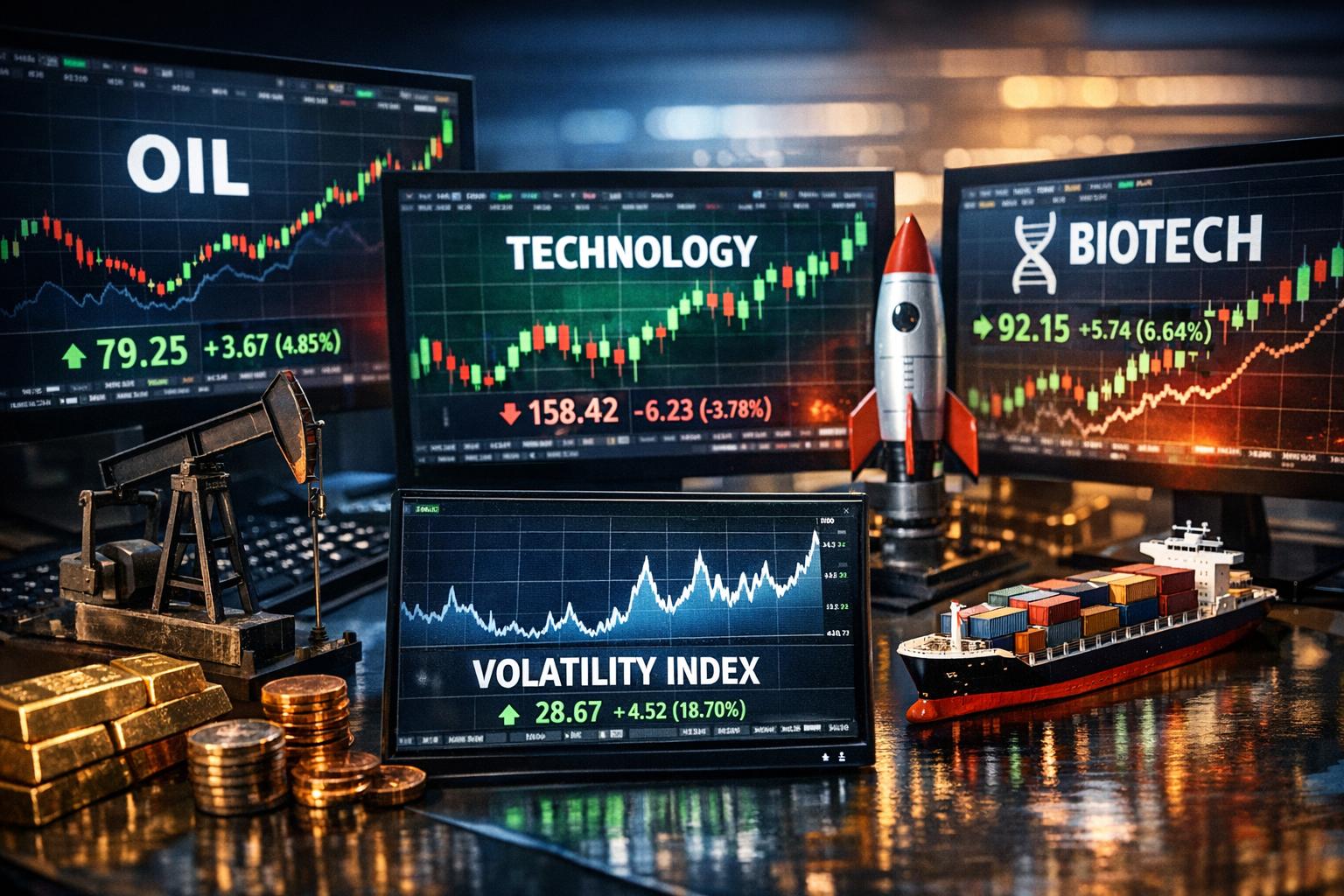
High-volatility stocks can show up in many industries, but you’ll most often see them in growth-oriented areas like technology, biotech, and smaller-cap segments where expectations change quickly.

Building a High-Volatility Stock Watchlist

A watchlist should do two things well: (1) help you organize ideas, and (2) help you decide what to monitor more closely. If it becomes a dumping ground, you’ll eventually stop looking at it. Then it’s not a watchlist—it’s a museum.

Identify Potential Stocks

Use Beta as a First Filter

The most straightforward way to start is using beta as an initial filter. Stocks with a beta greater than 1 typically show greater price sensitivity than the market. Investors often begin here because it’s quick: screen, shortlist, then dig deeper.

But don’t treat beta like gospel. Beta is backward-looking and depends heavily on the time period used. A stock can have a high beta because it was volatile in the past, but it might stabilize—or it might become more erratic. So beta should help you rank candidates, not finalize a decision.

Screen with Multiple Volatility Signals

If you want a watchlist that’s more than “vibes and moving averages,” use a combination of measures. Alongside beta, consider:

Average true range (ATR) or other volatility statistics: helpful when you’re trying to quantify typical daily movement.

Standard deviation of returns: another way to measure how spread out price changes have been.

Relative volume: tells you if the moves have attention behind them.

You don’t have to calculate these by hand. Screening tools from reputable platforms can surface the data quickly. The main goal is not to find “the most volatile stock,” but to find stocks whose volatility you understand enough that you can plan around it.

Check the Price Context (Not Just the Volatility)

A stock can look “high-volatility” simply because it’s had a recent crash or a sudden surge. That could mean it’s genuinely volatile, or it could mean it’s in a transition period.

Before you add a stock, ask basic questions:

  • Is the volatility persistent, or did it appear after one major event?
  • Does the stock move in response to fundamentals, or mostly to trading momentum?
  • Is the stock currently liquid enough to trade without getting stuck in spreads?

This isn’t overthinking. It’s the difference between “this might be a rollercoaster” and “this is a ride with no seatbelt.”

Mind the Timing with Real-Time Data

Market conditions change. What looked like a workable volatility profile last month can flip when the broader market shifts, interest rates move, or a sector enters a new news cycle.

That’s why real-time or near-real-time data matters. Use it to confirm that your candidate stock still behaves like a high-volatility name. Otherwise you risk building a watchlist around a stock that already changed its behavior—which happens more often than people want to admit.

Utilize Reliable Financial Data

Once you have candidate stocks, your job becomes research and verification. This is where data quality matters. If your data source is sloppy or delayed, your conclusions will be shaky, too.

Use Reputable Data Providers for Historical Moves

Reliable platforms such as Bloomberg and Reuters, among other financial data providers, often offer historical pricing, corporate action timelines, and adjusted price histories. Adjustments matter because splits, dividends, and certain reorganizations can alter how price charts should be interpreted.

With a trustworthy dataset, you can do practical analysis:

If a stock’s biggest swings align with earnings dates, guidance updates, or product events, you can plan around those. If swings appear randomly with no clear catalyst, you may need to interpret them as trading-driven behavior.

Look for Patterns That Actually Show Up in Live Trading

Historical data should help answer: “What tends to happen next?”

For high-volatility stocks, patterns might include:

  • Sharp moves around earnings and short windows afterward.
  • Gap-ups or gap-downs at the open due to premarket news.
  • Mean reversion (prices often returning toward a prior range) or trend continuation (moves keep going for a while).

It’s also okay if patterns aren’t consistent. High-volatility names can behave differently across different macro regimes. Still, by checking the history carefully, you can avoid assuming last quarter’s behavior is guaranteed to repeat.

Be Honest About Data Limitations

Even high-quality data can’t remove uncertainty. For example, historical volatility measured over a short period might reflect unusual news events. Measuring volatility over too long a period may dilute recent regime changes.

A practical approach is to check volatility across multiple time windows—for example, 3 months, 1 year, and 3–5 years—then compare how the stock’s behavior differs.

Consider Sector-Specific Volatility

Volatility clusters by sector. That doesn’t mean “all tech stocks are volatile and all utilities are calm.” It means the drivers of price moves often differ, and those drivers can create similar volatility patterns within a sector.

Technology and Biotech Tend to Swing More

Sectors such as technology and biotechnology often show higher volatility because expectations shift quickly. In tech, that can happen around software adoption trends, platform competition, regulation affecting data practices, or product cycles. In biotech, it can happen around trial results, regulatory decisions, and pipeline updates.

If you know the common catalyst calendar in that sector, you can interpret price moves more accurately.

Example: a biotech stock might not “suddenly” become volatile at random. It might be closer to understanding how trial timelines or FDA-related headlines work.

Other Sectors Can Be Volatile for Different Reasons

Industrials, real estate-related companies, and energy can also experience volatility, but often for different underlying reasons:

  • Industrials: orders, supply chain disruptions, and margins tied to industrial cycles.
  • Real estate-related names: interest rate sensitivity and refinancing expectations.
  • Energy: commodity price swings and geopolitical risks.

So instead of only ranking by volatility metrics, you also want to understand why the volatility exists.

Maintaining Your Watchlist

The real test of a watchlist comes after you build it. Markets don’t care about your intentions. If you don’t update your list, your “research” becomes a history lesson.

Regular Updates

A watchlist should receive regular review. How often depends on your style and time horizon, but the general rule is simple: review frequently enough to capture meaningful changes, not so frequently that you obsess over every wiggle.

When you review, focus on:

  • Has the stock’s volatility profile changed?
  • Did the company’s fundamentals change (guidance, earnings quality, balance sheet risk)?
  • Did the broader market or sector shift in a way that changes correlations?

Past volatility doesn’t guarantee future volatility. That’s why an outdated watchlist can quietly turn into a liability.

Set Alerts for Price Changes

Automated alerts are one of the easiest ways to stay responsive without constantly babysitting charts. Many investors set alerts for price levels (support/resistance zones), percentage moves, or unusual volume spikes.

When you receive an alert, you don’t automatically trade. Instead, you verify what caused the move, then decide whether the move changes your thesis—and whether liquidity conditions are still acceptable.

A practical approach for high-volatility names is to set alerts for larger moves (not every tick). That keeps your attention on the moves that actually matter.

Review Corporate Announcements

Corporate actions can create volatility even when the market feels calm. Earnings reports, guidance updates, mergers and acquisitions, lawsuits, product launches, or regulatory decisions can all push prices around quickly.

For watchlist maintenance, create a habit: check upcoming events for the stocks on your list. Then be ready for the fact that volatility may spike shortly before or after those events. If you only look at prices, you’ll be reacting late. If you look at announcements, you’ll be reacting with context.

Track Liquidity and Spread, Not Just Price

For high-volatility stocks, liquidity changes can be as important as price changes. A stock can become harder to trade during certain periods, especially if news creates a rush of interest or if the stock is thinly traded.

If you notice spreads widening or abnormal volume drying up, that can affect your ability to enter or exit positions at expected prices. That may not show up in your volatility metrics, but it shows up in your results.

Avoiding Survivorship Bias

Survivorship bias is one of those statistical mistakes that feels innocent until you realize it has been quietly messing with your conclusions.

In stock analysis, survivorship bias happens when your dataset only includes companies that are still around. You end up studying successful survivors and ignoring those that were delisted, dissolved, acquired under unfavorable terms, or simply failed. The result is a dataset that sounds more optimistic than reality, because the bad outcomes aren’t in the sample.

Why It Matters for High-Volatility Analysis

High-volatility stocks often include younger companies or growth stories. Those names may fall out of favor, face financing challenges, or fail to meet expectations. If you only study names that currently trade, you automatically remove a portion of “what volatility can lead to.”

And here’s the part that stings: volatility itself can increase the odds of failure by increasing financing costs and investor turnover. If you exclude the failures, your volatility data may look cleaner and less dangerous than it really is.

Include Delisted Stocks in Analysis

When possible, include delisted stocks in your volatility assessment. That helps you measure volatility in a more realistic way, because it includes the full outcome range: both successes and failures.

This doesn’t mean you need to obsess over every dead stock. But if you’re using data to understand risk, excluding delisted names makes the risk feel smaller than it should.

Broaden Your Dataset

A broader dataset typically includes:

  • Stocks that were delisted within the historical period
  • Short-lived high-volatility names
  • Greater variety in market cap and trading behavior

The goal isn’t to collect more data for the sake of it. The goal is to capture more realistic scenarios so your return assumptions and risk expectations don’t drift into fantasy.

Utilize Robust Analytical Models

Some models explicitly adjust for survivorship bias by using datasets that include delisted entities or by applying correction methods based on missing data. This can make your analysis more credible, especially if you’re evaluating strategies that depend on volatility behavior over time.

Practically, that might mean:

  • Using backtesting frameworks that support delisted-name returns
  • Cross-checking results across multiple data sources
  • Viewing “performance” as a distribution, not a single average outcome

Even if you’re not building models from scratch, you can adopt the mindset: “If the dataset is missing losers, my results might be lying to me politely.”

A Simple Mental Model for Filter Safety

If you want a quick sanity check, ask yourself: “Would my process still look good if it included companies that failed?” If the answer is no, your dataset is probably too clean. In finance, clean data often means missing pain.

Practical Watchlist Setup: A Real-World Approach

Let’s make the idea of a high-volatility watchlist less theoretical. Imagine you’re an investor who doesn’t want to commit money to every flashy chart. You want a list that helps you act when conditions line up.

Here’s a realistic setup workflow:

Step 1: Start with a Volatility Screen

Use screening tools to find stocks with beta above 1 or with historical volatility metrics that place them above the average stock in your market category.

Don’t worry about getting it perfect. You’re building a candidate list, not signing a contract.

Step 2: Verify Liquidity and Price Behavior

Once you have candidates, check:

  • Average trading volume
  • Bid-ask spreads (especially around news windows)
  • Whether large moves come with identifiable catalysts

A high-volatility stock with decent liquidity is a different animal than a volatile stock with poor execution conditions.

Step 3: Add a Sector Catalyst Calendar

Look at the type of events that commonly move the stock or its sector—earnings, clinical trial updates, regulatory decisions, or product launches. Then schedule time to review those windows.

If you track catalysts, you’ll spend less time watching the chart and more time interpreting why the chart is moving.

Step 4: Set Alerts and Rules for Review

Set alerts for major percentage moves or specific price levels you want to monitor. But also set review rules like:

  • Review weekly for high-volatility candidates
  • Review within 24 hours of major earnings/guidance summaries
  • Review after significant corporate announcements

These rules prevent your watchlist from turning into a daily anxiety check.

Step 5: Keep the Watchlist Lean

It’s tempting to grow the list. Resist that urge. Too many stocks means you’ll miss important changes. A manageable watchlist lets you notice patterns and deviations before they get expensive.

For many investors, a watchlist of 10–30 names is more sustainable than 100 names they “sort of” remember.

Risk Management Considerations for High-Volatility Stocks

A watchlist helps you find potential opportunities, but risk management helps you survive them. High-volatility stocks can punish mistakes quickly, so you need a plan for position sizing, entry timing, and exit rules.

Position Sizing Matters More Than Prediction

If you’re wrong about the direction, how wrong will determine whether you can keep trading. Many investors use smaller position sizes for high-volatility names. That way, a sudden drop doesn’t force you to abandon the process entirely.

If you wait for perfect certainty, you’ll run out of time. The market doesn’t wait. But if you size positions responsibly, you can keep learning without paying for every mistake at full price.

Plan Your Exits Before You Enter

High-volatility trades often swing past your entry price multiple times. That means you should define in advance:

  • What price level invalidates your thesis
  • What conditions would prompt taking partial profits
  • What you’ll do if volatility spikes around a known event

You don’t need complicated systems. You need a consistent approach you can follow when emotions arrive—because they will.

Watch for “Volatility That Changes Meaning”

Sometimes a stock’s volatility increases because something fundamental changes (new guidance, a failing product, a surprise risk). Other times, volatility increases just due to short-term trading activity. Distinguishing between those two is a major difference-maker.

A good watchlist doesn’t just measure volatility. It classifies it.

Common Mistakes When Building High-Volatility Watchlists

If you’ve ever built a watchlist that looked brilliant for two weeks and then became irrelevant, you’ve probably hit one of these issues:

Assuming Volatility Is a Constant

Volatility is often regime-based. Macro conditions, sector trends, and company-specific developments can change volatility behavior quickly. Your list needs periodic re-checking.

Ignoring Corporate Actions Until After the Move

Earnings, mergers, and regulatory events create predictable volatility windows. If you only check price after the move, you’ll tend to buy the highs and sell the lows. That’s not investing; it’s paying tuition to the market.

Using One Metric and Calling It Done

Beta alone can miss nuance. Pair it with historical volatility and real-world trading context like liquidity and volume. Your “high-volatility” definition should reflect more than one number.

Overlooking Data Bias

Survivorship bias can make your analysis look better than it is. If your dataset excludes delisted companies, you may underestimate the ways volatility leads to unwanted outcomes—like dilution, bankruptcy, or failing to recover after a major event.

Conclusion

High-volatility stocks can offer opportunity, but they also demand discipline. Building and maintaining a high-volatility stock watchlist is one way to turn chaos into something you can work with. You start by screening for volatility signals like beta, then verify the behavior using reliable historical data and sector context. You maintain the list with regular updates, price alerts, and ongoing attention to corporate announcements.

Just as important, you avoid survivorship bias. If your analysis ignores delisted stocks, your risk picture gets cleaner than reality—and reality tends to charge interest.

If you want tools and reference material while you research, platforms such as Investopedia and Fidelity can help with definitions, market concepts, and practical guidance. Then it’s back to the part that actually pays off: keep your watchlist current and your decision process consistent, even when a stock wants to do cartwheels.
The Psychology of Trading High-Volatility Stocks

The Psychological Dynamics of Trading High-Volatility Stocks

High-volatility stocks have a way of getting under your skin. One minute you’re watching a chart creep upward, the next minute it’s slicing through support like it’s made of paper, and you’re left wondering whether you’re a genius or just lucky. That emotional whiplash is not an accident—it’s baked into how volatile markets behave, and it directly shapes how traders think, act, and manage risk.

This article focuses on the psychological dynamics you’re likely to run into when you trade high-volatility stocks. It’s not about “keep calm and trade smarter” posters. It’s about how fear and greed show up in real decisions, how stress changes mental processing, and what practical steps can reduce damage when the market decides to be unpredictable.

The Allure of High-Volatility Stocks

High-volatility stocks attract traders for two simple reasons: speed and magnitude. Prices can move quickly, and when they do, the potential rewards can look unusually large compared with steadier stocks.

The first thing traders notice is how fast outcomes can happen. In a high-volatility name, the distance between “small win” and “life-changing gain” can sometimes be measured in days—or even hours. That speed creates a feedback loop. You see movement, you act, movement continues, and your brain starts treating each new candle like a new test of whether you’re right.

The second thing traders notice is the possibility of dramatic gains from relatively small price changes. When implied volatility is high and order books can thin out, price swings can occur even without major long-term fundamentals shifting. That can make these stocks feel like they’re offering opportunity at every turn.

A lot of traders also get pulled in by stories. Social media and trading forums contain plenty of examples of traders who bought a volatile stock “at the right time” and got paid. Even if those stories are cherry-picked (they usually are), they still do their job: they make the possibility feel close. When you believe an outlier can happen soon, you start taking outsize risks more easily than you would in a calmer market.

Then there’s the thrill. Trading high-volatility stocks can feel like a live event. The watchlist becomes more than a spreadsheet—it becomes a scoreboard. The adrenaline comes from monitoring sudden moves, reacting to breakdowns, and getting immediate feedback. That adrenaline is fun… until it starts steering your decisions.

Psychological Challenges

Volatility doesn’t just create trading opportunities. It creates emotional pressure. When prices move fast, traders have less time to think and more time to react. And when the environment rewards frequent decisions, it also encourages frequent mistakes. You can be disciplined in quiet markets and still get wrecked in volatile ones, largely because your emotions get louder.

Fear and Greed

The two big emotions are fear and greed, and they tend to alternate rather than coexist. In practice, traders often experience them as a cycle:

– Greed shows up when a trade is working and your expectations expand.
– Fear shows up when the trade stops working and your brain starts calculating losses.

Fear of missing out (FOMO) is a common spark. High-volatility stocks move quickly, and it doesn’t take much time for a stock to rip upward without you. If you missed it, your mind starts bargaining: “If I don’t jump in now, I’ll watch the gain disappear.” That thought creates urgency, and urgency often reduces research quality.

FOMO pushes traders toward decisions with fewer checks. They may enter based on momentum alone, ignore broader market conditions, increase leverage prematurely, or skip confirming signals that they would normally wait for. Sometimes they even average down immediately, not because the plan called for it, but because the fear of “being left behind” overrides the risk logic.

On the other side, fear of loss can cause premature selling. In volatile stocks, it’s common for price to swing back and forth around your entry level. Those swings can look like “the reversal is happening” even when the broader setup is still intact. When panic kicks in, traders sell too early—often at a small loss—just to stop feeling the pain of uncertainty.

This is particularly brutal because high-volatility stocks often mean-revert in chaotic ways. A trader exits during a dip, then watches the stock recover and trend upward again. That recovery can punish the trader twice: first emotionally during the panic, and then emotionally when the “what if” replays in hindsight.

The harmful part isn’t that fear exists—it’s that fear starts directing attention. When you’re scared, you stop scanning the full situation. You focus on the part that confirms your worst-case scenario. Your brain narrows, and your decisions narrow with it.

Stress and Anxiety

Stress in high-volatility trading rarely looks like a dramatic panic attack. It usually looks more boring than that: constant checking, restless thinking, and second-guessing.

There’s a mechanical reason it happens. High volatility forces faster evaluation. Price changes more often, so you update your mental model more often. If you’re checking the chart every few minutes (or every few seconds when you’re learning the hard way), your brain never gets a chance to rest.

That constant monitoring creates mental fatigue. Over time, fatigue doesn’t just slow decisions—it changes how you judge probabilities. Studies on decision-making often show that stress increases reliance on heuristics: rules of thumb. In trading, heuristics become dangerous. A common one is “if it’s going down right now, it will probably keep going down,” even though volatile markets frequently reverse.

Anxiety also makes traders more sensitive to new information. Every small move feels like confirmation that you might be wrong. As anxiety rises, you might start rewriting your thesis mid-trade. You’ll tell yourself the setup changed, even when it’s only price that changed.

And when the market can turn “against you in an instant,” the mind starts preparing for impact. That preparation looks like overtrading, reducing patience for normal pullbacks, or increasing trade size because you want the exit to happen faster. Unfortunately, bigger size can turn a manageable fluctuation into a psychological and financial problem—fast.

Common Cognitive Traps in Volatile Stocks

Even if a trader understands fear and greed in theory, real behavior can still drift because of cognitive traps. These are patterns of thinking that distort probabilities and inflate confidence.

Overtrading and the “One More Trade” Pattern

Overtrading doesn’t only happen because traders are bored. It also happens because volatile price action creates small reinforcements. You might take a quick win, then another. Each win teaches your brain that action equals progress.

But markets don’t move in a straight line, and volatile markets often produce false starts. After a few wins, the “one more trade” idea shows up. The trader isn’t just trading—he’s trying to recover momentum. If the next trade loses, the problem compounds because now the trader is trying to fix the emotional discomfort of a mistake rather than following the plan.

Anchoring to Entry Price

Anchoring is when your thoughts stick to the entry point. In high-volatility stocks, that entry price is tested repeatedly. Every time price dips below your entry, it feels like a verdict. Every time it rises back above, it feels like vindication.

That emotional labeling is expensive. Your entry price isn’t a moral identity. It’s just a point on a chart. If your setup is sound, you should focus on whether the thesis is still valid—not whether you’re “back to even” yet.

Confirmation Bias Under Pressure

Confirmation bias is common when traders feel stressed because they want certainty. You might start selecting news, volume signals, or technical indicators that support your thesis while downplaying anything that contradicts it.

In volatile markets, contradictory information is frequent, because price action is noisy. A healthy approach accepts that noise exists and sets risk rules that don’t require certainty.

Strategies to Mitigate Psychological Impact

You can’t eliminate emotion from trading. Even if you’re the calm type, the market will occasionally slap you with a move you didn’t expect. The goal is to reduce how much emotion controls your execution.

The best psychological protection usually comes from structure. The more your process is defined ahead of time, the less your brain needs to improvise when volatility spikes.

Develop a Trading Plan

A trading plan doesn’t need to be a novel. It does need to be specific enough that it can survive stress.

A good plan typically includes:
– What conditions justify entry (and what conditions invalidate it)
– Where you might exit for profit
– Where you exit if price moves against you
– How much capital you put at risk on each trade

The reason this works psychologically is simple: it creates permission to stop thinking during the trade. When you’ve already decided what signals matter, you don’t have to argue with yourself every time price flickers.

A common mistake is writing a plan that looks good on paper but doesn’t match reality. For example, a trader might say, “Buy strong momentum when trend is up,” but never define how “strong,” “momentum,” and “trend” get measured. In a volatile stock, ambiguity creates emotional space—exactly the space where fear and greed fight.

Risk Management

Risk management is not only about survival. It also reduces stress, because loss becomes predictable rather than terrifying.

Two common tools:
Position sizing: limiting how much capital you commit to a single trade
Stop-loss orders: defining a level where you exit if the trade thesis fails

Think about what happens psychologically when you don’t use stops or you oversize trades. Every fluctuation becomes a threat. Your brain doesn’t know where loss ends, so anxiety stays high.

With predefined risk, your attention shifts. You can tolerate volatility without feeling like every dip is an emergency. You still feel it, sure, but you don’t lose control of decision-making.

One practical approach is to use a fixed percentage of your account risk per trade. The number varies by trader and strategy, but the principle stays consistent: keep risk low enough that a loss doesn’t derail your next decision. If a single trade can wipe out your confidence, you’ve already lost part of the game.

However, traders should also consider that stop-loss orders can get hit in volatile moves. This is not a reason to ignore risk tools; it’s a reason to set them logically, based on the chart structure and your time horizon. A stop placed randomly is still fear dressed up as “planning.”

Pre-Trade Routine: Reduce Decision Load

In high-volatility trading, the decision load can become heavy—especially if you trade multiple times per day. A routine reduces the mental labor, which reduces anxiety.

A pre-trade routine might include:
– Check market regime (is it trending, ranging, or chaotic?)
– Confirm your setup meets your rules (not your hopes)
– Check liquidity and spread if you’re trading intraday
– Confirm your entry level and stop level match real chart levels
– Decide your maximum acceptable loss for the trade (in dollars, not vibes)

When you treat these steps like a checklist instead of a debate, you create psychological consistency. That consistency is underrated. It keeps you from improvising during stressful moments.

Continuous Learning

Confidence isn’t arrogance. It’s competence that has been tested.

Continuous learning helps because it gives you more ways to interpret price action. When you already understand how volatile stocks behave—how false breakouts happen, how volume spikes can mean different things, how news can distort technical patterns—your brain stops interpreting every move as a personal disaster.

Educational resources, workshops, and reviews of past trades can help. But the most useful learning is usually your own: after each trade, write down what you observed, what your rules said, and whether the outcome aligned with probabilities.

A quick real-world example: a trader buys a volatile stock on a breakout. It dips back below the breakout level, and they panic-sell. After reviewing, they notice they always do this when price retests the level, even though their plan says to wait for confirmation or exit at a defined stop level. That pattern means the “mistake” isn’t the trade—it’s the reaction. Learning then turns into a behavioral adjustment, not a new magical indicator.

The Role of Technology in Trading Psychology

Technology doesn’t remove risk, but it can reduce emotional errors in execution. When volatility rises, execution timing can matter. A human can hesitate; a system can follow rules.

That said, technology is only helpful if your strategy rules are clear. A vague strategy plus automation is just speed-running mistakes.

Automated Trading Systems

Automated trading systems can reduce emotional interference by executing trades based on predefined criteria. When volatility spikes, a system doesn’t panic. It doesn’t chase. It doesn’t “feel” the need to fix a mistake.

This matters because psychological errors often appear at execution. Traders don’t lose because their analysis was wrong every time. They lose because they override their rules when emotions flare.

A well-set automated system can also enforce consistency. If your plan says “enter only if condition A and B are both true,” automation can help guarantee you don’t enter on partial signals. It can also help avoid the “one more trade” behavior, because the system won’t trade outside its rules.

Of course, automated trading comes with its own risks: bugs, data issues, unexpected market gaps, slippage, and broker execution differences. Still, from a psychological standpoint, automation can be a stabilizer.

Trading Algorithms

Trading algorithms can support decision-making by analyzing patterns objectively. Technologies like data analytics and machine learning can process large amounts of historical and real-time data to identify signals.

The psychological effect is similar to automation but less rigid. Instead of executing automatically, an algorithm can help frame the decision. For instance, it might classify whether recent volatility is “mean-reverting” or “trend-driven” based on features you define.

Machine learning can also reduce confirmation bias by providing results that don’t rely on your feelings. But it’s not a crystal ball. Algorithms can overfit and fail in new market conditions. If you use algorithms, you still need risk rules. Reliability comes from testing and monitoring, not from optimism.

How to Build Emotional Resilience for Volatile Trading

Trading is partly about the numbers. It’s also about your ability to stay functional when numbers change quickly. Emotional resilience doesn’t mean “never feel.” It means you feel and still follow a process.

Use “If/Then” Rules

If/then rules translate emotional reactions into predetermined actions. Examples might include:
– “If price hits my stop, I exit immediately and do not re-enter the same day.”
– “If I break my routine checklist, I pause and wait for the next setup.”
– “If I take two losses in a row, I reduce size or stop trading for the session.”

These rules aren’t there because the trader is weak. They’re there because humans are consistent in ways that don’t always help them. If you’ve learned that stress causes you to violate rules, you can build guardrails.

Limit Watching Time

Some traders believe constant monitoring improves outcomes. Sometimes it just improves stress.

If you trade using a defined time horizon (say, swing trading rather than tick-level day trading), consider reducing real-time watching. You can check at planned intervals. In volatile stocks, the temptation is always to watch “just a bit more,” and that bit more often turns into bad decisions.

Limiting screen time can reduce anxiety and improve execution. You trade when your plan says to trade, not when your nerves say to click.

Review Trades Without Drama

Trade review should be factual, not emotional. A review process might ask:
– Did I follow my entry criteria?
– Did I set risk correctly?
– Did I exit according to rules, or did emotion take over?
– What part of the trade felt “urgent,” and did urgency cause rule violations?

When you keep reviews grounded in process, you stop treating losses as personal attacks. In high-volatility stocks, losses are often part of the deal. If you can separate outcome from process consistency, you become less reactive.

Accept That Volatility Creates “Noise Wins” and “Noise Losses”

A lot of novice traders assume they must be correct every time in volatile markets. That’s rarely true. Volatility produces random fluctuations that can make a plan look wrong in the short term—and can also produce quick wins for trades that are only partially justified.

The psychological adjustment is to judge your strategy by probability, not by the emotional meaning of the last trade. That doesn’t require blind faith. It requires tracking results over enough samples to see whether your approach holds up.

Conclusion

Trading high-volatility stocks pulls on basic human instincts: the desire to get in before the move ends, the fear of getting stuck with a loss, and the stress of making frequent decisions while price changes quickly. Those emotions aren’t the enemy by themselves. The enemy is when emotion drives execution past your plan.

By recognizing how fear and greed show up as FOMO or panic-selling, and how stress and anxiety narrow attention, traders can reduce avoidable mistakes. A well-structured trading plan helps you act with rules instead of impulses. Risk management—through position sizing and stop-loss logic—turns loss into something finite, not a looming threat that ruins judgment.

Continuous learning builds confidence the grounded way, and it also gives you a better framework for interpreting noisy price action. Finally, technology like automated trading systems and decision-support algorithms can reduce emotional interference, though they work best when your strategy is clearly defined and tested.

High-volatility trading demands more than chart reading. It demands self-awareness under pressure. Traders who take that part seriously—who build process, protect risk, and review behavior honestly—are more likely to stay consistent when the market gets loud and unpredictable.

How to Spot High-Volatility Stocks Before Major Price Movements

Understanding Volatility

In finance, volatility is the measure of how much a security’s price tends to move around over time. You can think of it as the stock’s “wiggle room.” Some stocks barely twitch; others swing like they’re trying to win an award for dramatic acting. In practical terms, volatility describes the degree of rapid increases or decreases in price, usually over short periods.

High-volatility stocks are the ones most likely to make investors sit up straighter—sometimes for profits, sometimes for regret. If you’ve ever watched a chart where the price jumps up or down hard within a day (and then repeats the stunt the next day), you’ve met volatility in the wild. For investors, the appeal is simple: rapid price movement can create trading and return opportunities. The catch is just as simple: the same movement that can produce gains can also cause losses fast.

This article focuses on how to identify high-volatility stocks, how to interpret the main indicators people use, and how to manage the risk without throwing your portfolio into a blender. (No judgment—people have tried.)

What Volatility Really Means (Beyond the Definition)

Volatility isn’t just “big price swings.” The concept has a few layers that matter when you’re evaluating stocks:

1) Magnitude
How large are the price changes relative to the stock’s usual behavior?

2) Speed
How quickly do those changes happen? A slow drift over months is different from a sudden spike within hours.

3) Predictability
Some volatility is “expected” because the market knows the stock is sensitive to news, earnings, or macro events. Other volatility appears out of nowhere and is harder to plan for.

A useful mental model is to treat volatility as a mix of market expectations plus uncertainty. When uncertainty rises, volatility often rises too. And because markets feed on uncertainty, volatility tends to cluster—once a stock starts moving violently, it can keep doing so until new information settles the issue.

Why Investors Pay Attention to Volatility

Investors don’t study volatility just because it’s interesting (though it is). They care because volatility affects:

1. Position sizing
If a stock swings widely, your “comfortable” position size usually needs to be smaller. Otherwise, normal daily moves can knock you out emotionally or financially.

2. Options pricing
Options are priced partly based on expected volatility. That means implied volatility can signal how much the market expects large moves in the near future.

3. Risk and return behavior
Two stocks can have the same long-term average return but very different risk profiles. Volatility helps describe that risk profile in numeric terms.

4. Trading opportunities
If volatility is high and liquidity is decent, traders often find more entry and exit points. But more points also means more chances to be wrong quickly, so don’t confuse “more opportunity” with “more forgiveness.”

Monitoring Market Indicators

One effective approach to identifying high-volatility stocks involves monitoring key market indicators. Indicators are useful because they summarize behavior that might otherwise be hard to spot. They don’t guarantee anything, but they help you spot candidates that are likely to move.

A quick note: no single indicator tells the full story. High volatility can be driven by liquidity changes, news cycles, sector dynamics, or company-specific events. Usually you want multiple signals aligning, not just one lonely metric waving from across the screen.

1. Beta Value: The beta value of a stock measures how sensitive its price movements are compared to the overall market. A beta greater than 1 suggests the stock has historically moved more than the market—often interpreted as “more volatile.”

However, beta comes with baggage. It’s based on past returns, and “past behavior” doesn’t always repeat. A company can mature, change strategy, or shift into a different risk profile. Also, beta can look high simply because the stock had a noisy period historically, not necessarily because it will remain that way.

If you use beta, treat it as a starting clue, not a verdict.

2. Implied Volatility: Unlike beta, implied volatility is forward-looking and comes from the options market. The options market reflects what traders expect about future price movement over a specific time horizon. High implied volatility generally indicates the market expects the security to move a lot.

Implied volatility is often quoted for different maturities (like 30 days, 90 days, and so on). That timing matters. If implied volatility spikes for near-term options, you may be watching a short-term catalyst (earnings, a regulatory decision, a product launch). If it stays elevated across longer maturities, expectations may be more structural—like a sector under stress.

It also helps to remember that implied volatility can rise even if the stock hasn’t moved much yet. In those situations, the “move” might be anticipated, not already realized.

3. Trading Volume: Trading volume indicates how many shares (or contracts) are changing hands. Spikes in trading volume can act as a signal that something is happening: new buyers and sellers are stepping in, and consensus may be shifting.

Higher volume often correlates with higher volatility because active trading tends to accompany repricing. Sometimes volume rises before the biggest move; sometimes it rises afterward as more participants pile in. In both cases, a volume jump is worth treating as a “watch closely” signal, especially when it appears around news, earnings, guidance updates, or major market events.

Qualitative Factors

Volatility is not solely a math problem. It can be driven by events and human behavior—meaning news flow, investor psychology, and corporate actions. Quantitative indicators may hint at volatility, but qualitative factors explain the “why” behind the movement.

Mergers and Acquisitions: News about potential mergers or acquisitions can cause a stock to swing because investors react to new information and then speculate about outcomes. In rumor-driven periods, uncertainty is high, so price movement can get wild. Even when deals don’t close, the trading around the announcement can still generate volatility.

Regulatory Changes: Government actions can reshape costs, timelines, and profitability assumptions for sectors. When regulators change rules—environmental standards, industry oversight, licensing requirements—markets adjust expectations rapidly. For example, environmental regulations can push up compliance costs for energy firms, and that change can show up quickly in stock prices.

Earnings Announcements: Earnings reports often act like a volatility trigger. Investors build expectations before the release, and then the reported results can force a repricing. If earnings show upside surprises or downside disappointments compared to consensus, the stock can jump or drop sharply—sometimes in the same trading session. Guidance matters too: “what we expect next quarter” often moves stocks even more than the results themselves.

These qualitative drivers are why high-volatility stocks tend to cluster around specific calendar events. If you’ve ever noticed that volatility looks calm until earnings week and then turns into a roller coaster afterward, you’ve seen the mechanism at work.

How to Tell If Volatility Is “Event-Driven” or “Structural”

This distinction matters for both traders and longer-term investors.

Event-driven volatility tends to be tied to a specific catalyst (earnings, a court decision, a contract award). Once the event passes, volatility often mean-reverts—prices may still move, but usually less violently.

Structural volatility is more tied to the company’s business model or the market conditions around it—like ongoing financial distress risk, heavy dependence on volatile commodity prices, or a sector that stays sensitive to macro changes. In those cases, volatility can persist longer because the uncertainty doesn’t go away quickly.

You can often spot which category you’re dealing with by asking: “What information would need to happen for volatility to calm down?” If the answer is “not much,” volatility is probably structural. If the answer is tied to a single upcoming event, it’s likely event-driven.

Using Technology and Tools

Manual watching is fine until it becomes exhausting. Technology can help you identify candidates faster, especially when volatility shows up in multiple metrics at once.

Stock Screeners: Stock screeners let investors filter stocks based on chosen criteria. Common filters include beta, average true range (if the screener offers it), implied volatility, trading volume changes, and recent price movement. Screeners are especially useful when you build a process instead of relying on memory.

But remember: screeners only narrow the field based on your selected criteria. If your criteria are too broad, you’ll find plenty of “noisy” stocks that don’t fit your goal. If your criteria are too narrow, you may miss opportunities. A balanced approach wins more often than an overly clever one.

Algorithmic Trading Software: Some investors use algorithmic tools to analyze large data sets and identify high-volatility behavior patterns. Algorithms can monitor price changes, liquidity metrics, options activity, and news signals. They may also manage execution based on spreads and market conditions.

This approach can be powerful, but it isn’t magic. Algorithms still need inputs that make sense, and they still carry risk if the model assumptions fail. In practice, many investors treat algorithmic tools as assistants rather than autopilots.

News Aggregators: Keeping informed of the latest developments matters because many volatility events are driven by information flow. News aggregators collect headlines and updates about companies and markets. They help you stay aware of catalysts that might not be reflected immediately in your historical volatility metrics.

If you’ve ever missed an earnings date and got surprised by a gap move, you already know why this matters. Volatility is often time-sensitive; the calendar matters.

Options Data as a “Volatility Radar”

If you trade options (or even if you just watch them), implied volatility and related options metrics can function like a radar for expected movement.

– When implied volatility rises sharply ahead of an event, the market expects bigger price swings.
– When implied volatility falls after the event, the market may be pricing in less future uncertainty.
– When realized volatility (historical movement) and implied volatility diverge, there can be opportunities—though not without risk and not without careful checking.

Some investors also look at the “skew” between call and put implied volatilities. That skew reflects perceived downside risk and can hint at how markets are positioning around bad-case scenarios.

Risk Management Considerations

High-volatility stocks can offer the chance for outsized returns, but they also increase the odds of uncomfortable drawdowns. The math of volatility is not forgiving. If you size positions too aggressively, you may get stopped out or forced to exit at the wrong time—usually the time when the stock is behaving exactly as expected.

The goal of risk management isn’t to remove risk. It’s to manage how risk affects your portfolio.

Diversification: Diversifying helps reduce the risk tied to any single high-volatility stock. If one stock moves violently against you due to a company-specific issue, the impact on the entire portfolio may be smaller. Diversification can be across sectors, strategies, and asset classes.

One caution: “diversified” doesn’t mean “immune.” If your holdings all share the same risk drivers (like interest-rate sensitivity or commodity exposure), they can still move together during market stress.

Stop-Loss Orders: Stop-loss orders can limit losses by automatically selling if a stock hits a predetermined price. This can help control downside risk and prevent a small problem from becoming a big one.

However, in high-volatility stocks, stop-loss orders can also backfire. Rapid price moves can trigger stops and cause you to exit at a temporary low, only for the stock to rebound later. Some traders use stop-losses based on volatility levels or wider thresholds to account for normal noise. Others prefer position sizing and time-based exits over hard stop orders.

In short: stop-loss orders are a tool. They should match the stock’s behavior, not fight it like a stubborn cap at a windy ballpark.

Position Sizing: The Often-Ignored Superpower

Many investors study volatility metrics but still oversize the position because the chart looks tempting. Position sizing is where volatility planning becomes real.

A simple approach is to reduce share size when volatility is higher. You can use volatility-related measures (like average percentage moves) as a guide for how much the stock might move in a typical period. If a stock can reasonably swing 3–5% daily, your position should reflect the likelihood that you’ll experience that swing while still being able to hold or execute your plan.

If that sounded a lot like common sense, it is. It’s just not always followed when excitement kicks in.

Liquidity Matters More Than People Think

High volatility with low liquidity is a rough combo. If spreads are wide or market depth is thin, you may face slippage—getting a worse execution price than expected. That can turn a “good” trade setup into a disappointing outcome simply due to execution quality.

Before you commit capital to a volatile name, check:

– Trading volume stability (not just spikes)
– Bid-ask spreads (and whether they widen significantly during news)
– Historical behavior around earnings (did the stock gap and stay there?)

Even if a stock looks volatile on paper, actual tradability determines whether you can act on that volatility.

Common Patterns in High-Volatility Stocks

If you spend enough time watching volatile names, you start to notice patterns. These patterns aren’t rules, but they can help with expectations.

1. Catalyst-driven spikes
The stock often moves hardest around events and less between events.

2. Increased correlation during market stress
When the market gets shaky, many stocks start moving together, even if their business models differ. That can increase portfolio risk beyond what you expected from individual stock analysis.

3. Volatility clustering
After big moves, volatility often stays elevated. That means traders can’t assume a “quiet period” right after a spike.

4. Options activity precedes price moves
Sometimes options traders reprice uncertainty before the stock’s price fully reacts. That can be a time-saving clue.

Practical Examples: How Investors Use Volatility in Real Life

It’s helpful to look at a few realistic scenarios to see how these concepts come together.

Example 1: Earnings week trade planning
An investor screens for stocks with rising implied volatility and elevated trading volume ahead of earnings. Beta is higher than 1, signaling market sensitivity. The investor then sizes the position smaller than usual to account for wider day-to-day movement. A stop-loss is used carefully, or the investor uses a predefined exit plan because they know gaps might occur at the open.

Example 2: Regulatory headline risk
A sector-specific stock shows increased realized volatility over the last month. It also has options implied volatility moving upward, hinting at expected future movement. The investor monitors news alerts for regulatory updates and avoids placing aggressive trades right before major regulatory milestones. When the rule change becomes clear, volatility often compresses—at least compared to the uncertainty period leading up to it.

Example 3: Deal rumor volatility
A targeted stock suddenly attracts attention after a rumor surfaces. Trading volume increases sharply, and implied volatility jumps on near-term options. The stock’s chart looks chaotic, but the investor recognizes the volatility as event-linked rather than structural. They wait for confirmation or for the rumor to fade, keeping position size conservative because outcomes are uncertain.

These examples aren’t guarantees, but they show how investors connect indicators, events, and execution decisions.

Limitations and Misinterpretations to Watch For

Volatility is useful, but people misuse it all the time—sometimes in ways that are completely understandable. If you’ve ever heard someone say “high volatility means high profit,” you’ve met the misunderstanding.

1. High volatility doesn’t automatically mean high return
It means movement risk is high. Return outcomes depend on direction, timing, valuation, and whether your trade plan matches the market’s expectations.

2. Implied volatility can stay high even when the stock goes nowhere
This can occur if uncertainty remains elevated or if the market expects volatility but direction is unclear. Options can price uncertainty without requiring an immediate large directional move.

3. Beta averages can hide recent regime changes
A stock’s risk behavior may change after a strategic shift, restructuring, or leadership change. Beta based on older data can mislead if the stock’s underlying drivers have changed.

4. Volume spikes can be misleading
Some volume spikes come from short-term speculation that fades without a long tail. It’s not automatically “institutional accumulation” or “big money incoming.”

A good rule is to treat volatility metrics as a map, not the territory. You still need to confirm what’s happening in the news and in the order flow feel of the stock.

Building a Simple Process to Identify High-Volatility Stocks

You don’t need a spreadsheet the size of a small novel. You do need consistency. A basic workflow might look like this:

1) Use a stock screener to find candidates with known volatility signals (beta, implied volatility availability, volume changes, or recent price range).
2) Verify context: check for upcoming catalysts such as earnings, major meetings, or regulatory deadlines.
3) Look at liquidity and spreads to see whether you can actually trade or monitor effectively.
4) Decide your risk plan before you enter—position size first, then the rest.
5) Track how realized volatility behaves after the event. If volatility compresses quickly, you might be dealing with event-driven risk. If it stays high, structural drivers might be in play.

This process helps you avoid the classic mistake: getting excited about volatility and skipping the “does this match my plan?” part.

Risk Controls for Different Investor Types

Not everyone approaches high-volatility stocks the same way. The right risk controls depend on whether you’re trading short-term, investing longer-term, or using options as a hedge.

Short-term traders
They often focus on near-term implied volatility, liquidity, execution quality, and tight risk rules. Time-based exits are common because markets can reverse quickly.

Long-term investors
They usually care more about whether high volatility stems from uncertainty that is likely to resolve (like a cycle) versus ongoing business instability. They might accept volatility but still control exposure through position sizing and diversification.

Options-oriented investors
They pay close attention to implied vs. realized volatility, option skews, and expiration timing. They might use volatility strategies that benefit from changes in implied volatility, not just stock direction.

No matter which bucket you’re in, volatility should never be treated as a free lunch.

When High-Volatility Stocks Make Sense

High-volatility stocks can be appropriate when you have:

– A clear catalyst timeline or a business reason to expect repricing
– Liquidity adequate for your execution needs
– A risk plan that matches the expected price movement
– Realistic expectations about how long volatility might last

They may not make sense when you’re relying on hope instead of analysis. The market has plenty of ways to humble wishful thinking.

Closing Thoughts on Identifying Volatility

Volatility is a reliable indicator of uncertainty and price movement potential. The trick is using it correctly: combining quantitative metrics like beta, implied volatility, and trading volume with qualitative awareness around earnings, regulation, and corporate actions. Then, once you identify likely high-volatility candidates, you manage risk through diversification and thoughtful exit planning.

If you want to go further, talking with a financial advisor can help you translate volatility signals into a strategy that fits your risk tolerance and goals. Volatility doesn’t judge your personality, but your portfolio consequences will.

Why Tech Stocks Tend to Have High Volatility

Understanding the Volatility of Tech Stocks

Tech stocks have a reputation for dramatic moves. One week a company is the market’s favorite, and the next week the share price looks like it took a detour through a pothole. That’s not just hype from late-night finance shows—there are real, mechanical reasons why technology stocks tend to swing more than many other sectors.

At a basic level, tech stocks often reflect faster-changing business models, quicker sentiment shifts, and higher expectations baked into their valuations. So when new information lands—earnings, guidance, regulatory news, product releases—it can hit harder and faster than it might in older, more stable industries. In this article, we’ll break down the main drivers of tech stock volatility and what investors usually watch when trying to make sense of the chaos.

Rapid Innovation and Disruption

The tech industry is built on rapid innovation and frequent disruptions. Unlike sectors where product cycles are measured in years (and sometimes decades), technology companies often live on shorter timelines. That rhythm affects both the business and the stock price.

When a company ships a new platform, retools its pricing, launches an updated AI feature set, or changes how it sells subscriptions, the market may treat those changes as a turning point. The issue is that even when a product is “good,” investors still compare it to expectations that are sometimes unrealistic.

Consider what happens when a company introduces a new technology category. If that category catches on, revenue could accelerate. If it doesn’t, the company may still be stuck with development costs and slower adoption. Either outcome can spark big market reactions because investors quickly re-rate the company’s future growth prospects.

Tech disruption also has a “musical chairs” element. A new product can improve customer value, but it can also force competitors to respond. The result: earnings don’t just move with current performance. They move with market predictions about who wins next.

A practical way to think about it: tech businesses often make progress that looks small in the quarter-to-quarter numbers but looks huge in the forward-looking narrative. Investors trade narratives. And tech narratives change quickly.

High Valuation Multiples

Tech companies often trade at higher valuation multiples than firms in traditional sectors. The common reason: the market expects faster growth and better long-term margins. When the market believes in sustained growth, it assigns a premium price.

A common yardstick is the price-to-earnings (P/E) ratio. For many tech firms, especially those with large growth expectations, the P/E ratio can run above the level you’d see in slower-growth industries. Investors accept this premium because they expect earnings to rise—and soon.

But high expectations cut both ways. If future growth slows even slightly, the market can treat that as “proof” that the business is not improving as quickly as the premium priced it.

Here’s the typical chain reaction:

  • Investors look for growth metrics like revenue growth, user growth, retention, engagement, and margins.
  • They also track guidance: what management says about the next quarter and next year.
  • If results disappoint, the market revises expectations downward.
  • When expectations reset, the valuation multiple often compresses fast.

So the volatility does not only come from “earnings were worse.” It comes from a two-part adjustment: lower earnings expectations plus lower multiples at the same time. That combination can produce a sharp stock move even if the company is still profitable.

There’s another wrinkle too: many tech firms are valued on growth potential rather than current earnings. If the path to profitability becomes less clear, investors often lose patience quickly. You’ll hear phrases like “multiple compression” in financial commentary. The underlying idea is simple: the market is willing to pay less for the same earnings profile when growth credibility fades.

Regulatory Challenges

Regulation can be a major source of tech stock volatility. Technology companies often operate across borders, touching sensitive areas like consumer data, advertising measurement, online platforms, cybersecurity, and digital marketplaces. That puts them under continuous scrutiny.

Regulatory risk shows up through several channels:

  • Data privacy rules that change how companies collect, store, and monetize information.
  • Antitrust investigations that question market power or acquisition strategies.
  • Cybersecurity requirements that increase compliance costs or create liability risks.
  • Content or platform enforcement rules that affect user participation and revenue mechanics.

Even if a regulatory outcome is not immediately catastrophic, the market may price in the uncertainty first. Investors dislike uncertainty more than they dislike bad news that is already known. If regulators signal they might take action “later,” investors may still react “now” by reducing valuation.

For instance, a company facing a lawsuit tied to privacy compliance may see its stock drop on the day the case becomes public. Why? Because investors anticipate legal costs, potential product changes, and possible revenue impact. There’s also the sentiment factor: traders can pile into sell orders when headlines suggest “things could go wrong.”

The situation becomes especially volatile when regulations shift quickly across jurisdictions. A rule in one country may force product changes globally, which can disrupt near-term financial performance.

Global Competition

Tech companies are usually global by default. They sell software and services to customers across regions, depend on international supply chains, and compete against both local specialists and multinational giants.

This global posture introduces volatility through three main routes: competition speed, geopolitical risk, and currency or trade policy changes.

Competition speed matters because technology cycles are fast. A competitor can improve a product, undercut pricing, or roll out better distribution in a short window. When market share feels threatened, investors reassess the company’s growth durability.

Geopolitical tensions and trade policy can also hit quickly. Geopolitical tensions, tariff impositions, and shifting cross-border rules may create uncertainty around demand, costs, and hardware availability. Even for firms that “don’t look like” manufacturing businesses, hardware supply chains and data center construction still rely on global logistics.

If a company derives a meaningful portion of revenue internationally, shocks in one region can ripple through guidance. And because tech valuations are often forward-looking, small changes in regional outlook can create large stock reactions.

A good example in real life is how some tech companies adjust reseller networks, pricing, or partnerships when trade constraints tighten. Markets notice those adjustments because they signal that management is responding, not just selling.

Investor Sentiment and Market Trends

Not all volatility is about fundamentals. A lot of it is about people—specifically, how investors feel when they wake up and check their trading apps.

Investor sentiment plays a significant role because tech stocks often serve as “growth proxies.” When the market’s risk appetite rises, money often flows to high-growth tech names. When the mood changes—say, due to inflation fears, interest-rate expectations, or recession worries—investors may rotate out. Because tech valuations tend to rely on future cash flows, they can be sensitive to changes in discount rates.

Momentum investing and growth investing strategies also contribute. Many funds and traders hold tech stocks as part of a broader thematic bet. When a theme gains popularity, prices can rise quickly. When it loses popularity, the exit can be just as fast.

A secondary effect comes from news cycles and analyst reports. Tech is covered heavily—product rumors, earnings previews, competitor chatter, regulatory headlines. These stories affect expectations even when they don’t change the company’s current financial results.

Sometimes the market reacts to information that is only indirectly relevant. For example, an industry’s moving part—like a regulation proposal or a major competitor’s partnership—can shift the expected competitive landscape for multiple companies at once. That’s why you can see several tech stocks trade down together even if they haven’t reported anything new themselves.

There’s also the human tendency to overreact. Traders and investors may interpret limited information as a big signal. In tech, where progress can be hard to verify quickly, markets can swing between “this will change everything” and “this is all smoke.” That swing is part of the volatility.

How Volatility Shows Up in Real Trading

If you’re trying to understand tech stock volatility beyond the abstract, it helps to notice how it appears on the chart and in event calendars.

  1. Earnings and guidance reactions: A quarter can be merely “fine,” yet the stock can surge or drop based on guidance and forward expectations.
  2. Product and platform updates: A demo, release, or feature announcement may move the stock if it changes perceived competitive position.
  3. Macro sensitivity: When rates rise or the economy slows fear increases, tech valuations can compress regardless of company-specific news.
  4. Regulatory headlines: Policy announcements or enforcement actions can move stocks on timing uncertainty and risk repricing.

A common pattern looks like this: event occurs → market re-rates growth path → valuation multiple adjusts → price moves sharply. Sometimes the company’s long-term fundamentals don’t change much; what changes is what investors are willing to pay for the future.

Volatility Isn’t Always Bad—If You Understand It

This is the part people often skip. Volatility can be uncomfortable, but it can also create opportunities for investors who know what kind of risk they’re taking.

For long-term investors, short-term swings may matter less if they believe the business will execute over several years. But that belief still needs homework. You’d want to understand:

  • Whether growth is coming from a sustainable source (not just a temporary tailwind).
  • Whether the company can defend its product and distribution against faster competitors.
  • Whether regulatory risks are known and being managed rather than “hoped away.”

For shorter-term traders, volatility can mean better price movement—and therefore more opportunities. But it also means faster losses. You can’t treat tech volatility like a harmless weather pattern. If you’re trading, you’re managing risk, not collecting vibes.

In real life, many investors develop a “volatility coping strategy.” Some avoid high-multiple names and focus on improving margins. Some diversify across subsectors (software, semiconductors, cloud infrastructure, fintech). Others demand clearer forward guidance before getting interested. None of these guarantees success, but they reduce the chance of being surprised by the market’s mood swings.

Common Factors Investors Watch in Tech Stocks

Since tech volatility often comes from expectation changes, investors tend to track indicators that shape those expectations. While each company differs, a handful of themes show up repeatedly.

Growth quality

Investors rarely just want “revenue up.” They want the source of revenue. Who is buying, how sticky are customers, what’s the retention rate, and is revenue growth improving margins? If growth is expensive or churn is high, the market may treat the growth story as fragile.

Guidance credibility

Management guidance can move stocks because it anchors expectations. If a company consistently misses or repeatedly lowers guidance, the credibility discount builds. Investors start assuming negative surprises.

Regulatory and legal risk monitoring

Companies that already deal with heavy compliance burdens can sometimes be less volatile than those facing sudden legal scrutiny. The market penalizes uncertainty. If the risk becomes clearer and the company demonstrates compliance competence, the stock can stabilize.

Competitive positioning

In tech, the market cares who has distribution, switching costs, and platform advantage. If a company shows that it can improve product performance while keeping acquisition costs contained, investors tend to reward it. If competitors pressure pricing or product demand, the market may adjust quickly.

What This Means for Risk Appetite

A practical takeaway is that tech stock volatility should match the way you plan to invest. If you can tolerate drawdowns and you have a time horizon that’s long enough for execution to show up, volatility might be the “price” you pay for participating in growth.

If you want steadier performance, you might still invest in technology, but you may choose more mature segments or companies with less reliance on high-growth assumptions. Even then, tech still moves—just maybe not as dramatically.

Think of it like choosing which rides to go on. Some people love roller coasters. Other people prefer the Ferris wheel. Either way, you should know what you’re stepping into.

Conclusion

The volatility of tech stocks has a few repeating sources: rapid innovation, high valuation multiples, ongoing regulatory challenges, and pressure from fast-moving global competition. On top of that, investor sentiment and market trends can amplify moves, especially when valuations depend on future growth confidence.

The good news is that tech volatility is not random. It typically reflects changed expectations—sometimes about earnings, sometimes about regulation, and sometimes about whether the next product cycle will land. Investors who understand those mechanisms can make calmer decisions, even when the market refuses to be calm.

Tech stocks will probably keep swinging. The real skill is figuring out which swings are about temporary noise and which ones signal a real change in the story. As the tech sector keeps evolving, staying alert to the forces behind volatility gives you a better shot at making informed choices instead of reacting to the ticker like it’s a heartbeat.

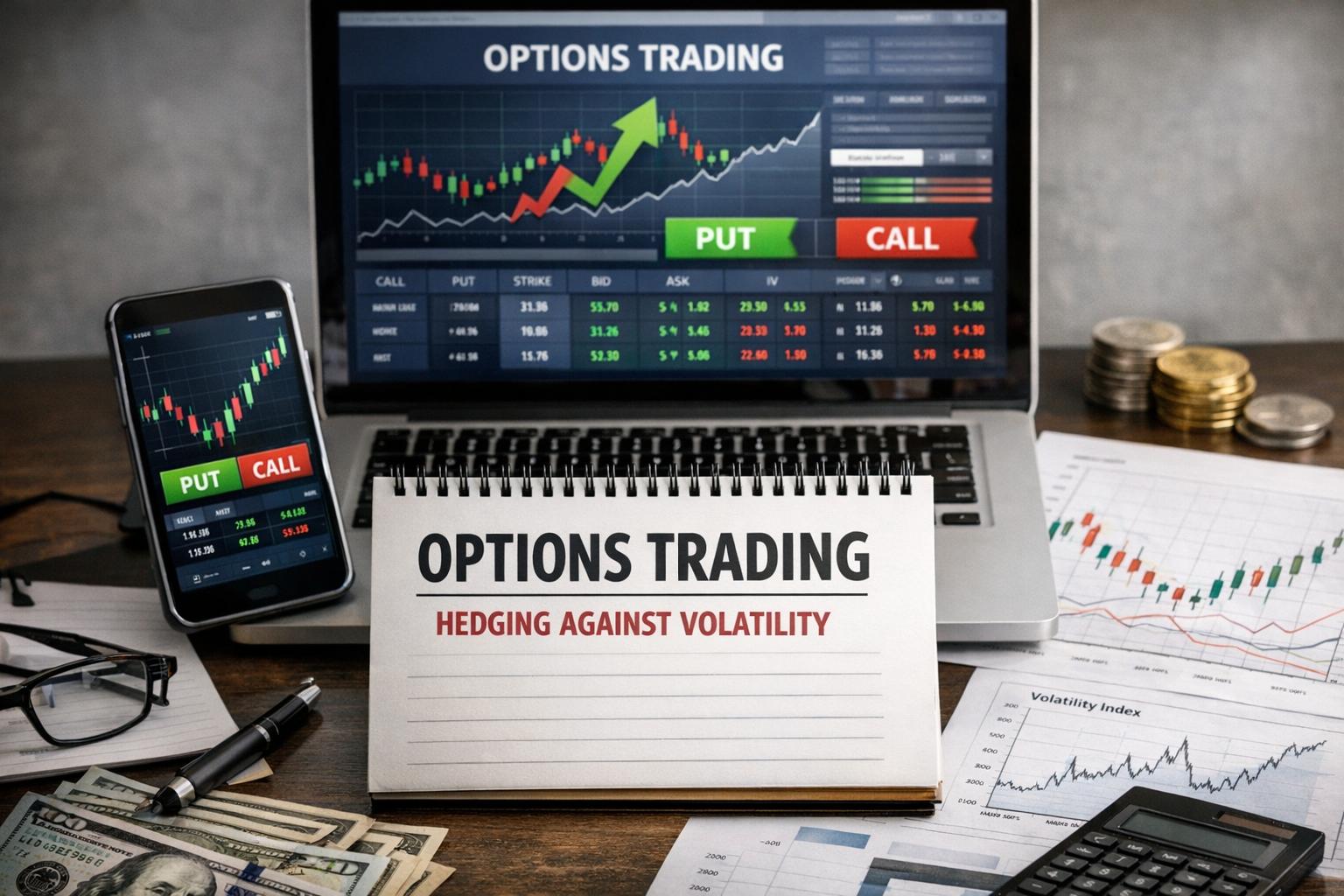
How to Use Options Trading to Hedge Against Volatility

Understanding Options Trading for Hedging

Options trading isn’t just a playground for people who enjoy math homework after dinner. When used correctly, it can help investors reduce the damage done by nasty surprises in the market—like sudden sell-offs, unexpected volatility spikes, or sharp trend reversals. The basic goal of hedging is straightforward: you accept paying a price (often in the form of an option premium) to reduce the risk you can’t comfortably live with.

Options themselves are contracts. They give the holder the right, but not the obligation, to buy or sell an underlying asset at a predetermined price before (or sometimes on) a specified date. That “right, not the obligation” piece matters a lot: it allows investors to structure positions where their potential losses are more manageable, while their upside can still be preserved depending on the strategy.

How hedging with options fits into investor reality

In real portfolios, hedging usually shows up in situations like these:

  • You own shares of a stock (or a basket) and worry about a downturn around an event—earnings, a regulatory decision, macro data, geopolitical headlines.
  • You’re not necessarily bearish long term, but you’d sleep better if your downside were capped for a few months.
  • You want income, but you don’t want to ignore risk; you’d rather collect premiums while setting boundaries.

Options can help with all of that, but only if you understand the ingredients and the trade-offs. The market loves a plan that’s too vague. Your strategy should be specific enough to hold up when prices start moving fast—because they will.

Key Components of Options

Before you hedge anything, you need to be clear about what the option contract actually contains. Most confusion starts here: people treat options like a single product instead of a bundle of assumptions. The bundle has parts, and each part affects pricing and payoff.

Underlying Asset: The underlying asset forms the basis of the option contract and can be composed of various financial instruments, including stocks, bonds, or indexes. It is the specific item that the option contract provides rights to buy or sell and determines the option’s inherent value.
Strike Price: The strike price is a critical factor in options trading, representing the set price at which the option holder can transact the underlying asset. For call options, this denotes the price at which the holder can buy the asset, whereas, for put options, it is the price at which they can sell it.
Expiration Date: As the timeline governing the option’s validity, the expiration date marks the deadline by which the option must be exercised or it becomes invalid. The approaching expiration date impacts the option’s value and necessitates strategic timing.

Options Pricing: why the premium isn’t “just a fee”

The premium is the price you pay (or receive, depending on whether you buy or sell the option). People often underestimate how much goes into that price. A rough, practical view is:

  • Intrinsic value: If the option is already “in the money,” it has value even without any future movement.
  • Time value: Even if it’s not in the money, the option may still have value because there’s time for the underlying to move into profitability before expiration.
  • Volatility expectations: Markets price the possibility of movement. Higher expected volatility generally increases option premiums.
  • Interest rates and dividends: These can slightly affect pricing, especially for longer time frames.

For hedging, the key takeaway is that you aren’t just buying protection—you’re buying protection under specific assumptions about time and volatility. If those assumptions change, your hedge may cost more (or perform differently) than you expected.

Types of Options

Options can basically be categorized into two main types, each serving distinct purposes in investment strategies.

  • Call Options: Call options provide the holder with the right to acquire the underlying asset at the predetermined strike price. This type of option benefits investors expecting an increase in the asset’s value.
  • Put Options: Conversely, put options grant the right to sell the underlying asset at the strike price. These are particularly advantageous for those anticipating a decrease in asset value, offering a method to hedge against potential downturns.

Understanding moneyness: why “strike vs price” is only half the story

When people talk about whether an option is “in the money” or “out of the money,” they usually only compare the strike price to the current price of the underlying. That’s necessary information, but not sufficient. For hedging, what matters is how likely the underlying is to move enough, before expiration, to make the hedge useful.

For example:

  • A put option slightly out of the money may still protect you if the stock drops enough to bring the option into profitability.
  • A put option deep in the money may protect well but cost more because it has more intrinsic value.
  • An option far out in time (“long-dated”) may be pricier, but it can hedge a longer risk window.

This is why two hedges with the same underlying can feel totally different in practice.

Hedging Against Volatility

One of the prominent uses of options in an investment strategy is their ability to hedge against market volatility. This involves using options to counterbalance potential losses due to the inherent fluctuations in market prices, which can be especially acute in volatile or uncertain market conditions.

Volatility doesn’t just mean the stock goes down. Volatility can also mean:

  • Prices swing rapidly, making your entry/exit points less reliable.
  • The market reprices risk quickly, sometimes ignoring fundamentals short term.
  • Correlations shift—stocks that usually move together stop behaving nicely.

Options react to these changes. That’s why hedging with options can feel like buying insurance: it won’t stop the storm, but it can reduce the damage.

Protective Put Strategy

Purchasing put options as a protective measure against portfolio devaluation is a common approach among investors. Known as a protective put, this strategy involves holding a long position in the underlying asset while simultaneously buying a put option for the same asset.

For example, if an investor holds a stock position that they fear might drop in value, acquiring a put option ensures that they can sell the stock at the strike price, despite any downturns below this level. This effectively caps potential losses, as the gains from the put option can offset declines in the stock’s price.

What payoff looks like in plain English

If the stock rises, your shares gain value. The put option you bought will likely lose value over time (because it’s not needed), but your overall position still benefits from the stock’s upward move. If the stock drops, the put helps offset losses by allowing you to sell at the strike price.

Most investors end up using protective puts when their time horizon for risk is clear—like a planned holding period around a known catalyst. If the risk window ends and you no longer need insurance, you can close the put before expiration instead of waiting and watching it bleed time value.

Choosing strike and expiration for protective puts

This is where hedging becomes more than “buy a put and hope.” Consider:

  • Strike price selection: Higher strike prices generally provide stronger protection but cost more.
  • Expiration selection: Shorter-term puts cost less but provide protection only for a narrower window. Longer-term puts cost more due to more time value.
  • Probability of the move: Options markets price volatility. If implied volatility is high, you may pay a higher premium for protection.

A practical approach is to match the hedge to the period you actually worry about. If you’re worried about the next month, don’t buy a hedge meant for six months unless the extra cost feels justified.

Covered Call Strategy

A covered call is another strategy that allows investors to generate additional income from their investments while providing a hedge. This involves owning the underlying stock and selling call options at a strike price above the current market price.

Although this caps potential upside gains if the stock’s price surges above the strike price since the investor would be obligated to sell, it allows them to receive premium income from the sale of the call options. This premium can serve as a buffer against downside risk, providing a measure of income that can absorb some losses or fluctuate below the strike price.

Why covered calls “hedge,” but not like protective puts

Covered calls can reduce net losses because you collect premium. If the stock falls or moves sideways, you likely keep that premium. If the stock rallies sharply, though, you may be forced to sell shares at a price that is below where the market could go next.

So, this isn’t a strict downside insurance policy. It’s more like negotiating a deal with the market: “I’ll sell you upside above a certain price, and in return I’ll take some premium today.” For many income-focused investors, that works well when their goal is steady returns with acceptable trade-offs.

Common ways people structure covered calls

  • Monthly or rolling hedges: Many investors sell calls on a repeating schedule (e.g., monthly) and roll them forward if needed.
  • Strike selection based on expected volatility: If implied volatility is high, you can often sell calls at strikes that you might not get paid for in calmer markets.
  • Share sizing discipline: You must own the shares you cover. If you don’t, you’re not running a covered call—you’re running something closer to uncovered risk.

Covered calls also have tax considerations in many jurisdictions. Premium income and potential capital gains can interact with local tax rules, so it’s worth checking before you assume the math is all that matters.

Using Options on Volatility Indexes

Investors seeking a broader market hedge may turn to options on volatility indexes such as the VIX, which represents market expectations of near-term volatility conveyed by S&P 500 index option prices. Buying such options can offer protection against sharp market movements, effectively neutralizing potential losses from market swings.

Important reality check: volatility instruments aren’t the same as “market crashes”

The VIX and similar measures are derived from options pricing on an index, not a direct measure of stock prices. That’s a subtle but important difference. When markets get nervous, volatility tends to rise, but it doesn’t always follow a perfect script.

Also, VIX futures and volatility products can behave differently from the simple intuition “volatility up equals hedge up.” If you hedge with VIX options, pay attention to how the product is constructed and how it has historically reacted to market moves.

Still, for some investors, these instruments can be a useful tool—especially when the concern is about broad market stress rather than a specific company.

Hedging Scenarios: how investors typically apply these strategies

Here are a few workable “day-to-day” examples that illustrate why these strategies exist.

Scenario 1: Long-term investor with a short-term worry

Say you hold shares of a software company you like. You believe in the long-term story, but the next earnings report could be messy. You buy a protective put for a couple of months, covering the risk window.

If earnings go well and the stock rises, you lose some premium. If earnings disappoint and the stock drops, the put offsets a portion of that damage. Either way, you reduce the chance that a single event derails your plan.

Scenario 2: Income focus on a stock you’re willing to sell

Now assume you own a stock and you’re basically okay selling it if it gets expensive. You sell a covered call at a strike price above current levels. If the stock stays flat or declines, you keep premium and your shares remain. If it rises above the strike, you sell at a price you previously set.

That’s “hedge” in a casual sense: you trade some upside for premium that softens downside. It’s not a guarantee against drawdowns, but it’s a predictable structure.

Scenario 3: Portfolio-level stress hedge

If your entire portfolio is exposed to broad equity risk, protecting only one stock won’t help much. In that case, you might use options on volatility indexes (or other index-based options) to guard against sharp market swings.

Here the goal is not to pick the next winner, but to avoid being blindsided by systemic volatility.

Risks and Considerations

While options serve as a useful hedging instrument, they also carry associated risks that require careful consideration by investors.

  • Time Decay: As options approach their expiration date, they experience *time decay*, a gradual erosion in value. This phenomenon requires astute timing since an option’s value diminishes as the expiration nears without favorable price movements in the underlying asset.
  • Premium Costs: Purchasing options involves paying a premium. These costs can become significant, and investors must weigh them against the potential protection afforded by hedging. If the cost of these premiums exceeds the relief or hedging benefits provided, the strategy could be counterproductive.
  • Market Movements: Options trading requires predictions about market directions. Misjudgments can lead to losses, particularly if the expected price movement in the underlying asset does not materialize, rendering the hedging strategy ineffective.

Time decay (theta): the “insurance policy you pay to keep”

Time decay happens whether the underlying moves or not. If you buy a protective put and the stock stays flat, the put still tends to lose value. That means your hedge only “wins big” when the underlying moves enough in the direction you’re protecting against.

This is why many investors treat a hedge like a trade with an expiration date. If the conditions that warranted the hedge don’t show up, you might still close the position to limit bleed rather than riding it to expiration like it’s a slow-moving train.

Volatility risk: implied vs realized

Options are priced by implied volatility (the volatility expected by the market). Your hedge performance depends on realized volatility (what actually happens). If implied volatility falls after you buy, your hedge can lose value even if the underlying moves a bit in your favor.

This is one of the most common “wait a second” moments in hedging. It can feel like you did everything right, yet the hedge didn’t pay off. In many cases, it’s because volatility expectations changed.

Greeks in practical terms (without going full textbook)

Options are often described using “Greeks,” which measure different sensitivities. You don’t have to memorize all of them to hedge responsibly, but you should know what they roughly mean.

  • Delta: How much the option price tends to change when the underlying price changes.
  • Theta: Time decay over time.
  • Vega: Sensitivity to changes in volatility.

For hedging, delta helps you understand how strongly your hedge reacts to price moves. Theta tells you how fast it loses value if nothing happens. Vega tells you how much the hedge’s value depends on volatility shifting.

Assignment and exercise considerations

If you buy options, you generally control whether you exercise. If you sell options, assignment can happen. With covered calls, assignment risk matters because selling calls means you might be forced to sell shares at the strike price if the calls finish in the money.

Most brokerages handle this automatically at expiration, but it still affects your position. If you care about holding shares or tax timing, you should understand that selling call options isn’t just a “collect premium and forget” action.

Liquidity and bid-ask spreads

Hedging works best when the option market is liquid. If you trade options with wide bid-ask spreads, your cost to enter and exit increases. That can turn a “reasonable” hedge into an expensive one, especially for shorter-dated options or less popular strikes.

As a rule of thumb: if you can’t trade it without paying a noticeable spread, you may want to reconsider the strike or expiration.

Premium costs vs protection level: deciding if the hedge is “worth it”

The hardest question in hedging is usually not whether options work. They do. The harder question is whether the cost is justified for your specific situation.

This is where investors benefit from thinking in ranges rather than binary outcomes. A hedge can reduce losses without necessarily preventing all downturns. You decide if that reduction matches what you’re paying.

If you buy a protective put and the stock drops, and your portfolio loss shrinks meaningfully, you likely did what you intended. If the stock stays stable and your put value decays mostly to zero, you paid for peace of mind. Peace of mind counts, but you should acknowledge it as a cost, not pretend it’s free.

Hedging consistency: one mistake that’s easy to make

People often hedge at the worst time—then stop hedging just as volatility rises. Markets don’t care about your calendar. Your strategy should define rules: when you hedge, how much protection you buy, and when you re-evaluate.

That might mean rolling protective puts monthly for recurring risk periods, or setting a threshold where a hedge is adjusted if the underlying price moves too far away from the strike. Consistency is boring—but it’s the boring part that keeps your plan from falling apart.

Conclusion

Integrating options into a hedging strategy can offer substantial advantages in managing risks and securing investments amid market volatility. The protective put can cap downside for investors who want to stay invested in a stock through uncertain periods. The covered call can generate premium income while adding a buffer against mild drawdowns, with upside capped by design. Options on volatility indexes offer another route for portfolio-level stress concerns, though they come with their own nuances about how volatility products behave.

However, engaging in options trading requires careful planning and real understanding of how options price risk over time. Time decay, premium costs, volatility shifts, and directional assumptions can all determine whether a hedge reduces damage or just adds expense. If you’re going to use options for hedging, treat it like a tool with parts: match the strategy to the actual risk window, choose the strike with intention, and decide in advance what would make you close or adjust the position.

The complex nature of options and the variety of strategies available doesn’t mean you should avoid them. It just means you shouldn’t wing it. With a measured approach—and, if needed, help from a qualified professional—you can use these contracts to protect portfolios in a way that feels less like gambling and more like risk management with a receipt.

The Role of Institutional Investors in Stock Price Volatility

Understanding Institutional Investors

Institutional investors are the heavy hitters of the financial markets. They manage large pools of money and, because of that, their buying and selling can quietly steer prices, change liquidity conditions, and influence how the rest of the market behaves. If you’ve ever wondered why certain stocks move sharply around major earnings reports or why a sector can feel “reactive” on particular days, institutional trading patterns are often part of that story.

These investors usually include organizations such as pension funds, mutual funds, insurance companies, and hedge funds. Each type has its own incentives, time horizon, and risk tolerance, which helps explain why their market impact isn’t uniform. Some institutions buy steadily over years; others trade more aggressively. Some are constrained by regulations and client withdrawals; others can take more flexible positions. Put it all together, and you get a market where “who’s trading” matters almost as much as “what’s being traded.”

This article breaks down how institutional investors affect financial markets, why their actions can increase volatility, and what market mechanisms exist to dampen the rough edges.

What Counts as an Institutional Investor (and What Doesn’t)

The phrase “institutional investor” can sound broad—like it includes anyone with a spreadsheet and caffeine. In practice, it usually refers to entities that manage assets on behalf of others and do so at scale.

Most commonly, you’ll see:

  • Buy-side institutions (pension plans, mutual funds, insurance companies, asset managers) that invest to meet long-term objectives or client mandates.
  • Hedge funds and other alternative managers that pursue returns using a wider toolkit—sometimes including long/short, derivatives, and event-driven strategies.
  • Asset allocators and investment vehicles that route capital through funds and mandates, sometimes creating layered flows that matter during rebalances.

What usually doesn’t qualify: a single high-net-worth individual making occasional trades. That person can move prices in thin markets, but the word “institutional” typically implies repeatable, structured decision-making at scale.

Market Influence of Institutional Investors

Institutional investors have the kind of financial muscle that most individual investors can only watch from the sidelines. When they decide to buy or sell a large position, the trades themselves can become a pricing event. In a market with limited liquidity, a single large order may move prices simply because there aren’t enough buyers or sellers immediately available at the previous price level.

But it isn’t only size. Institutional decisions often come from more formal processes than you’d see at most retail levels. They rely on research, internal models, analyst reports, and dedicated risk teams. Their trades are also frequently executed through specialized systems—so the market impact can show up not just as “big buying” or “big selling,” but as the result of coordinated execution over time.

Institutional investors can also cause signaling effects. For the rest of the market, a large buy might look like validation of a thesis, while a large sell might look like a loss of confidence—or at least a shift in portfolio strategy. That interpretation can trigger additional buying or selling from other players, amplifying the initial move.

How Institutions Turn Research Into Orders

A useful way to think about institutional influence is to connect the chain from “idea” to “action.” Typically, an institution explores fundamentals, then translates that into a position size, then decides how to execute without blowing up the portfolio—or ruining the price for everyone watching.

Depending on mandate, an institution might:

  • Build a position gradually (to reduce market impact and alignment risk).
  • Adjust holdings at set dates (like index changes or quarterly risk reviews).
  • Trade around information releases (earnings, guidance, macro prints) when their process allows for it.
  • Use hedges to manage downside while maintaining a core view.

That last point matters because hedges don’t always stay invisible. When derivatives positions change, the math can pressure the underlying shares too.

Why Their Trades Can Move Prices (And Sometimes Fast)

A useful way to think about price movement is to separate two forces:

1. Order flow (how much buying/selling is happening)
2. Liquidity (how easily that order can be absorbed without large price changes)

Institutional orders often involve both. They place size through time, use execution algorithms, and sometimes concentrate activity around predictable moments (like index rebalances, earnings windows, or macro data releases). Even when their trades are planned, the market may not be in a condition to absorb them smoothly.

When multiple institutions act in the same direction, the effect can be even stronger. This “crowding” doesn’t always happen intentionally. Sometimes it’s just that many institutions respond similarly to the same information—say, a change in interest rate expectations, a new regulatory rule, or a major earnings surprise. If everyone updates their outlook at the same time, price can jump more than you’d expect from fundamentals alone.

Institutional Investors: Stabilizing vs. Destabilizing Forces

It’s tempting to treat institutional investors as either heroes or villains, but the reality is more boring—and more useful. Their influence comes with a dual nature.

On the stabilizing side, institutions can provide continuity. Some, like many pension funds and insurance companies, often hold assets for long periods. They rebalance, but they generally aren’t constantly flipping positions on a hunch. When the broader market becomes shaky, stable holders can reduce the frequency of forced selling, which helps limit panic-driven cascades.

On the destabilizing side, large institutions can still create volatility. Their orders may be too big for the market to swallow gracefully, especially in small-cap names or during stress when liquidity disappears. Also, if institutions face redemptions, regulatory requirements, or risk limits, they may need to sell faster than they’d prefer. When selling pressure hits along with widening bid-ask spreads, volatility can spike quickly.

That’s why you’ll often see “calmer” markets when liquidity is healthy, and “jumpy” markets when it isn’t. Institutional investors are one part of the machinery, but they don’t operate in a vacuum.

Factors Contributing to Volatility

Not every institutional trade causes the same amount of volatility. Several factors determine how large and how fast price movements can be.

  • Size of Holdings: Institutional investors typically manage and maintain large positions in many companies. When they shift or liquidate these positions, the result can be substantial. A major reallocation doesn’t only change a stock price; it can influence adjacent names, sector ETFs, and broader sentiment. In practice, this can look like “why did everything in the group move today?”—often because capital moved in bulk.
  • Trading Strategies: Institutions use a wide range of execution methods. Among these are algorithmic trading and high-frequency trading. Algorithmic trading uses multiple variables—liquidity conditions, order book depth, timing constraints—to execute buys and sells based on predetermined criteria. High-frequency trading focuses on speed and frequent order placement, often exploiting small price differences before broader participants react. These strategies can improve liquidity, but they can also lead to quick price fluxes that magnify volatility when conditions get weird (and conditions always get weird sometimes).
  • Market Sentiment: Institutional actions shape sentiment beyond the stocks they trade. When institutions are bullish on a sector, retail and non-institutional investors often follow, pushing prices higher than a narrow view of fundamentals might suggest. Likewise, bearish positioning can spread fear. Because many investors watch similar signals—earnings revisions, credit spreads, guidance, and macro expectations—sentiment can turn into a synchronized movement.

That list sounds tidy, but reality has messier edges. For example, size doesn’t always cause volatility if the market is liquid and spreads are tight. Strategy doesn’t always increase volatility if execution is carefully calibrated. Still, those three factors cover a lot of ground.

Size of Holdings and Portfolio Reallocation

The connection between holdings and volatility is straightforward: large positions mean changes are harder to hide. If an institution holds a meaningful slice of a company’s float, even a percentage change in its exposure can require substantial trading activity.

This is one reason index membership matters. When a stock enters or leaves a major index, index-tracking funds may need to buy or sell predictable amounts. If the stock’s liquidity is thin, that mechanical flow can produce abnormal volatility around rebalancing dates—even if no new fundamental information has arrived.

There’s also the matter of cross-asset effects. Suppose institutions reduce risk across the board because of a macro shock. They might sell equities, or they might rebalance derivatives exposures, which can indirectly pressure equity prices through hedging activity. So “stock volatility” can come from a chain of positioning adjustments rather than a direct view of that one company.

A more practical way to see it: think of volatility as the “price of moving.” When institutions need to move large quantities through limited liquidity, the cost shows up as higher spreads and bigger moves.

Trading Strategies: More Than Speed

Trading strategy is where institutional volatility becomes both technical and human. Even when algorithms are involved, traders still design them. And that design reflects incentives: tight funding costs, risk limits, performance benchmarks, and manager career survival (yes, that’s a real factor in the industry).

Algorithmic trading often aims to reduce market impact. It may break a large order into smaller pieces and spread them out using signals from the order book. That can dampen volatility compared to “one-shot” execution. But if multiple institutions run similar execution algorithms at the same time—around a shared event like a takeover rumor or the close of an index rebalance—price can still move sharply. Algorithms reduce impact on average; they don’t guarantee smooth markets.

High-frequency trading can add liquidity, but it can also accentuate short-term swings when markets are stressed. Speed matters in both directions. If volatility rises, spreads can widen; then rapid strategies can react in ways that further shift order flow over seconds or minutes. Individual investors rarely see this happening explicitly, but they experience the results as sudden dips or spikes around otherwise “quiet” times.

It’s also worth noting: high-frequency strategies tend to be sensitive to liquidity—if liquidity evaporates, the “always-on” behavior can turn into “everyone runs for the exits.”

Market Sentiment: The Feedback Loop

Sentiment is hard to measure precisely, but you can observe its effects. When institutional investors signal confidence—through large buys, positive guidance, or position changes—other market participants often interpret that as information.

The feedback loop works like this:

– Institutions act based on their thesis and research.
– Price responds to their orders.
– Other traders and investors react to the price move and to public signals.
– That reaction can push prices further, even if the original thesis hasn’t changed.

This doesn’t mean institutions “manufacture” sentiment. It means markets are social systems built on interpretation. If enough participants interpret the same signals, the market moves.

The opposite loop can happen during stress. If institutions de-risk, the selling pressure can trigger stop-losses, margin calls, or risk limit reductions across other participants. Then sentiment turns into action, and action turns into more price pressure. That’s when volatility feels like it “appears from nowhere,” even though it usually has a chain of positioning logic behind it.

Regulatory and Market Mechanisms

Because institutional trading can amplify volatility, regulators and exchanges introduced tools to manage extreme disruptions and improve transparency. The goal is not to remove volatility—markets still need risk and price discovery—but to prevent disorder.

One major tool is the use of circuit breakers. A circuit breaker temporarily halts trading when a stock or market index moves beyond preset thresholds. The pause gives participants time to digest information, verify data, and reassess risk. In practice, circuit breakers help reduce reflexive trading where participants react too quickly to a temporary move or to a rumor that hasn’t been fully confirmed.

Circuit breakers are especially relevant during “information shocks,” where uncertainty spikes and liquidity vanishes. In those moments, a halt can prevent a spiral where selling accelerates simply because everyone is trying to get out at the same time.

Another important mechanism is transparency through reporting. Markets impose disclosure requirements for certain large trades and holdings. The intent is to allow market participants to understand who owns what and when big positions change. While the timing and granularity of reporting vary by jurisdiction and security type, the general idea is consistent: reduce information asymmetry.

When smaller investors and market analysts have better visibility, they can adjust beliefs more calmly rather than guessing. That reduces the chance of overreaction caused by missing pieces. It’s not perfect—markets still interpret—but it makes the guesswork smaller.

Liquidity Measures and Execution Practices

Regulatory action isn’t the only line of defense. Exchanges and market operators also influence volatility through market structure. Examples include improving order execution rules, monitoring for abusive practices, and supporting systems that maintain orderly trading even at high volume.

Execution practices among institutions also matter. Many institutions use execution algorithms designed to minimize market impact. They consider volatility, spread costs, and the depth of the order book. When these tools work properly, they can reduce the chance that a large order translates directly into a large price move.

That said, there’s a practical truth you’ll hear on trading desks: “Liquidity is a condition, not a badge.” In calm times, liquidity is plentiful and execution is smoother. In stress, liquidity can disappear quickly, and even careful execution can’t fully prevent price moves.

Real-World Examples of Institutional Impact

It’s one thing to explain these concepts; it’s another to see them in action. While individual events vary, the patterns repeat.

1) Index Rebalances and Mechanical Buying/Selling

When major indexes rebalance, funds that track those indexes must buy or sell shares to match the index composition. If a stock is relatively illiquid, it can experience unusual volatility around the adjustment period. Traders often refer to it as “index week jitters,” and you can usually spot it on charts as abnormal volume and wider price swings around the event dates.

Even if the institution’s motivation is passive (tracking rather than “betting”), the effect on price can still be dramatic because it concentrates demand and supply at the same time.

A practical example many investors have seen: a smaller company announces nothing dramatic, guidance hasn’t changed, and yet the stock moves like it just got a new CEO. Sometimes the story is boring: it got dragged into buying or selling flows because of an index decision.

2) Credit Events and Cross-Market De-risking

During credit stress, institutions that hold corporate bonds or structured products may face mark-to-market losses. To manage risk and regulatory capital, they may reduce exposure to equities directly or indirectly. That can push equity prices down broadly, even in companies that didn’t have a distinct stock-specific problem. Investors then say, “The whole market moved,” but the driver started somewhere else—often institutional balance-sheet pressure.

If you’ve ever watched equity indexes drop while “the news” seemed unrelated, this is part of why. Institutions don’t trade in neat, isolated boxes. Risk is connected across markets.

3) Earnings Surprises and Portfolio Re-hedging

When a major earnings report hits, institutions may adjust not just their stock positions but also derivatives hedges. Options market activity can spike, and “delta hedging” can lead to rapid trading in the underlying shares. If large players re-hedge in similar directions, short-term volatility can increase around the reporting window.

Retail investors might focus only on headline numbers, but the market’s movement often reflects hedging mechanics too.

If you want a real-life “why did it jump again?” scenario: sometimes a stock moves first on results, then moves again as hedges get recalibrated. The second move can be faster than fundamentals, because it follows math and risk limits.

How Institutional Investors Affect Different Market Participants

Depending on who you are in the market, institutional influence can feel helpful or harmful.

Retail investors often experience institutional actions as price swings. From the outside, retail participants may not know whether the jump is based on new information, portfolio reallocation, or risk reduction. As a result, retail sentiment can lag behind reality.

Market makers and liquidity providers may benefit from predictable flows when volatility is moderate. But they also have to manage inventory risk when institutional orders arrive unpredictably or when spreads widen. In volatile markets, liquidity providers may pull back, making it harder for institutions to execute smoothly.

Company management and boards can feel institutional effects too. Large holders influence governance decisions, voting, and sometimes public messaging. While investors don’t “control” corporate outcomes directly, their expectations can shape incentive plans and strategic direction.

All of this is why you’ll hear market watchers talk about the “plumbing” of financial markets: order flow, positioning, liquidity, and information. Institutional investors are one of the biggest plumbing components.

Volatility Isn’t Always Bad (Yes, Really)

A common knee-jerk reaction is to treat volatility as purely negative. It certainly can be harmful. Excess volatility can trigger panic selling, worsen funding stress, and cause investors to miss long-term opportunities. But some volatility is also part of healthy price discovery. If there were zero volatility, prices would fail to reflect new information, and mispricing would persist longer than anyone would actually want.

Institutional investors contribute to volatility because they operate at scale and often react quickly to information. Sometimes that leads to overreaction. But it can also correct mispricing and improve market efficiency by forcing prices to adjust closer to updated expectations.

So the right question isn’t just “Do institutional investors increase volatility?” It’s more like: In which conditions do they increase volatility, and when do they reduce it?

When Institutional Investors Tend to Increase Volatility More

Volatility tends to rise more when:

– liquidity is thin (spreads widen, fewer shares trade)
– institutions must trade under constraint (redemptions, margin needs, risk limits)
– large-cap names are less affected than small/mid-cap names where fewer participants hold inventory
– many institutions update positions simultaneously due to shared information triggers

A quiet market can stay quiet. A stressed market can turn into a pinball machine. Institutions are often the ball.

There’s a subtle reason for the “thin liquidity + forced selling” combo: in those conditions, there may not be enough natural buyers to absorb the sell flow at a stable price. So the market adjusts through price rather than through time. Price, being dramatic, gets the spotlight.

When Institutional Investors Tend to Stabilize Markets More

Stabilization tends to show up when:

– institutions have long time horizons and aren’t forced to exit quickly
– markets have enough liquidity for orders to be absorbed
– trading is diversified rather than concentrated at one moment
– transparency and reliable reporting reduce interpretation errors

Even then, institutions can’t guarantee calmness. But they can sometimes act as the “steady hands” that keep the market from slipping fully into chaos.

In other words, the same institution can produce different outcomes depending on the surrounding conditions. A pension fund selling slowly behaves very differently than a portfolio manager forced to cut exposure overnight.

Common Institutional Trading Patterns You’ll Actually See

If you spend any time watching charts, you’ll notice the market has rhythms. Some are tied to macro calendars, but quite a few come from institutional structure. A few patterns show up repeatedly.

Rebalancing at predictable intervals

Many strategies run on schedules. Mutual funds and some asset managers rebalance risk and weightings at set times. Index funds rebalance mechanically. That predictability creates “known demand,” which markets sometimes price in—until the actual execution hits and the liquidity reality checks everyone.

Position changes that lead to “gap moves”

Institutional trades can be designed to reduce visible impact, but they still rely on the market being willing to absorb flow. When execution occurs near the open, around news, or around a key option-expiration time, you may see gap moves that don’t seem to match the narrative. The narrative might come later; the positioning impact shows up first.

Risk reduction cycles

A classic institutional behavior is to reduce risk when stress builds. That might be triggered by credit spreads widening, volatility rising, or tightening liquidity in funding markets. Because many institutions respond to the same risk indicators, selling can become synchronized. Investors feel it as a sudden drop in “confidence,” but the mechanism sometimes starts with balance-sheet constraints.

Hedge adjustments around options activity

Derivatives trading can influence the underlying securities. When implied volatility shifts or when option positioning becomes lopsided, hedgers may buy or sell shares to match exposure. This doesn’t always create long-term mispricing, but it can absolutely create short-term volatility.

What Individual Investors Can Learn From This

Institutional investors are not “the enemy,” and they’re not a magic force that decides everything. Still, understanding how they operate changes how you interpret market moves. It helps you avoid the most common retail trap: assuming every sharp move means something fundamental changed about the underlying company.

Recognize when the move might be flow-driven

Some signals you can look for (without turning your life into a market microstructure hobby):

  • The stock moves a lot without matching news.
  • Volume spikes around known event windows (earnings season, index changes, major macro releases).
  • Multiple stocks in the same sector move together quickly.
  • Volatility spikes while fundamentals seem unchanged.

These aren’t guarantees. Markets have surprises. But when patterns repeat, it’s usually because the plumbing is doing its job.

Use volatility with humility

Volatility is information, but it’s incomplete information. It can reflect news, but it can also reflect positioning, liquidity conditions, and hedging flows. The more you understand those mechanics, the less likely you are to read every candle like it’s a prophecy.

If you’re investing long-term, you can treat short-term volatility as a cost of waiting. If you’re trading, you treat it as a variable in your execution plan. Either way, you don’t ignore it—you just don’t worship it.

Understand that “stabilizing” can still feel rough

Even when institutions stabilize markets on average, you may still see short bursts of volatility. Stabilization doesn’t mean “no sharp moves.” It means volatility is less likely to spiral out of control because there is enough liquidity, enough patient capital, and enough reliable information.

Conclusion

Institutional investors are undeniably a cornerstone of financial markets, playing a major role in shaping stock price dynamics and overall market health. Their large trades can produce price moves, and their execution strategies can either smooth the process or amplify swings—depending on liquidity and market stress. At the same time, they provide liquidity, long-term capital support, and more formal information processing that improves price discovery.

For individual investors and other participants, understanding how institutional behavior affects market volatility matters more than memorizing random trading tips. When you know the likely drivers—portfolio rebalancing, crowded positioning, risk-limit selling, algorithmic execution—you’re less likely to panic when a chart does something dramatic.

Institutional investors keep refining strategies and adapting to changing economic conditions. In a way, they’re like the market’s most organized professionals: not perfect, not always calm, but consistently influential. For further insights into institutional investors and stock market dynamics, one may refer to financial publications or websites like Investopedia for more detailed analyses and information.

How to Trade Penny Stocks and Their High Volatility

Understanding Penny Stocks

Penny stocks sit in a weird corner of the stock market where the prices look friendly, the headlines can be exciting, and the fine print loves to stay hidden. In most cases, “penny stock” refers to shares of small public companies that trade at prices below $5 per share. Because many of these companies have low market capitalization and limited investor coverage, they often trade over-the-counter (OTC) instead of landing on major exchanges like the New York Stock Exchange or NASDAQ.

That low price tag is what draws people in. If a stock moves from $0.50 to $1.00, that’s a 100% move—at least on paper. But markets don’t exist to make your spreadsheet look pretty. Penny stocks are known for big swings, thin trading, and a tragic number of businesses that don’t have the fundamentals to support the hype.

So, yes, penny stocks can deliver impressive gains. They can also punish overconfidence and sloppy decision-making in a hurry. If you’re going to trade them, you need to understand what you’re actually buying and why it might move the way it does.

What Penny Stocks Usually Are (and What They Aren’t)

Penny stocks aren’t a single category of companies with one shared business model. Instead, the label usually describes price and trading venue rather than a specific industry. You can find penny stocks in biotech, mining, consumer products, fintech, and plenty of other sectors.

What they aren’t:

  • “Automatically cheap” businesses with bargains waiting to be discovered
  • Guaranteed high-return investments
  • Consistently liquid stocks you can always enter or exit without friction

What they often are:

  • Small companies with limited trading volume
  • Fewer analyst reports and less mainstream coverage
  • Greater sensitivity to rumors, promotional campaigns, and sudden sentiment shifts

Because of that, penny stocks tend to behave less like steady investments and more like trading instruments influenced by news flow and market psychology.

How Penny Stocks Are Traded

Most investors hear the word “OTC” and assume it means “less important.” That’s not quite right. OTC simply means trading happens through broker-dealer networks rather than on a single national exchange.

This matters because trading conditions differ. You might see:

  • Wider bid-ask spreads (the cost of entering and exiting can be higher)
  • Lower liquidity (fewer shares traded on a regular basis)
  • Less transparency (sometimes slower or less consistent disclosure)

In practice, you should treat OTC penny stocks as “harder to trade” than large-cap shares. It’s not always bad—just not the same game.

Why Penny Stocks Attract Traders

Penny stocks tend to attract investors for three common reasons:

  • Accessibility: A lower share price can feel less intimidating.
  • Potential upside: Small companies can grow faster than large ones if they hit the right milestones.
  • Short-term movement: Some penny stocks respond dramatically to catalysts like financing, contract announcements, trial results, or changes in management.

If you’ve ever watched a penny stock chart spike and then collapse within days, you already understand why people get hooked. It looks like opportunity. It can be. It can also be chaos wearing a name badge.

Characteristics of Penny Stocks

Several distinct characteristics of penny stocks make them unique compared to larger, more established stocks. Their price level usually correlates with how the market treats them: fewer shares traded, fewer eyes looking, and more sensitivity to any new information—whether reliable or not.

High Volatility

One of the most prominent features of penny stocks is their high volatility. Volatility describes how quickly the price of a stock increases or decreases over a given time frame. With penny stocks, rapid price swings are common because small companies can be impacted dramatically by relatively small events: a financing announcement, a delayed filing, a lawsuit, a sudden shift in guidance, or even a wave of social media attention.

Volatility works like a boomerang:

  • On the way out, it can deliver fast gains.
  • On the way back, it can deliver fast losses.

This doesn’t mean you should run away screaming. It does mean you need a plan for position sizing, entry timing, and exits.

Low Liquidity

A frequent challenge for traders of penny stocks is their low liquidity. Liquidity refers to how easily you can buy or sell shares without moving the price too much. Many penny stocks see thin trading volume, which means:

  • You may struggle to execute a large order at your expected price.
  • You may experience delays between placing an order and completing it.
  • The bid-ask spread (the gap between the price buyers pay and sellers accept) can be large.

A simple real-world example: imagine you want to sell 50,000 shares quickly. If the order book is thin, you might find buyers disappear at your target price. The result is often a lower execution price than you wanted. This is why liquidity matters even if you’re “right” on direction.

Limited Public Information

Another characteristic of penny stocks is the limited public information available about the companies issuing them. Larger public companies usually have extensive reporting requirements, regular analyst coverage, and more consistent public filings. Penny stock issuers can have gaps in reporting, slower updates, or less detailed disclosures—especially if they’re small, thinly staffed, or financially stressed.

This can make it harder to evaluate the business. It also creates openings for promotional content that doesn’t hold up under scrutiny. People share “exciting” narratives, but narrative isn’t the same thing as audited financials.

Because of this, investors should focus on due diligence and prioritize primary sources over claims.

Corporate and Financial Risk

Penny stocks often come with higher business risk. Some companies might be early-stage, still developing products. Others might rely heavily on one or two customers. Many will need periodic financing to keep operating, which can create dilution (issuing more shares, reducing existing shareholders’ percentage ownership).

When a penny stock’s financing strategy changes, the stock can react strongly. Even if the company’s story sounds good, the market cares about:

  • How much cash the company has relative to burn rate
  • Whether financing requires issuing new shares at depressed prices
  • Whether revenue growth actually shows up in the numbers

In other words: the “why” behind the stock’s price matters more than the fact it exists.

Market-Manipulation Risk

Because penny stocks are often lightly traded, they can become targets for manipulation. That doesn’t mean all penny stocks are manipulated—some are simply small. But the market structure can make price moves easier to distort.

Common telltales can include:

  • Sudden spikes with no clear fundamental catalyst
  • Aggressive promotional campaigns
  • Repeated rumors that don’t match subsequent disclosures
  • Unusual trading volumes without matching news

If you’ve ever seen a stock jump 30% on “company is about to announce something,” you already know what real manipulation often looks like. The “something” sometimes never arrives.

Strategies for Trading Penny Stocks

Investing in penny stocks requires strategies designed for their real characteristics: volatility, liquidity issues, and information gaps. A thoughtful approach—built on research and disciplined risk management—keeps you from acting like you’re in a casino where the house always counts the chips.

Conduct Thorough Research

Conducting research is paramount when dealing with penny stocks, because you can’t rely on broad institutional coverage or analyst consensus. Investors should investigate:

  • Financial stability: revenue trends, cash levels, debt, and dilution history
  • Management: prior track record, experience, and consistency in communications
  • Business fundamentals: what the company sells, who buys it, and whether it makes real money
  • Corporate actions: reverse stock splits, dividends, buybacks, or plans for additional issuance

A well-informed investor makes decisions based on data instead of speculation. That doesn’t mean the data is perfect—small companies can mess up too. But you want evidence you can verify, not just a story told confidently.

Where people go wrong most often:

  • Reading one bullish article and treating it as due diligence
  • Ignoring dilution risk (common in smaller issuers)
  • Assuming a PR headline guarantees business progress
  • Skipping a review of recent filings because “it’s boring”

Boring is often where you find the truth.

Focus on Catalysts, Not Just the Chart

Penny stock price movement frequently follows catalysts. These can be scheduled (earnings, production updates) or unscheduled (regulatory decisions, contract news, litigation).

You’ll want to connect the catalyst to the business impact. A sudden stock surge before a filing could be traders anticipating news. Or it could be traders reacting to something unsupported. Research helps you understand the likely outcome compared with the buzz.

A practical approach:

  • Note upcoming dates (earnings, trials, regulatory deadlines)
  • Check whether the company has delivered similar milestones before
  • Assess whether the market already “priced in” the expectation

Catalysts give you a reason to watch. Fundamentals give you a reason to act.

Use Stop-Loss Orders

Stop-loss orders are a risk management tool that sets a predetermined exit price. The idea is simple: if the stock falls to a certain level, you sell to prevent the loss from getting worse.

In volatile penny stocks, stop-loss orders can prevent a small paper loss from becoming a life event. That said, you should understand the mechanics:

  • In thinly traded stocks, the price can gap past your stop and fill worse than expected.
  • Large bid-ask spreads may make “exact” stops less exact.

Because of that, some traders use charts and support levels to set stops. Others use a percentage cap that limits risk per trade. Either way, the core goal remains the same: you decide the maximum pain you’ll tolerate before you place the trade.

Limit Investment Amounts

Given the volatile, high-risk nature of penny stocks, it’s generally wise to limit how much capital you allocate. Many traders treat penny stocks as a small portion of their overall portfolio rather than the core of it.

Why? Because one or two bad outcomes can wipe years of careful returns if the position size is too large. A smaller allocation reduces damage when things go sideways.

A simple framework is to:

  • Cap total exposure to penny stocks to a small share of your portfolio
  • Use smaller position sizes per trade
  • Avoid concentrating too much on one issuer or one sector

Diversification here doesn’t mean “buy everything.” It means you don’t want a single mistake to dominate your account.

Consider Liquidity When Setting Order Types

With low liquidity, order type matters more than people think. Market orders can fill at surprising prices when there isn’t much trading activity. Limit orders can help control execution price, though they may not fill if liquidity stays thin.

If you’ve ever tried to buy a penny stock and your order partially fills like it’s “thinking it over,” you’ve met liquidity reality. Plan for it:

  • Use limit orders when spreads are wide
  • Monitor order execution rather than assuming it matches your intent
  • Scale into larger positions carefully

This isn’t glamorous, but it’s often the line between a controlled trade and a messy one.

Be Realistic About Time Horizon

Penny stock traders often mix up time horizon. Some treat a long-term investment like a day trade. Others treat a short-term trade like it needs to mature into value.

Because volatility is high, you should decide:

  • Are you trading a short-term catalyst with clear expectations for timing?
  • Or are you investing in business fundamentals with patience for slower results?

Then align your exit plan with that decision. A stock can move dramatically in either direction regardless of whether the business “should” be heading toward long-term value. Markets don’t wait politely for your thesis to catch up.

Risks Associated with Penny Stocks

Potential returns don’t remove risk; they just invite it in louder clothing. Penny stocks come with market risks, execution risks, and more serious risks related to fraud and manipulation. OTC trading and smaller company structures can mean less oversight and less consistent disclosure.

The Potential for Sudden Losses

One of the most emotionally punishing risks is the potential for sudden losses. Penny stocks can drop quickly due to:

  • Weak or delayed business updates
  • Financing announcements that dilute shareholders
  • Unexpected regulatory or legal problems
  • Overall market risk-off sentiment
  • Liquidity drying up after a hype cycle

You should also understand correlation effects. When small-cap or retail trading sentiment shifts, penny stocks often move together—sometimes for reasons that have nothing to do with the company’s actual performance.

If you’re going to hold penny stocks, plan for fast drawdowns. If you can’t tolerate drawdowns, penny stocks will do the psychological equivalent of rearranging your furniture while you’re asleep.

Risk of Fraud

Because many penny stocks trade OTC with limited regulatory oversight compared to major exchanges, there is an elevated risk of fraud. Investors should watch for promotional behavior that depends on incomplete information, exaggerated promises, or unclear relationships between promoters and company stock.

Common fraud patterns include:

  • Pump-and-dump schemes: coordinated promotion to drive price up, followed by selling by insiders or promoters
  • Misleading revenue claims: revenue shown in a way that doesn’t reflect cash flow or actual demand
  • Unverifiable technology or partnerships: claims without contracts, timelines, or credible documentation
  • Frequent “almost there” updates: endless delays without measurable progress

A practical way to reduce fraud risk is to verify claims with primary sources. If a press release claims a contract, look for the evidence. If a partnership is announced, check for details you can trace: who the parties are, what the agreement covers, and whether anything is reflected in filings.

And yes, sometimes you’ll discover nothing—just marketing. That’s your cue.

Reverse Stock Splits and Dilution

A less talked-about risk is dilution. Many penny stock companies require capital and may issue shares to fund operations. Dilution can reduce existing shareholders’ value even if the company remains technically “alive.”

Another corporate action that can shock traders is the reverse stock split. A reverse split reduces the number of shares while increasing the share price proportionally. It often aims to meet minimum price requirements to avoid delisting or to improve trading appeal.

For existing shareholders, a reverse split doesn’t automatically make the business stronger. It changes the share structure and can reset how the stock charts look. Traders sometimes interpret these changes as “good news,” but the underlying economics might not have improved.

You don’t need to fear corporate actions blindly. You do need to understand the reason for them and their expected impact on future funding.

Execution and Trading Friction

Low liquidity creates execution risks. Prices can move between when you place an order and when it fills. Spreads can eat into gains. And in extreme cases, you may not be able to exit when you want to.

This matters for two reasons:

  • Timing risk: you might sell lower than your planned exit.
  • Cost risk: wider spreads increase transaction costs.

If you’re profitable, execution costs won’t ruin you. If you’re guessing, it can turn a small loss into a bigger one faster than you can blink.

Psychological Risk

Penny stocks can stress people out. That’s not therapy talk; it’s market mechanics. When prices swing wildly, it’s easy to:

  • Chase moves after they’ve already happened
  • Hold losers hoping they come back (they often don’t)
  • Take profits too early due to fear

Good trading—especially with penny stocks—requires decision discipline. You can’t treat every spike like it’s the start of a new chapter. Sometimes it’s just a chapter break before the plot collapses.

How to Spot a Penny Stock Worth Watching (Without Overpromising)

Not every penny stock is a trap. Some are genuinely small companies building real products, with stock prices that don’t yet reflect stable fundamentals. The challenge is figuring out which ones have a path forward.

Here are practical screening habits you can use without turning it into a full-time job.

Look for Proof of Business Activity

Promotional materials sound great. Numbers sound better. When reviewing a company, focus on whether the business shows real activity:

  • Revenue that’s explained clearly in filings
  • Cash flow trends, not just optimistic forecasts
  • Progress milestones that match timelines (or at least explain delays)

If a company only talks about future potential, that’s not automatically fraud, but it is a warning sign.

Check Financing History

If a company has repeatedly raised capital through frequent share issuance, that can signal a financing dependence. That doesn’t mean the company is doomed. It does mean existing shareholders may get diluted repeatedly.

A simple approach:

  • Review whether financing came with heavy dilution
  • Check if capital raised translated into progress
  • Assess whether future financing needs look inevitable

The more predictable the financing path, the easier it is to model outcomes. The more mysterious it is, the more you should treat the stock as speculation.

Understand the Chart, Then Respect the Risks

Technical analysis can be useful for penny stocks, but you should use it to manage risk—not pretend it predicts the future. Consider:

  • Recent support and resistance levels
  • Volume changes around news
  • Whether moves hold after the initial spike

If a stock spikes on thin volume, it can retrace quickly when liquidity normalizes. If it responds to news with sustained volume, it may reflect stronger interest. Still, nothing removes the possibility of disappointment, especially with small companies.

Watch Company Communication

For penny stocks, communication patterns can matter. Consistent filings and clear explanations are better than vague statements and sudden silence. Watch whether the company:

  • Meets deadlines for filings
  • Provides updates that track to measurable milestones
  • Acknowledges setbacks with some plan

A company that communicates poorly might still succeed. But it’s harder to trust, and trust is part of risk management.

Trading Penny Stocks: Common Scenarios (What Usually Happens)

Penny stock trading often looks repetitive from the outside—spike, pause, drift, collapse, or repeat. Here are a few common scenarios and the types of decisions involved.

Scenario 1: The “Pre-News Pop”

A stock rises before a planned announcement. Traders expect the company to deliver. If the announcement matches the expectation, the stock may keep climbing. If it misses, the stock can drop fast.

How traders respond:

  • They enter early with tight risk controls (stop-loss orders, small size)
  • They scale out after the first big move
  • They avoid going “all in” before the actual news

It’s tempting to chase the early move. That’s also how accounts get “donated” back to the market.

Scenario 2: Funding News and Dilution

A company announces funding or financing. Sometimes the market treats it as survival and the stock reacts positively. Other times, the market worries the funding will come with heavy dilution.

The stock might initially spike, then decline as traders adjust expectations. This is not always predictable from the headline. The details in the filing matter—terms, share amounts, conversion prices, and timelines.

A smart approach is to read those details quickly and decide how the economics change your expected value.

Scenario 3: Reverse Split Shock

A reverse split can cause short-term volatility. Some traders sell quickly to avoid confusion. Others believe the structure change signals a push toward stability.

Often, the main question becomes: did cash reserves and business operations improve, or is it just a mechanical change to share count and price?

If the underlying model didn’t improve, share structure change alone isn’t a miracle. It’s just math with new numbers.

Scenario 4: The Quiet Period That Doesn’t Mean Safety

Sometimes penny stocks go quiet—no major price spikes, no obvious news, no obvious drama. People relax. Then a filing arrives or a rumor spreads and the stock moves again, sometimes violently.

Quiet doesn’t mean safe. With thin liquidity, a stock can move sharply when interest returns suddenly.

So, even during quiet periods, it helps to keep:

  • Your risk plan in place
  • Your exit criteria defined
  • Your awareness of upcoming dates or deadlines

How to Reduce Risk Without Removing the Point of Penny Stocks

Penny stocks exist because markets sometimes misprice small companies. If you believe a small company is undervalued, penny stocks might be a way to access that potential. But you don’t get to keep upside without managing risk.

Here’s a practical risk-focused mindset that works better than wishful thinking.

Use Position Sizing Like It’s Your Job

Position sizing is the part of penny stock trading that can be boring and still save you money. If each trade risks a small portion of your portfolio, one losing trade won’t ruin your plan for the next 30 trades.

If you size too aggressively, you might hit a winning trade and still lose the account due to a later loss. Penny stocks don’t reward “almost” and “maybe.” They reward discipline—and sometimes luck.

Have an Exit Plan That Isn’t Based on Hope

Before you buy, decide when you will sell if the trade doesn’t work. That can be a stop-loss order, a time-based exit, or a thesis-based exit (for example, if a milestone is missed by a set amount).

If you don’t plan exits, you’ll end up making decisions when emotion is already involved. Emotion is fine for sports commentary. It’s a bad trading partner.

Keep a Simple Trade Journal

You don’t need a fancy spreadsheet with six tabs and a romantic attachment to chart colors. A basic journal helps you see whether your strategy is actually working.

Track:

  • Why you entered (catalyst, thesis, chart level)
  • How you managed risk (stop-loss, position size)
  • What happened after the catalyst
  • Your outcome and whether your expectations matched reality

Over time, you’ll likely notice which setups consistently work better than others.

Conclusion

Penny stocks offer a compelling mix of low entry prices and the potential for outsized returns. But that same mix is why they also carry steep risks: sudden price drops, thin liquidity, incomplete information, and a higher chance of fraud and manipulation than many investors realize.

A sensible approach combines comprehensive research, realistic expectations, disciplined risk management, and attention to how OTC trading conditions can affect execution. If you want additional context for how these markets work and what disclosures typically look like, individuals may also seek guidance from financial advisors or review information available on reputable financial regulatory websites.

As is true with any investment endeavor, a balanced perspective, grounded decision-making, and respect for risk matter more than the excitement of the next “sure thing.” Penny stocks can be profitable, but only when you treat them like what they are: small companies with big market reactions and not much room for mistakes.

Best Sectors for Finding High-Volatility Stocks

Understanding High-Volatility Stocks

High-volatility stocks move around a lot—sometimes majestically up, sometimes unceremoniously down—often within the span of days or weeks. “High volatility” isn’t a moral judgment or a prediction that a stock will go up; it simply means the price tends to swing more than the average stock. For investors, that usually translates into two things: bigger potential gains and bigger potential shakes. If you’ve ever watched a portfolio value jump $500 and then drop $400 a few trading sessions later, congratulations, you’ve met volatility in the wild.

This article focuses on which sectors tend to contain these stocks, why those sectors behave this way, and what investors commonly miss when they try to “trade volatility” without understanding its drivers.

What “high volatility” actually means

Volatility is often measured statistically (think: standard deviation of returns). Practically, you don’t need the math to use it well. If a stock’s price fluctuates frequently and sharply, expect higher volatility. That volatility can be driven by company-specific news, broader economic forces, or both.

It’s also worth distinguishing between two common investor experiences:

  • Volatility that follows fundamentals: e.g., earnings disappoint, guidance changes, trials fail or succeed. Price swings reflect new information.
  • Volatility that follows sentiment: e.g., a hot product rumor, meme-driven trading, or speculative expectations. Fundamentals may not change as fast, but the stock still whipsaws.

In real markets, the lines get blurry. Still, knowing which driver dominates helps you decide whether the volatility is “informational” or “emotional.”

Why sector matters when you hunt for volatility

Some sectors are naturally prone to high-volatility stocks because their business models create frequent inflection points. Those inflection points show up as earnings surprises, regulatory outcomes, commodity price moves, product adoption news, or interest-rate sensitivity.

Sectors also differ in how much information the market processes quickly. For example, technology firms may deliver updates frequently and shift expectations fast. Biotech can swing hard on a single trial result. Banks can swing on macroeconomic changes that affect credit losses and interest margins.

So if you’re trying to understand where high-volatility stocks tend to live, it usually makes sense to start at the sector level. You then filter down to individual companies with the specific catalysts that can plausibly move the price.

Technology Sector

Technology is often the poster child for high volatility, mainly because innovation moves quickly and the market expects a constant stream of progress. Tech companies frequently operate in changing environments shaped by new inventions, shifting customer needs, and competitive disruption. When expectations change fast, stock prices do too.

Within technology, volatility can be especially pronounced in sub-sectors tied to major narratives—artificial intelligence, blockchain, cybersecurity, cloud infrastructure, semiconductors, and developer tools. These groups can see sudden repricing when there’s a breakthrough, a scaling milestone, a competitor leap, or a new regulation that changes how products can be sold.

Valuation swings happen because future growth is the product

Many tech stocks don’t just trade on today’s earnings. They often trade on beliefs about future growth: revenue trajectories, margins after scale, total addressable market, and the ability to sustain competitive advantage. That means the stock can react sharply to relatively small operational changes—because the market interprets the change as a signal about the company’s long-term path.

A simple example: a company launches a feature on schedule, it gets traction, and investors revise their growth assumptions upward. Price can surge quickly. On the flip side, a delay, a security incident, or public criticism can cause investors to question the roadmap, which can hit valuation even if the company still performs reasonably well in the short term.

Startups and Market Disruptors

Startups are often the most volatile within technology, partly because they’re still figuring things out. They may have limited revenue history, uneven cash burn, and products that evolve under real-world use. Markets sometimes reward them fast when they hit milestones, but punish them quickly when progress isn’t as smooth as investors hoped.

For investors, two realities can be uncomfortable:

  • Some startups are volatile because they’re genuinely progressing.
  • Some startups are volatile because they’re running out of runway or have a weak commercial plan.

Distinguishing between those two is where research matters. High volatility isn’t inherently “good” or “bad”—it’s just a signal that expectations can change quickly.

What tends to drive tech volatility in practice

Tech volatility doesn’t come out of nowhere. Common triggers include:

  • Earnings and guidance: not only results, but forward-looking statements.
  • Product cycles: launches, upgrades, failures, adoption rates.
  • Regulatory updates: privacy rules, export controls, platform rules.
  • Competitive pressure: new entrants or faster rivals.
  • Supply chain and component constraints: particularly for hardware and semiconductors.

If you keep an eye on these categories, you’ll often be able to anticipate the “why” behind price swings rather than just reacting to headlines like they’re weather alerts.

Biotechnology and Pharmaceuticals

The biotechnology and pharmaceutical industries can produce some of the most dramatic volatility in the market, because so much value hinges on discrete high-stakes milestones. Drug development is slow, expensive, and full of scientific uncertainty. When uncertainty resolves—through clinical trial results or regulatory decisions—the stock often reprices sharply.

For small and mid-cap biotechs, the dependence on one or two programs can be intense. One Phase 2 or Phase 3 readout can make the difference between “promising” and “scrapped.” That concentration risk is a major reason you see big percentage moves in these names.

Drug approval and trial results aren’t “just news”—they’re repricing events

A biotech stock may trade for months with one dominant question: will the trial succeed, and will regulators approve the drug? When the answer changes, expectations jump. That can lift the stock for a while, but it can also reverse quickly if subsequent data don’t confirm the initial result, or if competitors show better efficacy.

Some investors like this volatility because it creates opportunities around known catalysts. Others avoid it because you can be right on the science and still wrong on the timeline, dosage, safety profile, or payer dynamics. Welcome to medicine: it’s complicated, because biology refuses to sign off neatly on spreadsheets.

Innovation in Drug Development

Innovation drives volatility because it changes the probability distribution of outcomes. New approaches—personalized medicine, new trial designs, improved delivery mechanisms, or next-generation biotech tools—can shift what investors think is likely to work.

However, innovation also creates new uncertainties. Better methods can reduce risk in one area while introducing new unknowns in another. That can produce whiplash if investors interpret results too optimistically or too pessimistically.

How investors typically manage biotech volatility

Common approaches include:

  • Catalyst timing: buying ahead of specific trial readouts or approval decisions, with defined risk limits.
  • Diversification: holding multiple programs so one failure doesn’t dominate the portfolio.
  • Probability awareness: using scenarios based on trial phases and endpoints rather than treating all results as “win/lose.”
  • Financing monitoring: many biotechs dilute shareholders when cash runs low, which can pressure stock regardless of clinical progress.

You don’t need to be a medical scientist to do this. You do need to read trial updates carefully and understand what endpoints actually mean—“statistically significant” isn’t always the same as “clinically meaningful,” and the market pays attention to that difference.

Energy Sector

The Energy stocks—especially oil and gas—tend to be volatile because their revenues depend heavily on external variables: commodity prices, global demand, and geopolitical disruptions. Add in the political reality of energy policy, environmental regulations, and investor reaction to long-term energy transitions, and you get a sector where prices can swing fast.

When global economic conditions improve, demand expectations often rise. That can increase oil and gas prices, lifting energy company valuations. When growth worries rise or production oversupply appears, commodity prices can fall and press margins.

Geopolitics and currencies make energy moves louder

Energy is also exposed to geopolitical risk. Conflicts in or near production regions can disrupt supply, change shipping costs, and shift pricing. Even if a specific company isn’t directly affected operationally, the market still reprices sector sentiment quickly.

Then there’s currency exposure. Many energy firms operate across borders and receive revenue in multiple currencies. If the dollar strengthens or weakens relative to currencies where they earn revenue, reported financial results can change, affecting stocks. That means energy volatility isn’t only about oil or gas—it’s also about the financial translation effects investors track.

Renewable Energy

Within the energy sector, renewable energy companies can also be very volatile, though for slightly different reasons. Renewables often depend on government incentives, subsidies, tax credits, and power purchase agreement structures. When policy changes—or when investors revise expectations about future incentives—stock prices can move sharply.

Technology shifts matter too. A new cost curve for solar panels, battery performance improvements, or grid infrastructure upgrades can strengthen or weaken business cases quickly. Investors frequently debate whether renewables will scale economically without subsidy support. That debate can make stocks swing around as new data and policy signals arrive.

Investment horizon and renewable reality

Renewable investors sometimes tolerate volatility because they believe the long-term trend is favorable. But there’s no free lunch: short-term results can be messy due to project delays, permitting issues, cost overruns, and changing financing conditions. If you’re watching renewables, it helps to look past just “headline sustainability” and focus on contract structures, backlog quality, and the pipeline of projects that can actually be delivered.

Financial Sector

The financial sector covers banking, insurance, brokerage, asset management, and more. Its volatility often relates to interest rates, credit performance, and broader economic cycles. When conditions change quickly, banks and insurers react in ways that show up in both earnings and investor sentiment.

Financial companies can appear relatively stable in calm markets because many operate with structured revenue models. But stability can vanish when credit quality deteriorates, when funding costs rise, or when economic conditions shift from “steady” to “uh-oh.”

Banking stocks

Banking stocks can show elevated volatility during economic stress or when interest rates shift quickly. The basic logic is straightforward:

  • Rate changes affect net interest margins.
  • Economic slowdowns affect loan defaults and charge-offs.
  • Market stress can reduce fee income and increase provisions.

On top of that, banking competition matters. Fintech models can pressure traditional players by taking market share or changing expectations about digital banking features and fees. So while “banks are boring” sounds nice, the market doesn’t always reward boring. It rewards what it believes will happen next to earnings power.

Insurance and other financial sub-sectors

Insurance isn’t only about interest rates. It can swing due to catastrophe events, medical cost pressures, underwriting losses, and investment portfolio performance. Even if insurance policies are priced for risk, the market still reprices companies if it believes the risk environment changed faster than expected.

Similarly, investment brokerages and trading-focused firms can become volatile if market activity increases or drops. Volatility often becomes a measure of how investors expect capital markets to behave.

Consumer Discretionary Sector

The consumer discretionary sector includes non-essential goods and services like automotive, entertainment, travel, retail, and luxury. This sector tends to be volatile because discretionary spending is one of the first things people cut when budgets tighten. When times are good, discretionary spending expands. When times are bad, discretionary becomes “not this month.”

That makes consumer discretionary stocks sensitive to macroeconomic conditions, employment trends, consumer confidence, and supply chain realities—plus how companies position products against competitors.

Retail Segment

The retail industry segment is particularly susceptible to volatility. Retailers face relentless pressure from e-commerce competition, changing customer behavior, and inventory risk. If demand slows, inventories pile up. That can trigger discounting, lower margins, and disappointing results.

As more consumers move online, brick-and-mortar retailers can get hit harder, unless they adjust their operations. The market often swings based on questions like:

  • Is the retailer gaining or losing customers online?
  • How expensive is inventory this season?
  • Will margins hold after promotions?
  • Can the company manage logistics efficiently?

Retailers that evolve tend to exhibit lower volatility over time—less because the business becomes perfect, and more because investors feel there’s a clearer path to cash flow. Retail volatility also reflects execution risk. When companies stumble on fulfillment, tech platforms, or pricing strategy, stock prices often respond quickly.

How to spot high-volatility behavior earlier

Once you know which sectors commonly produce high-volatility stocks, the next step is figuring out which individual names show volatility characteristics that are worth your attention—and which ones are “high volatility” mostly because liquidity is thin or the company is small enough that one trade can move the price.

A few practical red flags and confirmations:

  • Frequent price gaps: stocks that “jump” on news rather than moving steadily can create fast opportunities and fast regrets.
  • Large swings around earnings: if performance surprises correlate strongly with price movement, volatility is likely structural.
  • Upcoming catalysts: clinical trial dates, regulatory calendar items, product launch windows.
  • Balance sheet sensitivity: companies that rely on external financing can become volatile when capital markets tighten.
  • Commodity or rate linkage: when a stock price tracks commodity levels or interest-rate expectations closely, volatility can intensify with macro swings.

You don’t need to predict every move. You do need to know what tends to cause moves.

Risk isn’t just the downside—it’s the timing

Many investors think volatility equals risk, and volatility does carry risk. But the timing of risk matters just as much as its size.

A portfolio can survive a -20% move if it recovers quickly. It can also suffer psychologically (and financially) if drops occur when liquidity is tight or if you’re forced to sell during the worst moment. Some high-volatility stocks require patience; others punish patience.

For example, imagine two biotech companies:

  • Company A has an expected trial readout in 30 days. Volatility may rise as the date approaches.
  • Company B has no clear timeline and needs more trials plus financing. Volatility may keep grinding because uncertainty stays unresolved.

Same sector, different risk profile. That’s why investors often separate “event-driven volatility” from “uncertainty-driven volatility.”

Common investor mistakes with high-volatility stocks

High-volatility sectors attract brave (or curious) investors. That’s fine. Bravery should come with checks, though. Here are mistakes that show up repeatedly:

Confusing volatility with opportunity

Volatility creates opportunity only if you can manage risk and structure your approach. If you buy a high-volatility stock because it “moves a lot,” you’re really betting on direction plus timing plus your ability to stick around.

Ignoring dilution and financing

Biotech and high-growth tech often need cash. When capital markets turn risk-off, financing becomes harder and dilution can hit shareholder value regardless of the underlying product progress. You can’t read clinical results properly if you ignore the cash clock.

Not understanding what consensus expectations are

A stock can drop even after “good” news if expectations were higher. Many high-volatility stocks are priced around specific benchmarks—trial endpoints, subscription numbers, churn rates, guidance levels, or margins. When those benchmarks miss, the stock can overshoot on the downside because the market reprices quickly.

Using a one-size-fits-all holding period

A strategy that works for trading event catalysts might fail for longer-term uncertainty resolution. If you treat every volatile stock like it’s an earnings flyer, you’ll probably end up stressed and late to the lesson.

Practical ways investors can approach volatility

There are different styles of dealing with high-volatility sectors. You don’t have to copy anyone else’s playbook, but it helps to pick a method intentionally rather than by accident.

Scenario-based research instead of certainty seeking

Volatile stocks rarely offer certainty. Better practice is to map possible scenarios: success with strong adoption, success with weaker-than-expected margins, partial success with additional trials, delay or regulatory setbacks. Your goal isn’t to “find the one true answer.” Your goal is to understand what would need to be true for the stock to justify the price.

Position sizing with volatility in mind

Volatility affects position sizing. A position that feels comfortable with a stable stock can become too large when price moves swing. If you’ve ever woken up to a portfolio down 10% overnight, you know why position sizing matters. Volatility is generous with surprises.

Tax and liquidity awareness

Different investment structures have different friction. Some investors trade often, others hold for periods governed by tax rules. High-volatility stocks can also face liquidity constraints; thinly traded names can make it harder to exit on your schedule.

Monitor catalysts and “what changed”

Instead of reacting emotionally to daily moves, track what changed from the last time you checked. Did earnings guidance move? Did a clinical endpoint interpret differently? Did regulators issue a new standard? Did the market just get bored? Bored markets can still move, but they don’t move for fundamentally different reasons each time—usually.

Real-world examples of sector volatility in action

You’ve probably noticed how headlines can trigger price swings across the sectors we discussed. A few common patterns:

  • Tech: a company beats revenue and updates guidance upward—shares surge. Then competition or margin pressure appears in the next report, and shares fall sharply.
  • Biotech: a trial delivers positive results—shares jump and options prices spike. Later, safety concerns or follow-up data reduce enthusiasm.
  • Energy: an unexpected supply disruption pushes oil prices—energy stocks react. If demand expectations weaken shortly after, the stock can reverse.
  • Financial: interest-rate expectations shift—bank shares reprice rapidly. Credit default concerns can amplify the move.
  • Consumer discretionary / retail: a brand misses sales expectations—discounting expectations rise, and margins get questioned.

In each case, volatility isn’t random. It’s the market shifting its probability estimates about a future that may look clearer in hindsight, but never in real time.

How to narrow down within a high-volatility sector

Once you choose the sector, you still need to find the specific candidates. That process usually comes down to five practical filters:

  • Catalyst clarity: is there a known event with a timeline?
  • Balance sheet strength: does the company have enough funding to survive delays?
  • Sensitivity: how exposed is the stock to macro variables like rates, oil prices, or consumer demand?
  • Execution: can management consistently hit milestones?
  • Market expectations: is the stock priced for optimism, pessimism, or “priced for perfection”?

This doesn’t eliminate risk, but it reduces the kind of risk that comes from guesswork.

Getting comfortable with volatility without pretending it’s harmless

High-volatility stocks can reward investors who understand why the price swings happen and who can maintain discipline when the chart looks like a broken elevator.

If you’re choosing sectors, the overall pattern is consistent: technology, biotechnology/pharmaceuticals, energy (including renewables), financials, and consumer discretionary often contain high-volatility names. Within each sector, the reasons differ—innovation cycles, trial and regulatory outcomes, commodity geopolitics, interest rates and credit quality, and consumer spending habits.

And here’s the part investors usually learn the hard way: volatility doesn’t guarantee profits. It guarantees movement. If you’re ready to manage that movement—through research, scenario planning, and position sizing—then high-volatility sectors can become a place where your homework pays off faster than your feelings.

Final thoughts

Investors seeking high-volatility stocks should consider sectors like technology, biotechnology, energy, financial, and consumer discretionary, each offering different ways for prices to swing and different types of risk to monitor. Conduct thorough research before committing capital, track the specific drivers behind each move, and be honest about your time horizon and risk tolerance. Volatility can create real opportunities, but only when you treat it as information—not as a casino signal.

Understanding the VIX Index: The Volatility Gauge

Introduction to the VIX Index

The VIX Index has earned its nickname for a reason. Market participants often call it the “fear gauge” or “fear index,” because it gives a quick, numbers-first view of how anxious investors seem to be about future volatility. That makes it popular with retail traders, professionals, journalists, and anyone who’s ever watched a “calm” market suddenly decide it’s done with calm.

At its core, the VIX reflects the stock market’s expectations for volatility over the next 30 days, derived from option prices tied to the S&P 500 index. You can think of it as a real-time snapshot built from how traders price risk using S&P 500 index options. When option buyers (especially put option demand) get more worried, volatility expectations tend to rise—and, correspondingly, so does the VIX.

It’s also worth saying something practical up front: the VIX is not there to tell you whether the market will be up or down next week. It’s there to tell you what volatility the market is pricing in. In other words, it measures the market’s expectation of variation in returns, not the market’s opinion on the direction of returns. Traders can hate this distinction, but it matters. (It matters more than people want it to, because markets love to ignore our comfort zones.)

Understanding Market Volatility

Volatility is how much the price of a financial instrument tends to vary over time. In practical terms, it tells you the likely “range” of movement around average behavior. High volatility typically means the market is moving more aggressively—fast swings up, fast swings down. Low volatility usually means price action is steadier, at least according to how traders are pricing the future.

That’s why the VIX matters. It doesn’t measure uncertainty in a philosophical sense. It measures uncertainty as inferred from option prices—basically, what traders think volatility will be. And because volatility often rises when investors expect stress (earnings surprises, economic releases, geopolitical headlines, rate shocks, you name it), the VIX quickly becomes a proxy for sentiment.

There’s also a second-order effect that people sometimes miss: when volatility expectations rise, the market often reprices many risk assets at once. That’s not because every participant suddenly becomes psychic. It happens because risk models, portfolio constraints, and hedging costs all react to volatility assumptions. If volatility expectations increase, the cost of hedging increases; if the cost increases, risk appetite frequently drops. The VIX sits right in the middle of that feedback loop.

How the VIX Works

While the VIX gets talked about in simple terms, the construction is anything but simple. The index is calculated using a range of S&P 500 options. Specifically, the VIX methodology extracts implied volatility from out-of-the-money option prices across multiple strike prices. It uses both put and call options, then applies a weighting structure that turns those option prices into a single index figure.

These options tend to be highly liquid, which is one reason the VIX became the default “volatility barometer” for the U.S. equity market. High liquidity generally makes the implied volatility signal less noisy than it would be if you tried to compute a volatility expectation from thinly traded options.

If you’ve ever wondered why people react to the VIX at market open like it’s the weather forecast—this is why. The index is updated continuously during market hours, which makes it useful for real-time risk monitoring.

One more practical detail: implied volatility is forward-looking because it’s backed out from current option prices. Options traders are willing to pay premiums based on probabilities they assign to future volatility. That willingness shows up directly in the option chain, and the VIX effectively reads that chain like a report card.

The Importance of the VIX Index

The VIX provides a single, widely recognized number that many participants treat as an estimate of expected volatility. That matters because markets rarely move in perfectly linear ways. Even without a full options book, the VIX gives a quick sense of whether investors are pricing a “rougher ride” ahead.

In broad strokes:

  • Higher VIX generally signals expectations of larger price swings (often linked to market stress).
  • Lower VIX generally signals expectations of smaller price swings (often linked to calmer market conditions).

The practical value shows up around major news. For example, before or during events that can move equities—central bank statements, big CPI prints, unexpected geopolitical developments—the VIX often shifts quickly. Investors treat it as a warning light or, depending on their temperament, a signal to wait or to act.

If you’ve spent any time around a trading desk during a headline day, you probably heard the same conversation in different words: “Vol’s changing.” The VIX is one of the fastest, most standardized ways to communicate that change. It’s not the only measure, but it’s often the first one people mention because it’s easy to reference.

Using the VIX for Investment Decisions

People use the VIX in different ways, and it’s worth separating “watching” from “trading.” Most investors aren’t constantly buying VIX futures. They’re trying to decide how aggressive to be with risk.

Here are a few common patterns:

  • Risk reduction: If the VIX rises and stays elevated, some investors reduce exposure to long equity positions or shift to lower-volatility strategies.
  • Hedging: Fund managers may buy protection (or structure options positions) when implied volatility looks expensive or cheap relative to expectations.
  • Contrarian thinking: Some traders interpret very high VIX readings as signs that fear is already “priced in,” potentially offering better risk-reward entry points—though this requires discipline because fear can last longer than anyone’s patience.

It’s also common to see VIX referenced in daily market commentary, especially during drawdowns. If you’ve ever read “the VIX jumped” during a selloff, you already get the gist: traders became more willing to pay for protection, which often lifts the volatility forecast embedded in options.

In real portfolio work, the VIX often shows up alongside other controls, too. For example, a fund might limit exposure when volatility rises above a threshold, or it might tighten stop-loss behavior during higher-vol regimes. Even if the VIX isn’t the deciding factor, it frequently acts as a shorthand for “conditions changed, treat risk differently.”

Limitations of the VIX

The VIX is useful, but it’s not a magic crystal ball. Two limitations show up again and again:

  • It reflects expectations, not a guarantee: A high VIX doesn’t mean the market will immediately drop. It means traders expect higher volatility over the next month.
  • It’s context-dependent: The same VIX level can mean different things depending on trend, macro regime, and liquidity conditions. Without context, it’s easy to overreact.

Using the VIX alone can lead to rushed decisions. A safer approach is to pair the VIX with price action, broader market indicators, and—if you trade options—an understanding of how implied volatility interacts with strike selection and time-to-expiration.

Also, remember that people interpret the VIX through their own experiences. A retail investor might see VIX 22 and think “not too crazy.” A systematic trader might see it as a regime change if it broke from a long stretch below 14. The number is the same; the meaning isn’t.

History and Development of the VIX Index

The VIX didn’t appear because someone woke up and said, “Let’s invent fear as a number.” It emerged from a practical need: market participants wanted a standardized, transparent metric for expected volatility based on option markets.

In 1993, the Chicago Board Options Exchange (CBOE) introduced the VIX. At the time, the goal was straightforward—offer a measure of expected volatility using S&P 500 options. Over the years, the index has been refined so it better represents the volatility implied by options across a fuller set of strike prices and expiration terms.

Even though markets evolve, the underlying idea remains consistent: options embed expectations about volatility, and the VIX converts that embedded information into a way that anyone can compare over time.

If you zoom out, that “comparability over time” is the real reason the VIX stuck. Before standardized indices like this, implied volatility could be estimated, but it was harder to compare across days and participants. The VIX created a shared reference point. People still disagree about how the future will go, but at least they can agree on the volatility expectation input they’re talking about.

Calculation and Methodology

Modern VIX construction uses a consistent approach: it extracts implied volatility from a strip of S&P 500 options across multiple strike prices. The index methodology then converts those implied volatilities into a volatility estimate that corresponds to a theoretical 30-day horizon.

Rather than relying on just a few option strikes, the broader strike selection reduces distortions. In early versions, fewer strikes and a simpler approach limited how completely the index captured market-implied volatility. The current framework generally uses a wider strike set so the index reflects a more comprehensive view of option demand across different price levels.

Under the hood, the process involves:

  • Sampling option prices across strikes (both calls and puts, with rules to ensure consistency)
  • Computing implied volatility inputs from those prices
  • Weighting the contributions across strikes
  • Converting the results into the final index value expressed in volatility terms

For readers, you don’t need to reproduce the formulas in a notebook. But you should know the index is not a random “market mood meter.” It’s engineered from option pricing mechanics.

One helpful way to think about methodology is that it’s designed to approximate a specific time horizon and to dampen distortions from any single strike or expiration. Traders may still debate the “perfect” representation of volatility, but the VIX is broadly accepted because it’s consistent and transparent in how it maps option prices into an index number.

Why Investors Pay Attention to the VIX

People watch the VIX because it’s available, standardized, and recognized across the market. Trader psychology does not travel with paperwork, but volatility expectations do. When risk rises, the cost of protection changes first in implied vol—then you see the effect in spot market behavior.

The VIX also helps risk management. Even if you’re not trading options, the index gives a sense of whether “normal” is still applicable. A portfolio that’s comfortable in a low-vol regime might behave very differently once volatility expectations increase.

It’s also a timing tool. During a typical trading day, the VIX can tell you whether volatility is being repriced quickly or slowly. That matters if you manage intraday risk, if you trade options with short time to expiration, or if you’re managing leverage based on volatility forecasts.

The VIX in Context of Strategic Portfolios

Professional portfolio managers don’t treat VIX as the only variable, but it often shows up in risk frameworks, including:

  • position sizing rules (how much risk to hold at different volatility expectations)
  • stress testing assumptions (what drawdowns might look like)
  • hedging triggers (when to buy protection)

It’s also common for trading systems to incorporate volatility indices as features. For example, a strategy might reduce leverage when VIX climbs above a threshold, or it might widen intraday bands when volatility increases.

That’s the practical value: VIX gives you a quantifiable “knob” for volatility-regime awareness. Without something like that, managers would have to estimate implied volatility themselves, one option chain at a time, which is… a lot.

In hedge fund and institutional settings, “a lot” turns out to be expensive. The VIX saves time and simplifies communication across teams. When everyone uses the same reference metric, you reduce the chance that different models generate different interpretations of “volatility is up.”

Interpreting VIX Levels

There are no universally perfect cutoffs—markets don’t read textbooks—but certain ranges get used frequently in commentary.

  • Below 20: often associated with relatively stable conditions, where investors expect less movement.
  • 20 to 30: typically indicates moderate uncertainty. Markets may still be tradable, but price action can be less forgiving.
  • Above 30: commonly signals heightened uncertainty and a greater probability of sharper swings.

What matters is how VIX behaves relative to its recent history. A VIX move from 12 to 18 might feel dramatic to a trader accustomed to stability, even if it’s still “low” in absolute terms. Likewise, a VIX reading of 28 might look tame if it’s below recent extremes—or alarming if it’s rising quickly from 18.

Also, try not to treat VIX levels as “risk on/off” switches. A VIX of 27 might still mean less risk than a prior period of 35—or it might mean something totally different if it’s coming off an unusually low-vol stretch. Volatility isn’t just a level; it’s a change relative to what the market is used to.

Applications Beyond Traditional Equity Markets

Because the VIX is built from S&P 500 index options, it originates in U.S. equities. Still, it has grown into a broader risk reference. Traders in other asset classes often monitor the VIX because equity volatility spills over into other markets—directly through portfolio exposure and indirectly through risk sentiment.

In times of stress, you’ll notice correlations tighten, and “risk-off” behavior can dominate. The VIX often becomes part of the language used across desks, not because it describes everything, but because it describes something central: the cost of volatility expectations in equities.

For example, if implied volatility rises in the equity index, you often see changes in how investors value risk across credit and rates. That doesn’t mean every relationship will line up neatly, but it does mean the VIX can function as an early indicator of broader risk repricing.

Over time, derivatives based on the VIX also expanded the use cases. Instead of only watching implied volatility in the underlying equity options, traders can take positions tied to the VIX itself.

VIX Derivatives: Leveraging Volatility

Once the market realized investors wanted ways to hedge and speculate on volatility expectations, VIX derivatives moved from niche to mainstream. These include VIX futures, VIX options, and exchange-traded products (ETPs) linked to VIX exposure.

There are a few ways this shows up in real trading:

  • Hedging: If you have an equity portfolio that’s sensitive to volatility spikes, VIX-linked products may offer a way to add protection.
  • Speculation: Traders may attempt to profit from changes in expected volatility by taking positions based on future VIX levels.
  • Volatility trading: Some strategies focus directly on implied volatility dynamics and term structure, rather than direction of the S&P 500 itself.

If that sounds like “trading volatility,” it is. But it’s also trading something more specific: how the market prices volatility over time, including expectations about how volatility might evolve.

A small real-world story: a colleague once described options trading as “watching a ceiling fan.” You’re not controlling which room you’re in, but you can control trade-offs: the fan speed (volatility expectations), the time window (expiration), and the cost (option premium). VIX derivatives are similar. You’re mostly controlling exposure to the volatility forecast, not the “room temperature” of the economy.

Challenges Associated with VIX Derivatives

VIX derivatives aren’t “set it and forget it” instruments. The biggest challenges usually relate to pricing mechanics, product design, and the fact that volatility behaves differently from stock prices.

Some common issues traders run into:

  • Sensitivity to futures curves: VIX futures reflect expected volatility across different maturities, not just one point in time. A futures curve shape (contango or backwardation) can influence returns.
  • Holding period effects: Many ETPs aim to track volatility exposure over short horizons. If you hold longer than the product’s design expects, tracking can deviate.
  • Liquidity and spreads: Even though VIX-related products can be actively traded, liquidity can vary by contract month and by product type.
  • Complexity for non-options traders: Some people treat VIX derivatives like equity trades. That’s when they get surprised. Volatility products require a different mental model.

Think of it like this: if you buy a storm umbrella, you want it to work during the storm, not just during the forecast. With VIX derivatives, “the storm” can be noisy, and the timing matters.

Another nuance: volatility products can show negative expected performance over some environments, especially if the structure tends to decay. That’s not a moral failure of the product. It’s a mathematical consequence of how futures and implied volatility interact. If you don’t account for that, you can lose money while being “right” about the general idea that fear exists, simply because the timing didn’t cooperate.

Future Implications of the VIX

The VIX is likely to remain central because implied volatility derived from options will always be one of the most direct ways to infer risk expectations. As markets evolve—higher participation in options, more automated trading, and more events that move prices—the signals embedded in option prices will still be worth watching.

It also serves as a behavioral indicator. The VIX reflects how investors and institutions price fear, and fear rarely behaves politely. When volatility expectations rise and stay elevated, it often changes how markets price risk across the board.

At the same time, market structure keeps changing. New volatility products, evolving hedging practices, and ongoing updates to index methodologies mean you shouldn’t treat VIX as static. It’s stable as an instrument, but the market around it moves.

Over time, you may see more volatility indices and more ways to measure stress across asset classes. Still, for equities tied to S&P 500 options, the VIX remains the standard reference point because of its history, liquidity, and broad adoption.

How to Use the VIX Without Making It Your Whole Personality

You don’t need to obsess over the VIX every minute to make it useful. For most investors, it’s best treated as context.

Here’s a practical way to use it:

  • Watch whether the VIX is rising, falling, or flat relative to recent history.
  • Compare VIX movements with major market moves (including whether price and volatility are moving together).
  • If you trade options, think about whether volatility is cheap or expensive relative to your expected distribution of returns.

As a real-world example, consider a portfolio manager deciding whether to maintain equity exposure into an event week. If the VIX is rising and implied volatility for near-term expirations is bid aggressively, the manager might reduce risk or buy protection. If the VIX is flat and markets are stabilizing, the manager might hold steady. It’s not a guarantee, but it’s a coherent process.

In practice, the VIX works best when you already have a risk framework. Without a framework, you can stare at the number and create meaning where none exists. With a framework, you can treat the VIX as one input among many, which is what most professionals do, even if they talk about it like it’s a solo act.

Common Misinterpretations

The VIX attracts attention partly because people project narratives onto it. Sometimes that helps—meaning it clarifies what’s being priced. Other times, it confuses.

Common misunderstandings include:

  • “High VIX means the market will crash immediately.” Not necessarily. High VIX means expected volatility is elevated; price could chop sideways or rally with big swings.
  • “Low VIX means stocks are safe.” Low volatility can coexist with declines, especially if the decline happens without volatility expanding at first—or if volatility is being mispriced for a given time horizon.
  • “The VIX predicts direction.” The VIX is about volatility expectations, not a direction forecast.

If you keep returning to that core distinction—volatility expectation versus price direction—you’ll avoid a lot of avoidable mistakes.

One of the more common mistakes is treating VIX changes as an index of “news intensity” rather than implied volatility. News matters, sure, but the VIX is what traders are willing to pay for future volatility. That willingness depends on supply and demand for options protection, hedging needs, and how traders expect future events to shape realized volatility.

VIX in Practice: Scenario Thinking

It helps to imagine a few scenarios rather than treating the VIX like a standalone headline. Here are three simplified scenarios that show why investors care and why they also get into trouble.

Scenario 1: Calm market slowly gets noisy

Suppose equities trade higher for weeks with a VIX around the mid-teens. Then, after a major macro event, the VIX starts climbing. It may not surge to 30 right away, but upward drift in VIX suggests rising volatility expectations. Investors who ignore that drift might face larger drawdowns than their risk model assumed. Those who pay attention might reduce exposure or adjust hedges.

This scenario is common because markets often move from “price trending smoothly” to “price moving around more” without an immediate collapse. The VIX can show that shift in the background. If you manage risk with a stable-vol assumption, the drift matters. It also matters for option strategy selection because a slowly rising VIX usually means option premiums start to firm up even if the stock index keeps grinding upward.

Scenario 2: VIX spikes during stress, but markets don’t behave as expected

In a selloff, the VIX can jump quickly. The instinct is to assume “fear is extreme, so a rebound is near.” Sometimes a rebound comes. Sometimes it doesn’t. Volatility can remain high while price continues to grind lower—or it can whip around as participants reposition. The rational response is to treat the VIX as a volatility expectation tool and manage risk accordingly, not as a timetable.

In real trading, this is where discipline gets tested. People want simple stories: “VIX is high, therefore the bottom is in.” Markets rarely agree to that script. A spike can reflect the market’s demand for protection, changes in hedging flows, and repricing of future uncertainty. Even if fear looks “extreme” relative to recent levels, the market can keep repricing volatility until conditions stabilize.

Scenario 3: VIX back to normal, hedges start to hurt

After a stressed period, implied volatility can collapse. If you bought long volatility protection (directly or indirectly), the position might lose value even if you hedged successfully. That’s not a failure of your decision—it’s how volatility instruments work: you’re paying for expected volatility. If realized volatility comes in lower than implied, the hedge can “cost” you. Investors need to plan for that reality rather than being shocked by it.

This scenario is also where many investors learn the difference between protection that works during stress and protection that always makes money. A hedge can do its job while still being expensive in mark-to-market terms. The cost shows up when implied volatility reverts. That’s normal. The trick is to factor it into expected outcomes and not treat it like a surprise bill from the universe.

How Traders and Investors Usually Interpret the VIX Signal

Once you get past the basics, the VIX tends to get used in a few consistent patterns. You’ll see the same themes in risk reports and trading desk notes.

Volatility regime awareness

The most common use is identifying whether the market is in a volatility regime that matches your strategy. Trend-following systems, for example, often behave differently when volatility rises. Mean-reversion strategies might also need recalibration. The VIX helps you label the current environment.

There’s a practical reason this works. Many strategy assumptions depend on how fast and how far prices move. Volatility affects that directly. Even if a model can handle direction changes, it might struggle when the “movement width” changes. The VIX acts as a convenient proxy for that width.

Hedging cost awareness

For options traders, the VIX is related to implied volatility levels. If the VIX is high, the market is charging more for volatility exposure. That can affect choosing strike prices, expiration dates, and hedge ratios. If you’ve ever bought an option and watched it decay faster than your patience, you understand the idea—higher volatility can mean higher option premiums, and that can change your expected outcomes.

Another nuance: the option premium isn’t just about volatility level; it also reflects how traders think volatility will change over time. That shows up in the term structure and in the pricing of options across strikes. The VIX abstracts this into one number for quick comparison, but you still need the option chain to execute trades intelligently.

Risk appetite signals

Beyond the math, VIX reflects how much participants are willing to pay for protection. If the VIX rises because puts are becoming expensive relative to calls (or because the broader implied volatility surface shifts), it’s often the market’s way of saying risk appetite has cooled.

In periods where investors rotate into “safety,” you’ll see the VIX and other substitutes for risk sentiment move together. That said, the VIX can also rise during rallies if investors scramble for protection against big downside tail risks. So again: volatility expectation can increase without an immediate bearish price outcome.

Limitations Revisited: What the VIX Doesn’t Tell You

Because the VIX gets described as “fear,” it’s easy to assume it captures everything about sentiment. It doesn’t.

The index:

  • doesn’t directly measure liquidity stress in every market segment
  • doesn’t tell you whether investors are afraid of earnings, rates, credit, or geopolitics—just that volatility expectations are elevated
  • doesn’t reveal the entire distribution of possible returns; it compresses a lot of option pricing information into a single number

That means the VIX works best as an input to a broader decision-making process. Ignoring other signals can be costly. Overweighing VIX can also be costly. The trick is balance, and yes, “balance” is one of those words that gets overused. In this case, it’s still the right advice.

It also helps to remember that the VIX is tied specifically to S&P 500 index options. If your exposure is concentrated elsewhere—individual stocks, sector ETFs, credit spreads—the VIX is still a useful reference point, but it’s not guaranteed to match what you own. You can treat it as a market-wide signal, not a personal dashboard for your portfolio.

Lastly, the VIX tells you what implied volatility is for the specific model assumptions behind option pricing. Options markets embed assumptions about risk premia, expectations, and hedging flows. No single index can replace understanding those mechanics.

Conclusion

The VIX Index earns its reputation because it translates option market pricing into a practical expectation for 30-day volatility. It’s not a directional forecast, and it won’t prevent bad calls from happening. But it provides a consistent, widely used indicator of how much price movement investors expect, and that makes it valuable for risk management and trading context.

If you want to use it well, treat the VIX as information about volatility expectations—not as a prophecy. Pair it with market structure, price action, and the specific time horizon relevant to your positions. And if you step into VIX derivatives, be mindful of product mechanics and holding period effects, because volatility products don’t behave like stocks. A little respect goes a long way.

For most people, the best starting approach is simple: monitor the VIX for regime changes, understand what a rising or falling VIX implies about implied volatility, and only then decide whether to hedge, adjust exposure, or stay put. That’s not glamorous, but it’s how you avoid turning “fear gauge” into “fear strategy.”

How Interest Rate Changes Affect High-Volatility Stocks

Understanding Interest Rate Changes

Interest rate changes don’t happen in a vacuum. When a central bank adjusts rates, it effectively changes the “price” of money across the economy. That price tag shows up everywhere: in what it costs banks to borrow, what companies pay to fund growth, and what consumers pay on loans and mortgages. It also shows up in the return people earn (or don’t earn) on savings and bonds. In practice, interest rate decisions often shape expectations months in advance, and then the market reacts as the reality settles in.

Most interest-rate moves originate from the central bank, which uses interest rates as a main tool of monetary policy. In simple terms, higher rates tend to slow down spending and borrowing, while lower rates do the opposite. Central banks usually balance two conflicting goals: keeping inflation from running too hot, and avoiding unnecessary damage to economic growth. Getting that balance wrong can turn “economic cooling” into a long and uncomfortable slowdown, so policy decisions typically come with careful communication and data-checking.

This article focuses on how interest rate changes ripple into asset prices, especially stock markets, and why high-volatility stocks can feel the effects more sharply than many investors expect.

How Central Banks Think About Rates

Central banks adjust interest rates with policy goals in mind. The two big ones are:

Controlling inflation: When inflation rises too quickly, higher rates can reduce demand. Borrowing becomes more expensive, credit growth cools, and consumers and businesses tend to buy less on credit.
Supporting economic activity: When the economy slows or risks slowing too much, lower rates can encourage borrowing and spending. Loans become cheaper, and investors may move money from low-yield assets into riskier investments.

A helpful way to think about it is this: interest rate changes alter incentives. When costs of borrowing rise, some projects that looked profitable at lower rates stop looking profitable. When borrowing costs fall, more projects clear that profitability threshold.

The Immediate Effects: Borrowing and Savings

Interest rates influence at least two everyday financial outcomes: debt costs and savings returns.

1) Consumer borrowing costs
For individuals, rate changes can show up through several channels. Variable-rate loans can reprice quickly. Even fixed-rate loans don’t escape interest rate gravity—they usually get priced at higher rates when new lending originates. Mortgages are the obvious example. When central bank rates rise, lenders often demand higher mortgage rates for new borrowers.

2) Credit availability and deal terms
It’s not only the interest rate itself. Higher rates often lead banks to tighten lending standards. That means some borrowers get worse terms or get turned away entirely, which reduces demand further.

3) Savings and bond yields
When rates rise, yields on savings accounts and many fixed-income products generally rise as well. That shifts investor preferences. If your savings are suddenly earning more, it becomes harder to justify higher-risk equity investments for some people—at least until equity valuations adjust.

The Business View: Costs of Capital

Businesses care about interest rates through their cost of capital—the mix of borrowing costs (debt) and returns required by investors (equity). If a company can’t raise money cheaply, expansion slows.

For many firms, interest rates affect:

Project financing: Higher rates can make new facilities, R&D, or acquisitions less affordable.
Refinancing risk: Companies with large amounts of debt may face higher interest expenses when they refinance.
Consumer demand: Even if a firm’s borrowing costs stay manageable, higher rates can reduce consumer spending, which hits sales.

This is one reason markets tend to react quickly to interest rate expectations. Even before the central bank actually changes rates, investors reprice the likely future costs and profits.

Impact on Stock Market Dynamics

Stock markets are forward-looking. They don’t just react to what happened—they react to what investors believe will happen next. Interest rate changes matter because they affect valuations, especially through two common valuation approaches:

– Changes in expected future cash flows (via economic activity)
– Changes in the discount rate used to translate future cash flows into today’s value

When interest rates rise, borrowing costs rise for firms and consumer demand can cool. That can reduce revenue growth and increase financial drag, which makes earnings projections less optimistic. At the same time, the discount rate typically rises. Higher discount rates reduce the present value of future profits. With both effects working together, it’s not unusual to see stock valuations fall after rate increases, especially when earnings growth expectations don’t improve.

On the flip side, when interest rates fall, borrowing costs ease, capital spending becomes more attractive, and the economy usually gets a modest boost. Discount rates often fall too, which tends to support higher stock valuations.

Bonds vs. Stocks: The “Relative Return” Game

People often compare stocks to bonds, because interest rate changes alter bond yields directly. In many rate-increase cycles, bond yields become competitive enough that some investors reduce equity exposure. This shift can compress price-to-earning multiples, particularly for companies without consistent cash flow.

In more “rate-friendly” environments, equities tend to look more attractive relative to bonds. When bond yields drop, investors may lean into equities for return potential—sometimes at a faster pace than fundamentals alone would justify.

High-Volatility Stocks: An Overview

High-volatility stocks are shares that tend to experience large price swings over relatively short periods. That movement can be driven by real changes in business performance, shifting investor sentiment, or simply the market’s re-pricing of expectations.

High-volatility stocks often show up in sectors where future outcomes are harder to predict, such as technology, biotech, and other growth-oriented areas. These firms might not yet have stable earnings, or they might be dependent on outcomes that can take longer than investors hope. Because future cash flows are more uncertain, the market tends to “price uncertainty,” which often leads to larger swings.

In plain terms: high-volatility stocks can deliver impressive gains, but they can also punish patience quickly. If you’ve ever followed a stock that went up 20% in a week and down 25% the next, you’ll understand why investors treat this category with caution.

High-Volatility Stocks and the Interest Rate Connection

High-volatility stocks can be sensitive to interest rate changes for several reasons. It’s not always because the company’s underlying products suddenly change. Often, it’s because the market’s assumptions about future value shift.

When rates rise, the market typically becomes less tolerant of uncertainty. Investors may demand higher returns for riskier assets, and the discount rate used in valuation frameworks increases. For high-volatility stocks, which already live on the edge of prediction, that adjustment can hit harder.

When rates fall, the opposite can happen: risk appetite rises, discount rates fall, and investors may pay more for future potential—especially for companies that are still building revenue.

Why High-Volatility Stocks are Sensitive to Interest Rates

Several mechanisms explain why high-volatility stocks often react more sharply than “steady eddy” businesses.

1. Cost of Capital
When interest rates rise, the expense of financing increases. Even if a high-volatility company doesn’t rely on debt heavily today, it may still need external funding to scale. Many growth companies depend on capital markets for expansion, R&D, and working capital. If funding becomes more expensive, the company’s growth plan can slow, and investors often cut projections quickly.

This is the classic “future growth gets priced higher” problem. Investors may decide that the cost of reaching future targets has increased, so they mark down valuations.

2. Discounted Cash Flow Models (DCF)
A lot of valuation work—formal or informal—comes down to discounting expected future cash flows. Even when investors don’t calculate exactly like a spreadsheet, the underlying logic resembles one: future earnings are worth less when the discount rate rises.

When interest rates climb, the discount rate in DCF-like thinking rises. That reduces the present value of cash flows expected in later years. High-volatility companies often have cash flow streams that are more back-loaded in time (because profitability may be farther away). That makes them more sensitive to discount rate changes.

So even if a company executes fairly well, the valuation can still drop because the market’s valuation math changed.

3. Increased Uncertainty and “Risk-Off” Shifts
High-volatility stocks already carry uncertainty even when interest rates are stable. Rising rates can trigger a broader risk-off mood. Investors move toward safer assets like government bonds, or they favor stocks with steadier cash flows and less financing dependence.

When liquidity gets cautious, high-volatility stocks can feel it first. They often have more “moving parts” in terms of investor sentiment. If money is rotating toward safety, these stocks can see demand dry up faster than investors expect.

This is also why diversification matters. If all your exposure sits in rate-sensitive, high-volatility names, your portfolio becomes a single-factor bet on the interest rate story.

What It Looks Like in the Real World

Consider a scenario many investors lived through: a period of inflation concerns pushes rates higher. At first, the market argues it’s “temporary.” Then bond yields rise, and the equity market starts repricing. Growth stocks with weak or early-stage profitability can get hit more than mature companies, even if their long-term narratives remain intact.

That doesn’t mean the companies are suddenly worse—it means the market’s willingness to price long-dated profit projections at the same level has declined.

Another common pattern appears in tech and biotech during rate cuts. When rates fall, investors often chase growth stories again. Sometimes that helps fundamentally solid companies. Sometimes it helps companies whose only real edge is “being in the right sector at the right time.” Either way, volatility increases.

Strategies for Investors

If you hold high-volatility stocks, you don’t want to pretend you can control interest rate moves. You can’t. Rates follow macroeconomic conditions and central bank goals, not your portfolio preferences. What you can do is build a framework for decision-making.

1) Watch interest rate expectations, not just past moves
Markets often react to what rates might do next. Investors usually pay attention to central bank communications, inflation trends, and labor market indicators. Those inputs shape the path of future rates.

A rate hike already priced in can behave differently than a surprise hike. The practical advice: track the “expectations temperature,” not just the last headline.

2) Match risk level to your time horizon
High-volatility stocks can swing hard over weeks. If you need the money in a year or two, volatility isn’t your friend. If you can tolerate multi-year volatility, you’re more likely to ride out valuation swings tied to rate changes.

This is basic, but it’s worth repeating because people love optimism right up until they need cash.

3) Diversify across factors, not just company names
Diversification isn’t only about owning many stocks. It’s about avoiding that single-factor pileup. A portfolio full of high-growth, high-uncertainty names can still behave like one concentrated bet. Mixing sectors, valuation profiles, and financing models can reduce how strongly interest rate narratives dominate your returns.

4) Review balance sheet risk
Some high-volatility companies are more exposed than others. Pay attention to debt levels, refinancing needs, and liquidity. If a business has short-dated maturities or relies on frequent capital raises, rate pressure can become more than a valuation issue—it can become operational.

5) Consider valuation rather than letting stories run the show
Rate changes often affect valuation multiples. If a stock becomes expensive relative to its likely cash flows, even decent execution might not prevent drawdowns when discount rates rise. Conversely, if rates fall and a stock is reasonably priced, the upside can be more sustainable.

Further Reading

For those looking to deepen their understanding of how market dynamics and interest rate changes affect investments, websites like Investopedia offer detailed articles and expert commentary. These can help you connect the dots between monetary policy, bond yields, and equity valuation behavior without turning every article into a finance degree.

How to Read Interest Rate Moves Without Losing Your Mind

People often treat interest rate announcements as if they happen on a single day and then everything resets. In reality, markets build expectations gradually. If you want a calmer way to interpret interest-rate changes, focus on the three things markets react to most: the direction of the policy rate, the expected path over time, and how the economy looks relative to inflation and employment targets.

Policy Rate vs. Expectations: The “Already Priced In” Problem

Sometimes a central bank changes rates and the market barely moves. That happens when the move matches what investors already expected. Other times, a smaller change triggers a bigger reaction because the communication suggests future policy will differ from what markets had priced.

This is where the market gets noisy. People love the headline; investors care about the forward-looking guidance.

Inflation and Jobs: Why Two Indicators Can Be Louder Than One

Central banks typically respond to inflation because it’s the reason rates exist. But inflation doesn’t live alone. The labor market matters too. Strong employment can keep demand from cooling too fast, which can keep inflation sticky. Weak employment can reduce demand quickly, which may push central banks toward easing.

So when inflation drops but unemployment rises (or starts rising), the interest rate outlook can change fast. High-volatility stocks can react quickly because their valuations depend on assumptions about future growth, and those assumptions change under different economic conditions.

Bond Yields as a Translation Layer

If you want a quick “translation layer” between central bank policy and stock market valuation, watch bond yields. Bond yields capture much of the market’s expectation for future rates and inflation risk. When yields rise, discount rates effectively rise for equities too. When yields fall, the opposite tends to happen.

Bond yields aren’t the only input for stocks, but they’re often one of the faster indicators of changing financial conditions.

Valuation Sensitivity: Why Some Stocks Brace While Others Flinch

Not all stocks react the same way to interest rate changes. Part of that is business model, and part of it is investor expectations.

Stable Cash Flow vs. Future-Heavy Performance

A straightforward concept helps explain much of the difference. Stocks with stable, near-term cash flows tend to be less sensitive to discount rate changes because the market depends less on far-future outcomes.

High-volatility stocks often have performance expectations that stretch further out, which makes their valuation more sensitive to discounting. When the discount rate rises, far-future cash flows shrink in present value more than nearer cash flows.

Debt Structure and Financing Flexibility

Another factor is how a company handles debt. If a firm already has manageable leverage and long-term fixed-rate debt, the immediate impact of rate changes might be smaller. If the company has floating rate debt or frequent refinancing needs, rate changes can show up in expenses and cash flow sooner.

Investors notice. They don’t wait for an earnings report to figure out whether a refinancing wave is coming.

Competitive Dynamics Under Different Rate Regimes

Interest rate changes can shift competitive dynamics too. For example:

– In higher rate environments, businesses that depend on rapid expansion may struggle more.
– In lower rate environments, those businesses might gain share faster because financing becomes easier.

Markets anticipate these shifts. High-volatility stocks can respond quickly because their future growth narrative is often tied to financing conditions.

What Investors Usually Get Wrong About Rate Sensitivity

If you’ve been around markets long enough, you’ll notice a recurring pattern. People often confuse cause and effect or overreact to short-term moves.

Confusing a Rate Change With an Economic Signal

Sometimes central banks raise rates because inflation is running too hot. Other times rates rise because growth is strong and the central bank wants to avoid an overheating situation. The stock market reaction depends on which story investors believe. A “rate hike” alone doesn’t tell the whole picture.

Assuming All Growth Stocks Behave Like Each Other

Growth stocks aren’t a monolith. A profitable growth company with strong cash generation will usually react differently than a pre-profit biotech firm burning cash for clinical trials. Both can be “high volatility,” but their cash flow timelines and financing needs differ.

Overlooking Liquidity and Positioning

Even if the fundamental logic points toward one outcome, stock prices can overshoot. Liquidity dries up in certain market conditions, and crowded trades can unwind quickly. High-volatility stocks often experience larger swings partly because liquidity and positioning matter more when volatility is high.

Practical Examples: How Rate Changes Can Hit High-Volatility Stocks

Let’s make this less abstract. Below are scenarios investors often recognize.

Scenario A: Rate Hike Cycle

Imagine inflation stays stubborn, and the central bank raises rates. Bond yields rise. Discount rates increase. As a result, investors may stop paying huge multiples for profits expected later. High-volatility growth stocks can sell off even when their products look fine, because the valuation framework changed.

At the same time, some companies lose access to cheaper capital and slow hiring or expansion. That means the valuation move may become partially “real” later through weaker results, reinforcing the stock decline.

Scenario B: Rate Cuts During Slower Growth

Now imagine growth slows and inflation cools enough to justify cuts. Bond yields fall, discount rates decline, and investors reach for return again. High-volatility stocks often benefit because lower rates reduce the cost of capital and improve sentiment for risk assets.

But there’s a catch. If rate cuts happen because the economy is already in trouble, weaker demand can still hurt revenues. In that case, the stock may rally at first (because rates improved) but then struggle if earnings disappoint.

Scenario C: “Soft Landing” Communication

Sometimes the central bank signals stable policy or gradual change rather than dramatic shifts. Markets may interpret forward guidance as reducing uncertainty. High-volatility stocks tend to respond positively when uncertainty decreases because investors feel more comfortable pricing future growth.

This can happen even without an immediate rate move. Communication matters.

Building a Simple Interest-Rate Risk Framework

You don’t need a PhD to manage this kind of risk. You need a repeatable way to think through it.

Step 1: Identify your portfolio’s rate sensitivity

Ask what proportion of your holdings depend on external financing, long-dated profit expectations, or valuation multiples that can compress quickly. If most of your portfolio looks like that, you’re likely more exposed to interest rate changes, whether you meant to be or not.

Step 2: Track the “inputs” consistently

Instead of checking rates every day, pick a small set of indicators to monitor monthly or quarterly. Many investors use inflation data, labor market trends, central bank statements, and bond yields.

The trick is consistency. Markets move, but your process should stay steady.

Step 3: Decide in advance how you’ll react to volatility

High-volatility stocks can test your emotions. If you decide ahead of time whether you’ll hold through drawdowns, rebalance, or reduce exposure when valuations stretch, you reduce impulse decisions.

Investors tend to do best when they treat their strategy like it belongs to them, not to the daily news cycle.

Frequently Asked Questions

Do high-volatility stocks always fall when interest rates rise?

No. Markets may already price in expected rate hikes. Also, if a particular company’s fundamentals strongly improve, it can offset some rate pressure. Still, high-volatility stocks often get hit harder on average because valuation sensitivity and uncertainty tend to rise together.

Are high-volatility stocks “bad” investments?

Not automatically. High volatility can mean higher opportunity as well as higher risk. The real question is whether you can handle the swings and whether you have a plan for position sizing and risk management.

Should investors avoid high-volatility stocks during tightening cycles?

Some investors reduce exposure or increase diversification during tightening cycles, but avoidance isn’t the only approach. If you believe fundamentals will improve faster than the valuation headwind, you might still hold positions. Just don’t confuse a belief with a guarantee.

Final Thoughts

Interest rate changes move through the economy like weather moves through a region. It affects spending, pricing, funding, and confidence. Stock markets interpret those changes quickly through expectations and discount rates. High-volatility stocks, by virtue of uncertain or future-heavy performance, tend to feel that impact more strongly.

If you’re invested in these stocks, the goal isn’t to predict every rate decision. It’s to understand what rates do to valuations and funding costs, recognize why volatility can spike, and manage your risk accordingly. That approach won’t make market swings disappear—but it can keep you from making the worst possible trade: turning a long-term decision into a short-term panic.