How to Use Technical Indicators to Trade Volatile Stocks

Understanding Volatility in Stock Trading

Volatility in the stock market is one of those phrases you hear everywhere—often tossed around by people who sound confident even when the candles on the chart are doing interpretive dance. But there’s a real reason it matters. Volatility measures how wildly a stock’s price moves over a given period. The bigger the swings, the more uncertain the stock’s path becomes. That uncertainty can mean sharper losses, but it can also mean traders have more room to profit when they time entries and exits correctly.

If you already know the basics of buying and selling stocks, the next step is learning how to read price behavior during those “spicy” periods. That’s where technical indicators come in. They don’t predict the future like a crystal ball—sadly—but they help you quantify the chaos so you can make decisions with fewer gut-check guesses.

Why Volatility Happens (And Why It’s Not Always Bad)

Before getting into indicators, it helps to know what drives volatility. A stock can become volatile due to:

  • Company-specific news such as earnings surprises, guidance changes, lawsuits, or leadership changes
  • Macro events like interest rate decisions, inflation prints, or employment reports
  • Market structure where thin liquidity can cause larger price jumps
  • Speculation—sometimes the market is just pricing possibilities, not probabilities

The important point: volatility isn’t inherently “bad.” It’s information. A volatile stock is basically telling you that the market is unsure about valuation in the near term. For traders, uncertainty creates tradable movement, as long as you manage risk and don’t confuse excitement with strategy.

What Volatility Actually Measures

In plain terms, volatility tracks how much price varies. You might see it described as standard deviation in some contexts, but even without the math, the idea stays the same: higher volatility means larger and more frequent price swings.

Traders usually care about two things:

  • How fast prices move (speed changes often matter more to short-term trading)
  • How wide the range becomes (wider ranges usually increase stop-loss distance and position risk)

That’s why the same strategy can behave very differently on two stocks: one may drift calmly for days, while another can spike up and down within hours.

The Role of Technical Indicators

Technical indicators are tools that use existing market data—primarily price (and sometimes volume and open interest)—to transform raw charts into something easier to interpret. They help you answer questions like:

  • Is the market trending or chopping sideways?
  • Is momentum building or fading?
  • Is volatility expanding or contracting?
  • Are we approaching conditions that often lead to reversals or breakouts?

Indicators don’t remove uncertainty; they just structure it. And when volatility is high, structure becomes your best friend, because your eyes alone can get tricked by noise.

How Traders Use Indicators During High Volatility

Volatility changes the “rules” of trading habits you might use in calmer markets. For example:

  • Signals can become more frequent yet less reliable—you’ll see false breakouts more often.
  • Stops may need adjustment—tight stops can get hit by normal swings.
  • Timing matters more—a small delay in a volatile stock can mean buying higher than you intended.

This is why traders often treat technical indicators as a decision framework: not one “buy” or “sell” arrow, but a checklist of conditions that should align.

Moving Averages: Smoothing Out Volatility

Moving averages are popular for a reason: they smooth the mess. When a stock is volatile, the price line jumps around so much that it can hide the overall direction. A moving average reduces that noise by averaging prices across a set window (like 20 days, 50 days, or 200 days).

Traders often use moving averages to answer: “Are we generally going up or down, even if the daily moves are wild?”

There are principally two types of moving averages that traders use:

Simple Moving Average (SMA): The SMA calculates the average of closing prices over a designated period. By doing so, it provides a smoothed-out line on the price chart, assisting traders in identifying the prevailing trend direction. This insight is instrumental for making decisions about whether to enter or exit a trade during volatile times.

Exponential Moving Average (EMA): The EMA differs from the SMA in that it prioritizes more recent prices. This characteristic allows it to be more responsive to price changes, which is particularly advantageous when volatility is high. The EMA’s sensitivity to price shifts provides traders with timely signals to initiate or adjust their trading strategies.

Common Moving Average Setups Traders Use

Moving averages are extremely flexible, and traders often combine different time frames. A few standard approaches:

  • Short-term vs. long-term crossover: A faster average crossing above a slower one can signal trend improvement.
  • Price vs. moving average: Many traders interpret trading above a rising average as bullish (and below as bearish).
  • Moving average “role reversal”: In trending markets, an area that acted like resistance may later behave like support after a breakout.

In volatile markets, these setups still work, but you have to accept something: you might get more whipsaws. That means you may want to confirm with other indicators (like momentum or volatility measurements) instead of acting on the first signal.

Relative Strength Index (RSI): Measuring Momentum

The Relative Strength Index (RSI) is a momentum oscillator. Momentum, in trading terms, refers to the speed and strength of price movement. RSI helps you gauge whether bulls or bears have been pushing harder lately.

The RSI is plotted on a scale from 0 to 100. In typical interpretations:

  • Values above 70 often suggest the market may be overbought
  • Values below 30 often suggest the market may be oversold

For traders, particularly those engaged with volatile stocks, the RSI is an invaluable tool. It helps pinpoint potential reversal points in the market where the price may change direction. By leveraging the RSI, traders can time their trades more precisely, optimizing their potential for gain while mitigating risks.

A Reality Check About RSI in Volatile Stocks

Here’s the thing traders learn the hard way: RSI doesn’t always mean “reversal will happen now.” In strong trends, RSI can stay elevated (or depressed) for a long time. A volatile stock can show overbought readings repeatedly while the trend grinds upward, not downward.

That doesn’t mean RSI is useless. It just means you should interpret RSI as “condition pressure” rather than an automatic “turnaround switch.” Many traders use RSI in combination with trend signals from moving averages to avoid fighting the dominant direction.

Bollinger Bands: Identifying Volatility Levels

Bollinger Bands are one of the more intuitive volatility tools. A typical Bollinger Band set includes:

  • A middle band (usually a moving average)
  • Upper and lower bands located at a distance from the middle band based on standard deviation

When volatility rises, the bands widen. When volatility drops, the bands move closer together. Traders use these bands to detect breakout opportunities. When the bands are wide, it indicates a volatile market. Conversely, narrow bands suggest a period of reduced volatility, which often precedes significant price movements.

How Traders Read Bollinger Bands in Practice

There are a few common interpretations:

  • Band expansion: Often indicates a move with momentum is underway or about to start.
  • Band “walk”: In trending markets, price can ride the upper or lower band for a while.
  • Mean reversion behavior: In some assets, price tends to revert toward the middle band after spikes.

In volatile stocks, these behaviors might happen in bursts—then the stock switches behavior. That’s why you’ll see many traders tie Bollinger Band readings to trend direction (from moving averages) or momentum (from RSI).

Combining Indicators for Better Insights

Using one indicator is like using only one eye to judge depth. You’re not totally blind, but you’re not getting the full picture. Many traders combine indicators because different tools answer different questions, and volatility tends to distort the certainty you’d otherwise assume.

Why Combinations Work Better

Different indicators “speak” different languages:

  • Moving averages lean toward trend direction and structure
  • RSI focuses on momentum and potential exhaustion
  • Bollinger Bands focus on volatility expansion and contraction

When these line up, your trading decision gets more grounded.

Example: Moving Averages + RSI

When traders merge insights from both Moving Averages and the RSI, they gain a dual perspective of trend direction and market momentum. For example:

  • If a stock is trading above a rising moving average, the trend is leaning bullish.
  • If RSI dips from an elevated level but stays above a supportive threshold, some traders interpret that as a “bullish pullback” rather than a full breakdown.

This combined approach provides a more robust foundation for making trading decisions. The strategic use of these indicators, together with others, allows traders to develop a nuanced understanding of the market dynamics at play, thereby increasing their likelihood of successful outcomes.

Example: Bollinger Bands + Trend

Another common pairing is Bollinger Bands with a trend filter. Suppose you’re watching a stock that’s volatile and constantly poking out above and below its bands.

A trader might require:

  • Band expansion signaling momentum
  • Price staying above a moving average (bullish bias) for long trades

This reduces the chance you chase every spike randomly.

Example: “Volatility Compression” Setup

Some traders watch for periods when Bollinger Bands narrow. Narrow bands suggest less volatility, and traders often expect a larger move later. If this compression happens near a noticeable support or resistance zone, the payoff can be decent for traders who like breakouts.

But volatile stocks can also fake you out—so it’s common to use RSI as a secondary confirmation. For instance:

  • RSI moving back toward neutral or turning up can confirm increasing momentum
  • Moving average alignment can help confirm direction

Risk Management Still Matters More Than Indicators

This section tends to get shorter in many trading articles because it’s less fun than talking about chart patterns. But in volatile stocks, risk management becomes the difference between “good strategy” and “good story.”

Indicators can tell you what the market is doing. They can’t prevent you from paying the market’s rent if you size incorrectly.

Position Sizing: Don’t Trade Your Feelings

In volatile markets, your stop-loss distance might widen because price swings more. If you trade the same position size you’d use on a low-volatility stock, you might accidentally take on too much risk.

A practical approach is to tie position size to your stop distance:

  • If your stop is farther away, reduce shares/contracts accordingly.
  • If your stop is tighter, you can use more size—assuming liquidity allows it.

If you’ve ever watched a trade work for a day and then get clipped by one ugly volatility spike… yeah. That’s what position sizing tries to avoid.

Stops and Volatility: Widen or Tighten?

People often ask whether they should widen stops in volatile conditions. Usually, yes—because normal swings are bigger. But “wider” doesn’t mean “careless.” You widen based on actual price behavior, not optimism.

Bollinger Bands can help here. If the bands are wide, you can expect larger normal movement around the average. That doesn’t mean you should place stops outside the bands automatically, but it does give you a sense of typical range.

Time Horizon: Volatility Looks Different at Different Speeds

A day trader and a swing trader often interpret the same signals differently. A chart that looks volatile on a 5-minute timeframe might appear orderly on a daily chart. Your indicators should match your time horizon.

If you use a 20-period RSI on a 15-minute chart but then hold overnight like you’re doing swing trading, you’re mixing timeframes. Not illegal, just… messy.

Practical Workflow: How Traders Combine Indicators Without Overthinking

One of the most common mistakes new traders make is treating every indicator signal as a separate event. In real trading, you want a simple workflow that answers one question at a time.

Here’s a reasonable process many traders use:

  • Step 1: Identify trend direction using moving averages.
  • Step 2: Check momentum with RSI so you know whether buyers or sellers look tired.
  • Step 3: Confirm volatility conditions with Bollinger Bands to gauge whether breakouts or reversals are more likely.
  • Step 4: Place risk controls (stop-loss and sizing) based on the expected range.

This workflow doesn’t guarantee profit, but it keeps you from doing the classic “buy because RSI says maybe” routine.

Common Setups and How They Usually Behave

Below are a few trading setups you’ll encounter when using these indicators. Not all will work on every stock, but they’re useful starting points.

Trend Pullback Setup

Typical conditions:

  • Price above a rising moving average for long trades
  • RSI falls toward the middle or pulls back from overbought
  • Bollinger Bands show volatility not exploding against your direction

Behavior: Often seen in volatile stocks that still maintain a directional bias. You’re essentially buying “dips” rather than “random highs.”

Breakout After Compression

Typical conditions:

  • Bollinger Bands narrow (compression)
  • Price moves outside prior range
  • RSI turns upward and stays supported

Behavior: Can produce fast gains, but it also produces falseouts. Confirmation helps, especially if your moving average filter supports the breakout direction.

Mean Reversion Bounce

Typical conditions:

  • Price stretches to outer Bollinger Band
  • RSI approaches extremes
  • Trend filter suggests you’re trading against a short-term spike, not against the main direction

Behavior: Often works best when a stock is volatile but not in a strong directional trend. In strong trends, mean reversion trades can look smart right up until they don’t.

Limitations: What Technical Indicators Cannot Do

It’s worth being honest about what indicators can’t promise. They rely on historical price behavior, and markets can change their “mood” suddenly.

Here are a few limitations to keep in mind:

  • Lag: Moving averages are based on past prices, so reactions can be delayed.
  • Regime shifts: A stock may switch from trend to chop, breaking setups you relied on.
  • News shocks: A major announcement can override indicator signals quickly.

If you trade volatile stocks, you’re basically signing up for regime shifts. Your job is to notice when the regime changes and stop forcing old logic onto new behavior.

Putting It Together: Volatile Stock Trading in a Real Scenario

Let’s paint a common situation. Suppose you’re watching a mid-cap stock that has big daily swings after earnings. The price is jumping, the volume is spiking, and your chart looks like it needs a therapist.

You want a plan that doesn’t rely on “I feel like it’ll go up.”

1) You check moving averages. If the price sits above an EMA that has started rising, you take that as a bullish bias.
2) You look at RSI. If RSI is excessively high but starts dropping before falling below a supportive level, you treat it as potential cooldown rather than full breakdown.
3) You check Bollinger Bands. If bands are wide and expanding, you assume volatility is active. That hints that breakouts might be more reliable than fragile mean reversion attempts.

Then you decide: maybe you wait for RSI to stabilize and price to hold near the moving average area. If you get the alignment, you enter with a stop that reflects the stock’s typical swing size. If that alignment never happens, you don’t trade. Boring? Yes. Expensive? Usually less than forcing trades.

Conclusion

Trading volatile stocks doesn’t require magic. It does require discipline, a basic understanding of what volatility means, and a toolkit that turns messy price data into something you can act on.

Technical indicators form an indispensable component of this toolkit. Moving averages help you focus on direction rather than random noise. RSI gives you insight into momentum and possible exhaustion. Bollinger Bands translate volatility into a visual range you can plan around. When you combine these tools—rather than treating each one like a standalone verdict—you improve your chances of making smarter entries and exits.

As you gain proficiency with these techniques, you’ll also learn the most valuable skill in volatile markets: knowing when not to trade. Because sometimes the best trade is the one you skip, especially when volatility is doing its best impression of a blender.

For further exploration of trading strategies and deeper insights into the application of technical indicators, interested individuals may pursue supplementary resources that delve into these topics comprehensively. These additional resources can aid in expanding one’s understanding of the complexities associated with stock trading and the tactical application of technical analyses.

The Role of News and Economic Events in Stock Volatility

The Influence of News on Stock Volatility

The stock market doesn’t trade in a vacuum. Prices move because investors update what they think the future will look like, and news is one of the fastest ways to force that update. A headline can change expectations about profits, borrowing costs, regulation, competition, consumer demand, and even the rough odds of “things going wrong.”

That’s why stock volatility—how much prices swing over time—often spikes when news hits. Not every rumor moves markets equally, of course. Volatility depends on what’s being reported, how unexpected it is, who it affects, and how much of the market was already positioned for the outcome. Still, the basic mechanism is consistent: news alters beliefs, beliefs alter trading behavior, and trading behavior shows up as price movement.

If you’ve ever watched a stock jump on earnings only to give it back the next day, you’ve already seen this in action. Sometimes it isn’t the news itself—it’s the surprise level and the market’s reaction to what the news implies.

Types of News Impacting Stocks

News is broad, but it clusters into a few categories that matter for volatility. Investors typically react through two channels: information content (is this genuinely new?) and interpretation (how big is it, and for whom?).

Corporate News

Corporate announcements tend to hit the specific company’s stock first, but they can also spill over into competitors, suppliers, and the broader sector.

Earnings reports: Earnings are the classic volatility trigger. Markets care not just about earnings per share, but also guidance, margins, revenue growth, cash flow, and management tone. When results beat expectations, buyers tend to move in quickly. When results miss or management warns about future weakness, sellers often respond just as fast. The difference is that “miss” news can also reprice risk—investors may begin to think the company’s future path is materially worse, not just slightly disappointing.

Leadership changes: CEO or CFO changes are rarely neutral. A credible, competent successor can calm investors; an abrupt departure can raise uncertainty about strategy and execution. Even when the change is routine, markets may react because leadership affects decisions—capital allocation, risk appetite, and how aggressively a firm responds to competition.

Mergers and acquisitions: M&A announcements can swing both the target and the acquirer. A deal implies valuation decisions, integration costs, and potential synergy timelines. Markets also scrutinize whether the price paid makes sense. If investors think the acquisition is overpriced or strategically messy, volatility increases because traders try to reprice the probability of successful integration.

Product updates, lawsuits, and regulatory actions: A new product launch can create optimism about demand. A major lawsuit can introduce uncertainty about liability. Regulatory developments—especially for industries with heavy oversight—can rapidly alter the expected cost structure, timeline, or even whether a business model remains viable.

A practical way to think about corporate news: it changes the distribution of outcomes for a company. When that distribution widens quickly, volatility rises.

Macroeconomic News

Macro news is the “gravity” behind market-wide volatility. Even if a specific company is doing fine, investors might adjust discount rates, sector expectations, and broad risk appetite when they learn something new about inflation, growth, jobs, or liquidity.

Inflation and consumer pricing: Inflation affects everything from wage costs to pricing power to central bank policy. A hotter-than-expected inflation print can trigger a “higher for longer” narrative, pushing yields up and pressuring valuations—especially for stocks whose future profits rely heavily on long-term discounting.

Employment data: Payroll numbers, unemployment rates, and wages influence assumptions about consumer strength. Strong employment can support revenue expectations across many industries. Weak employment can create recession fears, which typically increases volatility because investors start pricing a wider range of scenarios.

GDP growth and activity indicators: GDP releases and related data help confirm whether the economy is expanding or slowing. But markets also react to revisions and trend changes—so a data point that looks merely “good” can still produce volatility if it contradicts expectations or breaks a trend.

Interest rate expectations: Macro data often acts like a steering wheel for expectations about central bank policy, which is why the same company can trade differently depending on the macro backdrop. In practice, sector performance can rotate quickly when markets reprice “what rates will do next.”

Geopolitical News

Geopolitical events are volatility multipliers. They add uncertainty in a way markets find hard to model. A war, election outcome, trade restriction, or diplomatic breakdown can affect energy prices, shipping routes, supply chain integrity, commodity costs, and regulatory priorities. Markets dislike uncertainty, and geopolitical news often arrives with it.

Elections and policy shifts: Even when economic policy is expected to be broadly similar, markets react to perceived risk—tax policy, spending levels, regulation, industrial policy, and trade stance. If an election resolves uncertainty, volatility can drop. If it increases uncertainty, volatility can climb.

Conflicts and sanctions: Sanctions can restrict sales, complicate payments, and force companies to reroute supply chains. Conflicts can disrupt shipping and production. Commodity markets often move first, and equity valuations follow.

Trade policy changes: Tariffs and trade agreements can reshape demand patterns, input costs, and competitive advantage. A tariff on key inputs, for example, can hit margins quickly. Markets then swing as traders update what’s “possible” for companies in the impacted supply chain.

Geopolitical news tends to create volatility because it affects the probability of adverse outcomes, not just the average outcome.

The Role of Economic Events

Economic events are some of the most closely watched market triggers. Think central bank meetings, interest rate announcements, and major fiscal policy updates. Investors don’t just look at the headline decision—they look at the language, the projections, and the credibility of future policy paths.

Interest Rates

Interest rates influence stock prices mainly through two mechanisms.

First, they change discount rates. When yields rise, the present value of future cash flows falls. That can weigh on valuation multiples, especially for growth-oriented companies whose earnings depend more on the far future.

Second, rates affect borrowing costs and demand. Higher rates mean loans are more expensive for both businesses and consumers. If borrowing slows, investment can drop, and consumer spending can cool—both of which can hurt earnings.

Central bank guidance can be more volatile than the rate itself. If investors think expectations have been “underpriced,” a decision that seems small may still cause large moves because it changes expectations about subsequent policy.

Employment Data

Employment is often treated as a real-time indicator of economic momentum. Strong employment typically supports demand, while weak employment can signal weakening demand before it shows up in earnings.

But it’s not just whether jobs grew or shrank—it also matters what kind of jobs they were (wage growth, participation rates, hours worked) and whether unemployment trends are worsening. Markets can also react to revisions. In other words, a “good” headline can still be market-moving if the last few numbers are revised downward.

When employment data changes expectations for growth, it also changes expectations for inflation. That feeds right into bond yields and equity valuations, which is why employment reports often show up as major volatility drivers.

Interplay Between News and Economic Events

News doesn’t impact stock prices in isolation. It overlaps, confirms, contradicts, or complicates other information flows. That overlap can either amplify volatility or soften it.

“Good news” can still lead to volatility. Suppose a company posts strong earnings, but the macro data that day signals weakening demand or higher inflation. Investors might say, “Sure, they beat this quarter, but what about the next few?” In that case, the strong company-specific results can be partially overshadowed by macro pressure.

“Bad news” can be discounted if macro looks supportive. Conversely, a company might miss earnings, but if broader economic indicators suggest stable growth and interest rates may remain contained, investors may interpret the miss as temporary. This can reduce downside pressure relative to what you’d see in a less supportive macro environment.

Expectations matter as much as outcomes. One of the most common market reactions is less about what happened, and more about how surprising it was. If the market expected rate hikes, a hawkish statement by itself may cause less volatility than if it breaks a calm consensus. Similarly, guidance that matches expectations may produce modest price movement compared to guidance that shifts the perceived risk and timeline.

Timing and sequencing can create “double punches.” If a company releases earnings right before a major macro event, volatility may combine. Traders might reposition based on both inputs, and price swings can look larger than the individual pieces would suggest. This is one reason you’ll often see intraday volatility spikes around scheduled releases.

In practice, investors treat markets like a constantly updating prediction machine. News provides fresh inputs; economic events adjust the “model” of future conditions. When the inputs and model shift together, volatility tends to be higher. When news aligns with existing expectations, volatility tends to be lower.

How News Translates Into Volatility (The Mechanics)

At a high level, volatility is what happens when the market revises its beliefs quickly. But it helps to know what that revision looks like in trading terms.

Expectation revisions and repricing

Stock prices are forward-looking. When news suggests changes in expected profits, cash flows, or risks, investors reprice shares. The speed of repricing depends on how fast information spreads and how uncertain the interpretation is. High uncertainty and high surprise usually mean traders disagree more, which increases buy-sell friction and price swings.

Earnings surprises are a good example. A company can beat earnings, but guidance may carry risk—say, margin pressure, demand softness, or cost inflation. The market then has to decide whether the beat is sustainable.

Liquidity, order flow, and “forced” trading

Volatility isn’t only about beliefs. It’s also influenced by market microstructure—how orders arrive and how easily positions can be adjusted. On heavy news days, trading volume may rise, but liquidity can also fragment between different participant groups.

Some traders respond with algorithmic strategies that react to news-driven signals (like swaps markets moving, yield spikes, or volatility indices trending). Others rebalance portfolios under risk constraints. Those mechanical effects can increase the magnitude of price movement, even when the underlying “news impact” wouldn’t logically require a huge repricing.

Volatility feedback loops

Volatility affects trading itself. When volatility rises, risk models may demand lower position sizes, which can create additional selling pressure. Options markets also price volatility expectations; those changes feed back into hedging activity. The net effect is that initial volatility spikes can become self-reinforcing for a short period, especially around big scheduled events.

This is one reason why news-driven moves sometimes overshoot early, then stabilize later once uncertainty clears.

What Kinds of News Create the Biggest Price Swings?

Not all news is equal. Some items are naturally volatility-friendly, because they change valuations, affect multiple sectors, or introduce ambiguity into the future.

Uncertainty-heavy announcements

News that adds uncertainty—regulatory enforcement, geopolitical escalation, major litigation—often causes sharper swings because investors can’t easily forecast outcomes. Uncertainty widens the range of possible future cash flows, and markets hate wide ranges.

Guidance changes and forward-looking statements

A company’s past results are important, but guidance shapes future revenue, margin, and capital needs. When guidance changes unexpectedly, it forces an update to models used for valuation.

Data that shifts central bank expectations

Macro releases that influence interest rate expectations (inflation, jobs, growth) tend to move both equities and bonds. When rates move fast, equity valuations often adjust quickly. That’s why you’ll often see sharp market moves around central bank decisions and major economic reports.

Cross-asset shocks

News may begin in commodities or bonds and then spread to equities. For example, an energy shock can increase inflation expectations, push yields up, and pressure equity valuations—particularly for sectors sensitive to input costs. These cross-asset effects can amplify volatility because multiple belief systems are updated at once.

The Investor’s View: Reading News Without Getting Played

News can be useful, but it can also be noisy. The trick is to separate information from theater. Investors who only chase headlines often end up trading “emotion,” not fundamentals.

Check whether the news was expected

A simple method is to compare the headline to consensus expectations. If the market already priced in the outcome, the impact may be smaller. If the news surprises the market, volatility can rise dramatically.

This doesn’t mean consensus is always right—it just means expectations were already moving.

Look for the “second-order” effect

Many headlines create first-order reactions (stock up because profit beat). But the second-order effect can matter more (why did profit improve—temporary factors or real margin durability? what does it imply for the next quarters?).

When interpreting corporate news, pay attention to:
– guidance and demand signals
– margins and cost structure
– cash flow quality, not just earnings

When interpreting macro news:
– what it implies for inflation and central bank policy
– whether it changes the growth narrative versus just adding noise

Don’t ignore positioning

Markets don’t just respond to news; they respond to how traders are positioned for news. When many participants are on one side of a trade, the market can move further if the outcome contradicts expectations. This can create exaggerated volatility even if the fundamental change is not enormous.

In plain terms: if everyone is crowded into the same bet, price can jump more than you’d think.

Be aware of the time horizon

News effects often differ by time horizon.
– Short-term: narrative, hedging, and trading flows dominate.
– Medium-term: guidance, demand trends, and financing conditions dominate.
– Long-term: profitability, capital allocation, and structural business conditions dominate.

A headline might cause big movement today but fade later if the underlying drivers were temporary. Or the opposite: a small headline can set off a repricing that plays out over months.

Real-World Examples of News-Driven Volatility

Not using specific tickers here (since people tend to get attached and start arguing in the comments), but the patterns are consistent.

Earnings day: the “beat, but…” effect

A company beats earnings expectations, so the stock opens higher. Then the market digests guidance—maybe management expects slower growth or higher costs. Traders then sell not because the quarter was bad, but because the future might be. This is a classic volatility pattern: price moves quickly, reverses partially, then stabilizes depending on how confidence balances out.

Central bank decision: the statement matters more than the vote

Sometimes the rate decision is broadly expected, and the headline headline doesn’t matter much. The market then focuses on wording about inflation, labor markets, or future policy. Small wording changes can move bond yields sharply. Once yields swing, equities—especially rate-sensitive segments—respond with volatility.

If you’ve ever watched a stock drop on “no change,” you’ve seen this mechanism. Markets trade expectations, and the statement changes expectations.

Geopolitical shock: correlations break the “normal” way

In calmer periods, sector correlations might be relatively stable. A geopolitical event can break those relationships: oil-sensitive sectors might spike while exporters or importers move in unusual patterns based on currency, supply routes, and sanctions risk. That shifting correlation structure tends to increase volatility because portfolio managers and risk models must rebalance quickly.

How to Use News to Manage Risk (Practical Approaches)

You don’t need to pretend you’re a full-time news analyst. But you do need a process. Otherwise, the market will give you a reminder that volatility is not a personal insult, it’s just how prices behave.

Build a simple event calendar habit

Scheduled releases—earnings dates, economic reports, central bank meetings—are high-impact information events. If you plan for them, you’re less likely to panic during normal volatility spikes.

This is especially relevant for:
– holding positions through scheduled earnings
– holding rate-sensitive assets during major macro releases
– using options around known event windows

Use volatility-aware positioning

If you’re investing without leverage, volatility can still matter. Large swings can shake your discipline. Some people hedge with options; others adjust position size ahead of major events. Either way, you’re trying to reduce the chance that a sudden headline forces a bad decision.

Separate “investing thesis” from “news reaction”

A common failure mode is letting a single headline rewrite your thesis. That might happen with corporate scandals, but it can also happen with temporary macro shocks. Try to ask: does the news change the long-term economics of the business, or is it a one-off?

If it’s the former, you reassess. If it’s the latter, you watch rather than react instantly.

Track price action, but don’t worship it

Price volatility can tell you uncertainty is rising. But it can’t tell you whether the uncertainty is rational or just traders running hot. Use price movement as a signal of changing expectations, and then corroborate with the news content and subsequent data.

How Markets Learn: The News Cycle and Its Effects

News-driven volatility often follows a pattern:
1) the initial report hits and spreads quickly
2) the first interpretation dominates
3) additional context arrives (guidance details, analyst notes, data revisions)
4) the market revises again

The highest volatility often occurs in the early stage, before enough information becomes available. That’s also why markets may move in one direction immediately, then partially reverse as better understanding arrives.

In other words: the initial headline is usually only the first draft of reality.

Common Myths About News and Volatility

“Market overreacts to everything.”

Sometimes it does. But sometimes markets react correctly and the move looks exaggerated because expectations were very tightly clustered. If a small piece of information truly changes the probability of an adverse scenario, volatility should rise—even if the change sounds minor.

“Only bad news creates volatility.”

Good news can create volatility too. Surprising upgrades may lead to rapid buying, and rapid buying can be met by profit-taking once the initial shock wears off. Also, “good news” can expose new risks (pace of growth, sustainability of margins), which can trigger selling even on an initially positive headline.

“Volatility means the stock is irrational.”

Volatility often indicates uncertainty, disagreement, or changing macro conditions. Those are rational responses to new information. Irrational behavior can happen, sure, but volatility is usually the market doing something: repricing, hedging, or rebalancing.

Conclusion

Understanding the influence of news on stock volatility is essential if you want to make sense of price action that feels, at times, like it’s powered by caffeine. News changes expectations about profits, risks, interest rates, and policy direction. Those expectations drive trading behavior, which shows up as volatility—often quickly and sometimes violently.

The real value comes from learning how different news types interact. Corporate announcements can be amplified or muted by macro conditions. Geopolitical events can shift risk across sectors at once. Interest rate expectations link economic releases to equity valuations in a way that feels almost mechanical when the bond market is moving fast.

If you want to stay useful in this environment, treat news as input—not as verdict. Develop a process for assessing surprise, interpreting second-order effects, and considering your time horizon. Then use that process to manage risk: by planning around event dates, adjusting position sizing, and avoiding knee-jerk reactions that ignore your original thesis.

Markets will always react to new information. The challenge isn’t eliminating volatility. It’s recognizing why it’s happening and making decisions that don’t assume the next headline will be kinder than the last.

For further reading on stock market trends and strategies, visit this resource from the U.S. Securities and Exchange Commission.

How Earnings Reports Impact High-Volatility Stocks

Understanding Earnings Reports

Earnings reports are one of those boring-sounding documents that still manage to move markets. On their own, they’re just financial statements and management notes. In practice, though, they act like a report card for a company—issued on a set schedule—and the stock market tends to grade it in real time. If you invest in individual stocks (especially the more jumpy ones), you’ll quickly learn that earnings day can feel less like reading and more like watching a weather forecast: the numbers tell you what happened, but the real question is what happens next.

Earnings reports are typically released quarterly, though some companies also provide guidance in other periods. They summarize how the business performed over the reporting window and, just as importantly, what management expects going forward. For high-volatility stocks—shares that swing a lot due to growth uncertainty, thin margins, macro sensitivity, or simply investor mood—earnings reports can trigger sharp price changes within minutes or hours.

The tricky part is that the stock price reaction doesn’t always track the headline profit or loss. Markets care about expectations, guidance, and how believable the story sounds. So the goal of this guide is straightforward: help you understand what’s inside an earnings report, how to interpret it, and why it hits volatile stocks so hard.

Contents of Earnings Reports

An earnings report usually includes several standard components. The exact formatting varies by company and jurisdiction, but the underlying structure stays fairly consistent. Think of it as a bundle that covers performance (income statement), financial position (balance sheet), cash reality (cash flow statement), and the narrative (management commentary and guidance).

Income Statement: This statement plays a crucial role in portraying a company’s financial performance. It displays the revenues earned and expenses incurred over a specific period. The income statement ultimately shows whether the company made a profit or a loss during that time frame. By analyzing revenue streams and cost structures, investors gain a clearer understanding of the company’s profitability and operational efficiency.

Balance Sheet: The balance sheet presents a detailed overview of the company’s assets and liabilities at a particular point in time. This statement provides insights into what the company owns, owes, and the equity held by shareholders. Understanding the balance sheet helps investors assess the company’s financial stability and its capacity to meet short and long-term obligations.

Cash Flow Statement: The cash flow statement is critical for evaluating how the company manages its cash generated from operational, investing, and financing activities. By understanding cash inflows and outflows, investors can assess liquidity and ascertain how well the company manages its cash to sustain and grow its operations.

Management Commentary: This section offers additional insights from the company’s management, providing context to the numbers reported. It often includes explanations of past performance, challenges, achievements, and a glimpse into future strategies and outlooks. Management commentary aids investors by providing the narrative behind the quantitative data.

That’s the typical “what’s inside” list. Below, we’ll get more practical about how to read each piece, what to look for, and where investors commonly trip over their own feet.

How to Read the Income Statement Without Getting Lost

The income statement is where most headlines come from: revenue, gross profit, operating income, net income, and earnings per share (EPS). But if you’re only looking for “profit up” or “profit down,” you’ll miss a lot of the information that matters.

Revenue: growth quality matters as much as growth rate

Revenue tells you how much the business sold, but the more useful question is how stable that revenue is. For volatile stocks, revenue growth might look great while underlying issues quietly build—like customer concentration, churn, or heavy discounting.

When you scan the revenue section, check for a few things:

– Is revenue growth broad-based or tied to one product line or customer segment?
– Did management call out one-time revenue items (which can flatter results)?
– Did revenue growth track well with operating expenses, or did costs rise faster than sales?

If the report breaks revenue into segments, segment performance can provide a clearer picture than total numbers. Total revenue can hide the fact that one segment is deteriorating while another props up the headline.

Margins: the “quiet” driver of valuation changes

Margins often drive the most dramatic stock reactions, especially in industries with fluctuating costs. A company can report steady sales and still spook investors if margins compress.

Look at:

Gross margin: how much it keeps after direct costs.
Operating margin: how efficiently it runs day-to-day operations after operating expenses.

Margins also help you understand whether cost increases are controllable or structural. A one-quarter spike in costs might be shrugged off. A repeated pattern, however, becomes a thesis problem.

Operating expenses: watch the mix, not just the total

Operating expenses can include research and development, selling and marketing, general and administrative costs, and other categories. Investors care about the relationship between these costs and the company’s ability to convert spending into growth or profit.

For high-volatility stocks, management sometimes spends aggressively during growth periods, and that can be totally legitimate. The point is to see whether the spending is producing results. If ad spend rises but customer acquisition metrics worsen, the “growth strategy” can turn into a cash-burning exercise.

EPS and “adjusted” earnings: treat with caution

Most public companies report both GAAP earnings (standard accounting) and, sometimes, “adjusted” figures that exclude certain items (like stock-based compensation, restructuring charges, or amortization). Adjusted EPS often appears in press releases and media coverage because it can look cleaner.

That doesn’t mean adjusted earnings are useless. It means you should verify what gets excluded and whether those exclusions are recurring or one-time. If the “non-recurring” items show up every quarter, the adjustment starts to look more like a marketing strategy than an accounting reality.

A practical habit: compare GAAP and adjusted numbers, then ask what changed in the actual income statement lines. If the stock moves on adjusted earnings but the underlying cash generation or margin trend looks shaky, don’t let your assumptions ride on a headline.

Balance Sheet Basics That Still Matter on Volatile Days

The balance sheet is sometimes treated like the less glamorous cousin of the income statement, but it tends to matter more than people expect—especially when a high-volatility stock is priced for a certain level of risk.

Assets and liquidity: can they pay the bills?

Start with liquidity: cash, cash equivalents, and short-term investments (if available). Then look at current assets and current obligations. A company can show decent profitability on paper and still struggle if it runs short of cash.

The “short version” of balance sheet analysis is:

– Can the company meet near-term obligations?
– Is the business increasing leverage or relying on capital markets for survival?
– Is the company accumulating cash, or consuming it?

For unstable or fast-growing companies, working capital changes (inventory, receivables, and payables) can cause sudden swings in cash—and cash flow statements will usually reveal it more plainly, but balance sheet trends give context.

Liabilities and leverage: the debt schedule isn’t a suggestion

Debt levels and other liabilities matter because they shape downside risk. A stock can react badly if new borrowing is expensive, maturities are coming due, or the company’s interest burden rises.

If a report breaks down debt by maturity dates, that information is useful. Even when total debt looks manageable, near-term maturities can create stress.

Equity: dilution risk and share structure

Equity isn’t just “what’s owned.” It can also hint at whether shareholders are being diluted. If the company issues shares to fund operations, that might not show up immediately in the income statement in the way people expect, but it does affect how profit translates into per-share outcomes.

If you see equity changes that line up with share issuance or equity-based compensation trends, it’s worth connecting those dots to EPS and cash flow.

Cash Flow Statement: where the story checks out (or doesn’t)

If the income statement is the company’s best attempt at describing performance, the cash flow statement is the company’s attempt at matching that story to actual cash movement. Investors ignore cash flow at their own risk, especially in volatile stocks where profitability can be “paper-perfect” while cash generation struggles.

Operating cash flow: the core test

Operating cash flow (OCF) reflects cash generated from day-to-day operations. Positive OCF is generally constructive; persistent negative OCF raises questions about sustainability.

But don’t panic at one quarter. The point is to evaluate patterns:

– Does OCF align with net income, or does it diverge repeatedly?
– Are receivables rising due to slower collections?
– Is inventory building, meaning products aren’t selling as fast as reported?

Investing cash flow: growth spending vs. asset sales

Investing cash flow captures cash used for purchases of long-term assets and investments, like property, equipment, or acquisitions. Negative investing cash flow isn’t automatically bad if the company is building productive capacity and cash is available elsewhere.

However, if a company repeatedly relies on asset sales to fund operations, that’s a different story entirely.

Financing cash flow: the “how did they pay for it” section

Financing cash flow includes borrowing, repaying debt, issuing shares, or paying dividends. In some business models, issuing shares can be normal (especially early-stage companies). But for high-volatility stocks, frequent financing activity can signal higher risk and can also contribute to share dilution.

If the earnings report shows improving operations but financing cash flow is doing all the heavy lifting, it’s worth interrogating how the business really funds its growth.

Management Commentary and Guidance: the real market catalyst

Management commentary often drives the surprise element in earnings reactions. The income statement tells you what happened; commentary tells you what management thinks will happen next, and those forward-looking statements can swing sentiment quickly.

Guidance: exact numbers vs. vibes

Some companies provide formal guidance for revenue, margins, earnings, or other metrics. Others provide qualitative outlook. In volatile stocks, guidance can be everything.

Expectations are often formed before earnings by analysts’ models, which are based on prior performance, industry trends, and macro data. When the company releases guidance above or below those expectations, the stock might react even if the quarter itself looked “fine.”

A common real-world scenario: a company misses EPS slightly but raises guidance, and the stock jumps anyway because the market cares more about the next few quarters than the last one.

Turnarounds and “headwinds”: read the language

Management commentary can become a fog machine. Watch for recurring phrases and whether they point to temporary issues or lasting structural problems. A simple rule: the more often the company cites the same headwind, the less “temporary” it starts to sound.

For example, supply chain disruptions that occur once might not spook investors. If the same disruption affects the company quarter after quarter, people will start thinking about resilience and costs.

Non-recurring charges: are they truly one-time?

Earnings reports sometimes discuss restructuring charges, litigation outcomes, or other items excluded from adjusted results. In commentary, management may frame these items as necessary and time-limited.

Your job as a reader is to check whether the charges are truly one-time or whether they signal ongoing operational stress.

Why Earnings Reports Hit High-Volatility Stocks Hard

High-volatility stocks can move sharply because their valuations and expectations tend to be more fragile. When a stock is already priced for a specific path—rapid growth, margin expansion, or a turnaround—small changes in assumptions can lead to big re-pricing of the stock.

Earnings reports influence high-volatility stocks through multiple channels.

Price reactions: surprise beats, but confidence is rare

When earnings results exceed analysts’ expectations, stocks often surge quickly. Conversely, missing expectations can lead to a fast selloff. It sounds basic, but the mechanism matters:

– Analysts build expectations using financial models.
– Markets price those expectations into the stock in advance.
– Earnings day updates the information set.

If the company reports numbers that match expectations, the stock might still move—because guidance or commentary can shift future assumptions. A “beat” on EPS but “worse-than-expected” guidance is still not great news for the forward storyline.

High-volatility stocks can also gap more dramatically because there are fewer “patient” buyers and more momentum trading around event dates. Liquidity is not always deep, so price can jump even on moderate order imbalance.

Increased trading volume: the event acts like a magnet

Earnings announcements tend to bring more traders into play. The stock becomes a focus point for both long investors and short-term traders. For high-volatility names, that can mean:

– wider bid-ask spreads around release times (liquidity can temporarily thin)
– more aggressive options trading (implied volatility often spikes)
– heavier volume as participants position for the next move

If you’ve ever watched a chart around earnings and thought “why is it doing that?”—well, it’s because a lot of people are trying to respond to the same new information at the same time.

Market sentiment and expectations: confirmation and contradiction both matter

Volatility stocks often sit on the edge of investor belief. A strong earnings report can reinforce confidence, especially if management provides credible guidance and explains margin drivers clearly.

A weaker report can damage sentiment in two ways: it can prove that the business is struggling now, and it can reduce the probability of a favorable future outcome. Investors don’t need the business to fail to sell shares—they just need the odds to shift.

Sentiment also depends on how the market interprets the “why.” Two quarters that look similar on the surface can produce very different outcomes if investors believe one is due to temporary issues and the other signals a longer-term problem.

Earnings Timing and the Investor Behavior Around It

Earnings reports have a behavioral component—people react not only to the facts, but also to the event itself.

Pre-earnings positioning: hope, fear, and jargon

Before earnings, some investors position based on forecasts, while others hedge using options. High-volatility stocks attract both because the potential payoff is bigger. The problem is that pre-earnings optimism (or pessimism) can get ahead of reality.

In the real world, pre-earnings price action often reflects:

– analyst estimate changes
– rumors and speculation (not always reliable)
– macro indicators affecting the sector
– technical chart momentum

If you’re investing rather than trading, it’s worth asking whether your thesis is strong enough to withstand an earnings “gap” day. If it’s not, you’re basically holding your breath and reading tea leaves.

During earnings: volatility is not just “movement,” it’s information

The most dramatic price moves usually happen right after release, when the market digests the numbers, guidance, and narrative. After the first reaction, there’s often a second phase: traders and investors reassess the details, and options markets keep moving because implied volatility and expectations change.

For high-volatility stocks, this “two-step” reaction is common.

Post-earnings drift: when the hype cools off

After the initial reaction, the stock can continue moving as analysts update models and investors digest the full report (including tables and segment detail). Management often hosts conference calls too, and answers to analyst questions can further refine understanding.

If you’re evaluating earnings beyond the first hours, you’re taking the long way around, which is fine. Markets move fast; investors who slow down can sometimes avoid knee-jerk mistakes.

Strategies for Investors Around Earnings

You don’t need a complicated system to handle earnings. What you do need is a repeatable process that respects what earnings reports can and can’t tell you.

Pre-Report Planning

Before the report comes out, check forecasts and what the company has promised historically. This doesn’t mean you blindly trust analysts. It means you figure out the “expectations baseline” that the stock already reflects.

A practical approach:

– Identify what metrics are most watched for that particular company (revenue growth, margins, subscriber counts, bookings, backlog, etc.).
– Review the last few earnings reports to see which numbers tended to surprise (up or down).
– Check whether management historically updates guidance frequently or rarely.

Then decide in advance how you would respond to different outcomes. Many investors get emotional after the release. Pre-planning helps you act like an adult when the market starts throwing chairs.

Post-Report Analysis

After the report is released, don’t stop at the headline. Compare actual results with forecasts:

– Where did the company beat or miss?
– Are differences driven by core operations or one-time items?
– Did margins behave differently than expected?
– Did cash flow confirm the earnings story?

Next, revisit guidance and management commentary. Ask whether the company is:

– raising future expectations
– maintaining guidance despite headwinds
– lowering expectations due to new constraints

Finally, consider whether the stock move matches the underlying information. If the stock drops hard on a minor miss but guidance is unchanged and cash flow looks solid, the reaction might be overly punitive. Conversely, if the stock rises on “beat” numbers but cash flow weakens and guidance softens, the rally could weaken later.

A note about “playing the earnings” vs. investing

People sometimes confuse event trading with investing. If your plan is to hold for years, the earnings report matters because it improves your understanding of the business. If your plan is to trade the event, you need to track volatility, timing, liquidity, and your risk limits.

High-volatility stocks are tempting for event traders, but they can be unforgiving. One bad interpretation can cost you more than a few cents of profit on an otherwise decent company.

Common Earnings Report Mistakes Investors Make

Earnings reports are detailed, but most mistakes are simple. They usually come from reading just one line item or assuming the stock reaction is “fair.”

Confusing revenue growth with business health

Some companies grow revenue while margins deteriorate. Others have revenue that grows because prices rise while unit economics weaken. Revenue is important, but it doesn’t replace margin analysis and cash flow checks.

Ignoring cash flow because the earnings look good

A company can report a profitable quarter and still burn cash if working capital expands or if operational cash conversion fails. If you care about sustainability, cash flow isn’t optional.

Over-trusting adjusted earnings

Adjusted metrics can be legitimate, but they hide the ball if often repeated exclusions are doing all the work. Cross-check adjustments against GAAP results and cash flow.

Taking guidance at face value

Guidance is forward-looking and can be wrong. Still, guidance provides clues about management’s confidence. Watch whether management’s tone and assumptions change.

Another subtle issue: guidance can be broad. If the company provides ranges or qualitative outlook, compare that language to prior periods to gauge whether “softening” is actually happening.

Example Scenarios (Because Theory Gets Boring)

Sometimes it helps to visualize how earnings report interpretation changes your view. Here are a few common patterns investors run into.

Scenario 1: Beat on EPS, miss on margins

Company reports EPS slightly above expectations due to lower expenses or favorable mix. But gross margin compresses due to higher input costs. Cash flow is weak, and management keeps guidance flat.

In this case, the stock might initially pop, then fade. Investors often like earnings “better-than-feared,” but they don’t love a margin deterioration story without a credible fix.

Scenario 2: Revenue miss, strong guidance

Company misses revenue due to a slower-than-expected quarter but raises guidance for the next two quarters. Management attributes the miss to timing and provides evidence that demand remains solid.

This can produce a positive stock reaction. For high-volatility stocks, forward expectations can matter more than one quarter’s results.

Scenario 3: Profit improvement, cash flow deterioration

Net income improves, but operating cash flow declines. Working capital drivers explain why cash didn’t show up. If receivables increase quickly, the cash conversion may be deteriorating.

Markets can react negatively even if the income statement looks good, particularly if the business relies on consistent cash generation.

Scenario 4: Positive surprise but repeated “one-time” charges

Company addresses restructuring charges and says they’re done. However, the report shows similar charges appearing again, plus additional transition costs.

Investors may interpret “one-time” as recurring operational stress. In volatile stocks, credibility matters as much as the numbers.

How to Use Earnings Reports for Better Decisions

If you want to make earnings reading more useful and less like homework, treat the report as a map rather than a scorecard. The income statement is the snapshot. The balance sheet is the stability check. Cash flow is the realism test. Management commentary is the narrative and future orientation.

Then connect them to your investment thesis.

If you bought a volatile stock because you expected margin expansion, verify whether gross and operating margins moved in the direction you predicted. If you bought it because you expected demand to grow, see whether revenue growth reflects actual demand improvements and whether it converts to cash.

Finally, remember the market can be irrational around events. Sometimes the reaction is too strong because traders are moving fast. Sometimes it’s too weak because investors ignore the guidance. Your job is to reduce the chances of being surprised by your own assumptions.

Earnings Reports and Risk Management

People like to talk about “reading earnings” as if it’s purely informational. But for high-volatility stocks, earnings also represent timing risk. A stock can gap in either direction, and that changes your risk profile overnight.

If you’re holding shares, consider:

– position size (you only get one account, after all)
– whether your thesis depends on a single metric
– whether you have an exit plan if guidance disappoints

If you use options, earnings day is when pricing changes fast. Implied volatility often rises, then falls, regardless of outcome. That means option prices can move due to volatility changes as well as due to directional moves in the stock.

You don’t need to be a derivatives expert to plan around this. You just need to respect that the pricing mechanics change when earnings hit.

Conclusion

Earnings reports are pivotal events for high-volatility stocks, frequently leading to sharp price adjustments and a spike in trading activity. The best way to handle them isn’t to memorize every acronym. It’s to read with purpose: check the income statement for performance, the balance sheet for financial stability, the cash flow statement for realism, and management commentary for what comes next.

When you understand how the report’s pieces connect—especially cash flow and guidance—you stop treating earnings day like a coin flip. You start treating it like what it is: a scheduled information update that can confirm expectations or force you to revise them fast.

For further enlightenment on the interplay between earnings reports and stock performance, platforms such as Investopedia provide valuable resources and analytical tools. Engaging with such materials can help sharpen how you interpret results and avoid the most common investor mistakes when volatility is doing its usual job of being, well, volatile.

Best Strategies for Trading High-Volatility Stocks

Understanding High-Volatility Stocks

High-volatility stocks are the sort of investments that can make your pulse pick up a little. Prices swing more than average, sometimes on nothing more than a rumor, a headline, or an earnings release that lands slightly off the mark. That extra movement is what attracts some traders—because it can produce outsized gains in short periods. The flip side is that the same volatility can also whip losses around faster than most people can react emotionally.

Before you jump into this corner of the market, it helps to understand why these stocks move so much, how to measure “high volatility” in practical terms, and what trading habits tend to keep people from getting chewed up. You don’t need to be a quant. You do need a plan, because the market certainly won’t make one for you.

In financial terminology, volatility refers to the measurement of price variations of a stock over time. A volatile stock can show large swings in daily or weekly prices, and those swings often come with higher uncertainty around valuation, earnings stability, competitive position, or even liquidity. High-volatility stocks can sometimes tempt traders with possibilities of considerable profits, but the odds often come with elevated risks. The practical goal isn’t to eliminate risk entirely—it’s to manage it in a way that keeps you in the game long enough for the parts that work.

What Makes a Stock “High Volatility” in the Real World

Volatility isn’t just one thing. It’s a mix of factors that can include:

1) The stock’s underlying business stability
Companies with inconsistent revenue, irregular margins, or heavy dependence on a single product line often see sharper price reactions to news.

2) Market liquidity and trading volume
Low-float stocks or names that don’t trade heavily can move more dramatically. If there aren’t many shares changing hands, the price can jump when buy or sell pressure hits.

3) Sensitivity to the market and news cycle
Some sectors react strongly to interest rates, regulatory changes, or macroeconomic data. Technology and biotech, for instance, can swing widely based on pipeline updates, clinical trial results, or guidance.

4) Valuation expectations
When analysts and investors have strong expectations baked in, even a small miss can trigger a big repricing.

A quick reality check: “high volatility” doesn’t always mean “high risk,” and “low volatility” doesn’t always mean “safer.” A more stable stock can still drop 20% on a major event. The point is that for high-volatility stocks, the swings are more frequent and often less predictable in timing.

Importance of Research and Analysis

If there’s one habit that consistently separates casual traders from people who can survive volatile markets, it’s research that goes beyond surface-level hype.

Fundamental to trading high-volatility stocks is meticulous research and detailed analysis. Traders are advised to accumulate information regarding the company’s financial health, existing market conditions, and prevailing industry trends. That information helps you understand whether a price move is likely tied to something that will fade soon—or something structural that will keep pulling the stock around.

In practice, traders pull data from:

– News reports and earnings headlines
– Quarterly earnings disclosures and guidance
– Management commentaries and investor presentations
– Industry reports and analyst notes
– Regulatory filings (when applicable)

Keeping abreast of these sources provides context that’s critical for decision-making. Without context, volatility can feel random—which is exactly how traders end up making trades based on feelings rather than evidence.

In addition to fundamental research, employing technical analysis can be immensely beneficial. Technical tools and charts allow traders to scrutinize price patterns and trading volumes, turning messy price action into something you can actually reason about. Technical data is not prophecy, but it can provide useful signals: where buyers previously stepped in, where sellers previously took control, and how strong (or weak) momentum has been.

Familiarity with technical indicators such as moving averages, RSI (Relative Strength Index), and MACD (Moving Average Convergence Divergence) enables traders to develop more informed strategies. The trick is to understand what each signal tends to describe rather than treating every indicator reading as a buy/sell button.

How to Think About Volatility Metrics (Without Getting Lost)

Most people hear “volatility” and assume it’s just a gut feeling. It isn’t. You can measure it. Common approaches include:

– Historical volatility: how much the stock has moved in the past
– Implied volatility: how much movement the options market expects
– Average True Range (ATR): a practical measure of typical daily movement

You don’t need to become an options trader to benefit from these ideas. Even basic use of historical patterns can help you set better expectations for position sizing and stop distances. If a stock typically swings $2 a day, placing a $0.25 stop is basically asking to get stopped out by noise. Volatility metrics help you pick levels that match reality.

Diversifying Your Portfolio

Risk management is where most “good intentions” either turn into discipline or evaporate. An essential component of risk management in trading is diversification.

The principle of diversification involves spreading investments across multiple assets to minimize the negative impact of one asset’s poor performance on the overall portfolio. In the context of high-volatility stocks, diversifying a portfolio might include a blend of high-volatility and low-volatility stocks, as well as other types of assets like bonds and real estate.

A practical way to think about it: if every trade you make is sensitive to the same news type or economic driver, you might be “diversified by number,” but not by risk. For example, owning multiple speculative stocks in the same sector might still leave you exposed to one broad selloff.

By adopting such a strategy, traders can cushion their portfolios against excessive losses that may arise due to the inherent risks present in high-volatility trading. Furthermore, diversification can also help smooth out returns, because not every stock will move the same direction at the same time.

Position Sizing: The Part People Skip

Diversification is helpful, but position sizing is what determines how much damage one trade can do. In volatile stocks, sizing often matters more than the exact entry point.

A common real-world mistake goes like this: a trader finds a stock that’s moving nicely, enters a position that feels “reasonable,” and then gets hit by a sudden reversal that moves more than expected. If your stop is wider than usual, your position size should shrink accordingly. Otherwise, volatility turns into a slow-motion disaster.

You can frame position sizing in a simple way: decide upfront how much you’re willing to lose on the trade, then set the number of shares so that your stop-loss corresponds to that loss amount. That’s basic arithmetic, but it works because it forces discipline.

Setting Clear Entry and Exit Points

A critical element in the trading of high-volatility stocks is the establishment of clear entry and exit points. These predetermined points play a crucial role in managing trades, enabling traders to avoid emotionally-driven decisions that can occur amidst abrupt market fluctuations.

Entry points may be identified through technical indicators, such as breakout patterns or pullbacks toward moving averages, or through fundamental developments like a company’s earnings report, product update, or guidance revision. The point is not to predict every wiggle. The point is to choose a scenario that you’re actually willing to trade.

On the exit side, traders can define exit points by target profit levels, by technical triggers (such as a breakdown under a support level), or as a response to unfavorable price movements.

Clear entry and exit strategies help traders maintain control and discipline, particularly in volatile markets where impulsive decisions can lead to financial setbacks. Anticipating different scenarios and setting these boundaries ensures a proactive rather than reactive approach. Volatility is fast. Your process has to be faster.

Using Stop-Loss and Take-Profit Orders

The utilization of stop-loss and take-profit orders is pivotal in the effective management of risk.

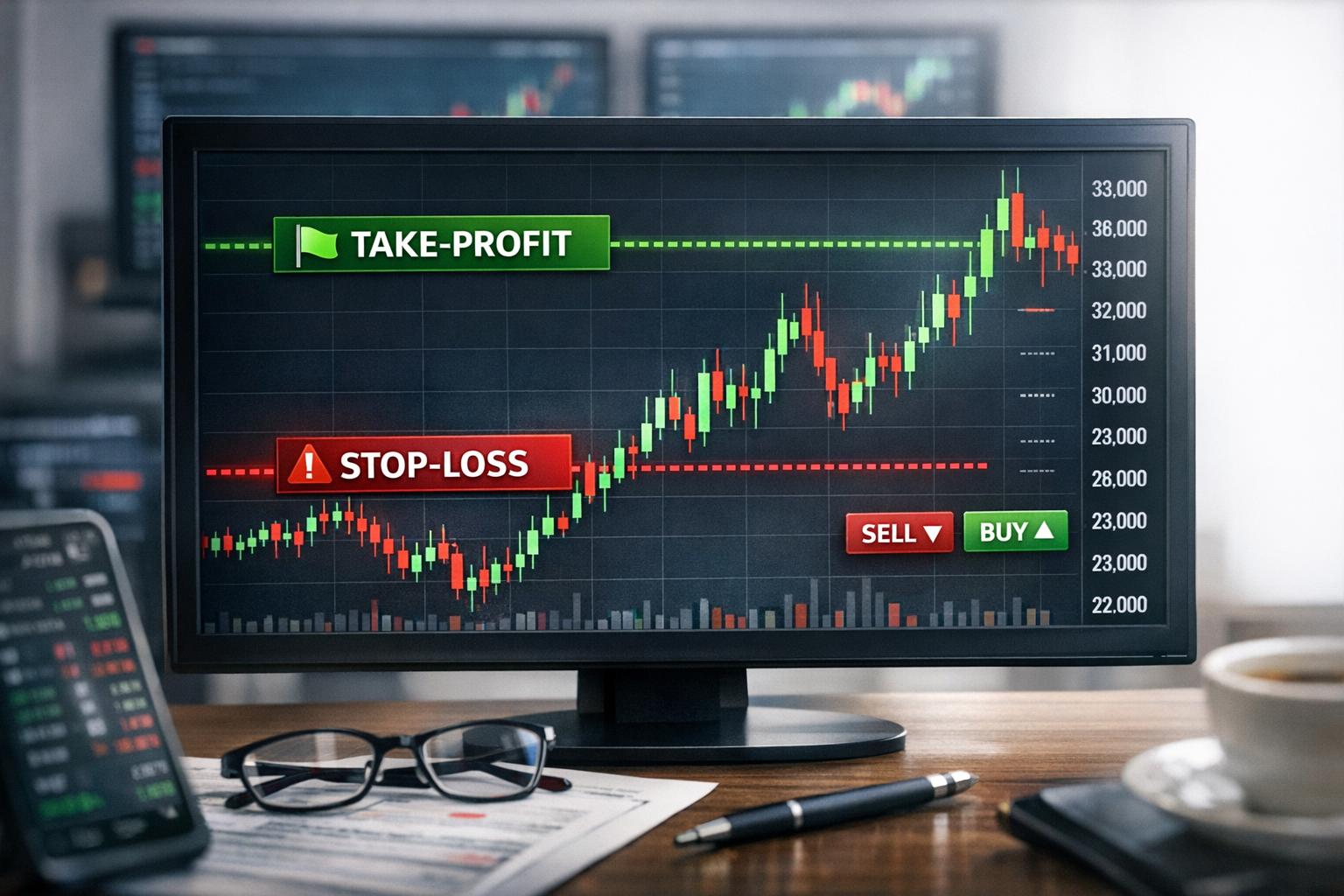
A stop-loss order automatically initiates a sale of a security once it hits a specified price. This mechanism is essential in limiting potential losses in a volatile market environment. But there’s a nuance: in high-volatility stocks, prices can gap past your stop in rare cases, especially around major news. Stops reduce risk, but they don’t magically prevent slippage.

Conversely, a take-profit order secures earnings by selling the stock when it reaches a targeted price level. Take-profit orders help traders avoid the classic trap where a good move turns into a mediocre one because the trader “just wants to see what happens.”

Implementing these automated orders is instrumental in safeguarding a portfolio from extreme volatility that might otherwise lead to detrimental financial consequences. In addition, these orders allow traders to stay consistent without constantly staring at charts every minute of the day. That last part is underrated. Watching tick-by-tick price action often makes people more confident than they should be, right before they do something dumb. (The market has a sense of humor. It just doesn’t laugh with you.)

Staying Updated with Market Events

In volatile stock trading, awareness of current market events and their potential impact on stock movements is indispensable. Economic announcements, political events, and industry-specific developments all influence volatility. Traders who ignore those inputs often wonder why their “perfect technical setup” dissolved the second the news hit.

Traders are advised to keep themselves informed by subscribing to financial news services or using market analysis tools to remain ahead in the dynamic environment. The goal isn’t to react instantly to every headline. The goal is to understand which events are likely to change the stock’s story.

This proactive approach allows traders to make better-timed, informed decisions rather than reacting spontaneously to inaccurate or outdated information. Being informed can open opportunities while also mitigating risks associated with unforeseen events.

A simple approach that works: track the company’s calendar (earnings date, investor day, regulatory milestones), and track the macro calendar (interest rate decisions, inflation releases, jobs report). High-volatility stocks often respond more strongly when the entire market is already shifting.

Volatility Around Earnings: How to Reduce Surprises

Earnings reports are a common catalyst for sharp moves. Even when the company’s fundamentals don’t change dramatically, expectations can reprice quickly. That creates a situation where you can be right about the company long-term, yet still lose money short-term.

To handle this, many traders avoid or plan around earnings dates:

– If you trade momentum, you may wait for the post-earnings reaction to confirm direction.
– If you trade longer swings, you might reduce position size before results.
– If you trade options (not required, but common), implied volatility can help shape expectations.

The overarching theme is planning. If you jump in without considering the event calendar, you’re basically letting the stock pick the trade structure for you.

Liquidity and Spread: The Hidden Volatility

Another underappreciated driver of volatility is trading conditions. A stock with thin liquidity can show exaggerated price swings even if the “true” value hasn’t changed much.

Pay attention to:

– Bid-ask spreads
– Trading volume at your time horizon
– Whether the stock gaps frequently around news

This doesn’t mean you must avoid thinly traded names. It means you should treat them with more respect in your order sizes and execution timing. Sloppy execution is a quiet killer in volatile markets.

Maintaining a Long-Term Perspective

Even though high-volatility stocks often attract short-term traders due to rapid price changes, maintaining a long-term perspective can still be advantageous. Many investors focus on the fundamental growth potential of a company, enabling them to withstand short-term volatility in anticipation of larger gains over time.

Long-term strategies often factor in broader market trends and economic conditions, which could lead to more substantial rewards and reduced stress from daily fluctuations. In other words: if you can hold your nerve, volatility becomes less personal.

Evaluating a company’s competitive advantage, future earnings potential, and market position are critical components of a long-term investment strategy. The idea is to hold through the noise when you have a reason to believe the business will improve relative to expectations.

Two Types of High-Volatility Investors

It can help to separate behavior styles, because they lead to different strategies:

1) The shorter-term trader
They care about price action, catalysts, and technical levels. They may fully exit positions quickly when the thesis breaks.

2) The longer-term investor
They care about business fundamentals, valuation ranges, and whether the company executes. They might tolerate bigger swings because their horizon is different.

You don’t have to pick one forever, but you do have to pick one for each trade you take. Mixed behavior (“I’ll hold for long-term, but I’ll act like a scalp trader”) usually ends badly.

How to Decide Between Trading and Investing

If you’re deciding where you fit, consider these questions:

– Do you understand the company well enough that short-term drops won’t change your view?
– Are you tracking catalysts and technical levels, or only reading fundamentals occasionally?
– Would you be comfortable holding through a major news event that temporarily hurts the price?

If the answer to the first question is “no,” you probably shouldn’t treat it like a long-term hold. If you can’t act with discipline, you probably shouldn’t use a high-volatility trading strategy either. The market punishes wishful thinking.

Practical Strategies for High-Volatility Stocks

Research and risk controls matter, but it’s useful to translate them into repeatable strategies. Below are common approaches used by traders and investors, including how volatility changes their behavior.

Momentum Trades With Defined Risk

Momentum is one of the most common responses to high volatility. When a stock starts trending up or down with strength, traders often jump in. Momentum traders typically look for:

– Breakouts above resistance or breakdowns below support
– Higher relative volume compared to recent trading activity
– Confirmation that the trend persists after initial movement

Risk management still matters. The point of momentum is that it can reverse quickly, especially after catalysts. That’s why stop-loss placement should account for typical daily range, not your personal comfort.

A practical example: suppose a stock usually moves about 3% per day. You might place a stop level that respects that range and avoid tiny stops that guarantee a stop-out on normal fluctuation.

Mean Reversion: Buying the Dip (But Not Anything)

Mean reversion strategies assume that prices can overreact and then partially come back. In high-volatility names, overreactions happen more often—but they don’t always snap back the way you hope.

Mean reversion traders typically look for:

– Pullbacks from prior highs or support tests
– RSI extremes (with caution)
– Signs that selling pressure is weakening

The big risk here is catching a falling knife. A stock can keep dropping if the fundamentals or expectations keep deteriorating. That’s where some fundamental sanity-check helps. If the company is in real trouble, mean reversion might not show up for a while, if ever.

Event-Driven Trading Around Known Catalysts

High-volatility stocks frequently react to known events: earnings, product approvals, regulatory decisions, contract awards, and large partnerships. Event-driven trading tries to profit by positioning ahead of a catalyst or reacting immediately after the market processes the news.

This approach can work, but only if you accept that uncertainty is part of the trade. Even with research, markets can interpret news differently than you expected.

To keep event-driven trading from becoming a coin flip, traders often:

– Compare expectations vs. likely outcomes
– Watch how the stock trades after the release (not just the first print)
– Keep position size smaller than usual due to headline risk

Scaling In and Scaling Out

If volatility is the storm, scaling is the boat steering through it. Instead of putting your entire position on at once, scaling helps reduce the risk of entering at the exact wrong moment.

For example:

– Scale in: take partial position on the first confirmation signal, add if price action holds
– Scale out: take part-profit at a target level and move remaining risk management to protect capital

This can reduce emotional pressure and improve execution. The cost is complexity and the need for a clear plan. If you scale in and then start improvising, you’ll end up with the same old problem: no discipline, just more trades.

Common Mistakes With High-Volatility Stocks

People don’t lose money because they’re stupid. They lose money because they’re human. High-volatility trading turns human habits into expensive habits.

Trading Without a Time Horizon

A volatile stock might move sharply today and then sit still for two weeks. If you don’t define what “success” looks like for your horizon, you’ll keep adjusting your plan mid-trade.

Before entry, decide:

– How long you expect the trade thesis to play out
– When you’ll exit if the move doesn’t happen
– Whether you’re trading momentum, value, or a catalyst

If you can’t answer those, volatility will answer for you.

Using Stops That Don’t Fit the Stock

Stops matter only if they align with typical price movement. A stop that’s too tight often hits “on noise,” not on thesis failure. A stop that’s too wide increases loss size and stress.

One helpful practice: review historical daily ranges and choose stop distances that reflect what the stock usually does. If it routinely swings $2–$3 intraday, you need more than a $0.30 stop to avoid being bounced around.

Ignoring Liquidity When You Enter

If you place large orders in a thin market, you can move the price against yourself. Even if your thesis is correct, execution can ruin your trade. Always consider volume, spreads, and whether your order will fill at reasonable prices.

Letting Winners Become Investors, and Losers Become Hope

This is the emotional version of accounting. Traders often:

– Take profits quickly when things go well
– Hold losers longer because “it has to come back”

In volatile stocks, hope is not a strategy. If the thesis is wrong, the thesis is wrong. Take the loss and live to trade again. Your future self will thank you—probably with fewer gray hairs.

How to Evaluate a High-Volatility Stock Before You Trade It

A good checklist is hard to mess up, and it keeps you from falling into the “I’ll research later” trap.

You can evaluate high-volatility stocks using a blend of business understanding and market structure:

Business Review (Fundamentals)

Focus on whether you understand:

– Revenue and margin stability
– Balance sheet health (debt, cash runway)
– Management credibility and guidance history
– Competitive positioning and realistic growth drivers

If you can’t explain what drives the business in one paragraph, you’re guessing. Volatility amplifies guessing.

Market Review (Technical + Trading Conditions)

Look for:

– Recent price trends and support/resistance levels
– Volume behavior during up and down moves
– Whether the stock’s swings are consistent or random
– Whether there are frequent gaps around headlines

Then choose a strategy that matches these conditions. Momentum rules in strong trends; mean reversion works better when the business isn’t deteriorating and the price action is choppy.

Risk Review (Your Plan)

Before entry, decide:

– Stop-loss level and what invalidates your thesis
– Take-profit targets (or partial profit plan)
– Position size

This is the boring part, but “boring” is how traders stay solvent.

Putting It Together: A Simple Example Scenario

Let’s say you’re watching a volatile technology stock that recently surged after a product update. The daily chart shows big candles, and volume expanded during the move. Meanwhile, the company’s latest earnings show improving gross margins, but guidance is still slightly uncertain.

A disciplined approach might look like this:

– Research: confirm whether the update changes long-term expectations or only short-term excitement
– Technical: identify resistance where price previously stalled and a support zone where sellers might lose control
– Entry: choose a trigger (breakout confirmation or pullback to a level that holds)
– Risk: place a stop-loss far enough to handle normal fluctuations, based on typical range
– Exit: set a take-profit target near the next resistance area, with a plan to reduce exposure if momentum fades

Notice the pattern: you don’t start with “where do I want to buy?” You start with “what would prove I’m wrong?” That one change alone makes volatility feel a lot less personal.

Further Resources for Traders

For further insights into trading strategies and broader financial markets, exploring additional resources from Investopedia and Morningstar is advisable, as these platforms offer a wealth of information and analytical tools tailored to support traders and investors with varying levels of expertise.

The Risks and Rewards of Trading High-Volatility Stocks

The Nature of High-Volatility Stocks

Trading high-volatility stocks means you’re working with securities that move fast—sometimes up, sometimes down, and often before you’ve finished your coffee. The defining feature is simple: these stocks experience rapid and relatively large price swings over short timeframes. That motion can be impressive, but it also introduces a particular set of risks and decision pressures that don’t show up as strongly with slower, steadier stocks.

High-volatility stocks often cluster in specific categories: companies early in their growth phase, firms tied closely to new product cycles, and sectors where public sentiment can swing hard. Technology and biotechnology sometimes fit this pattern, but the cause isn’t limited to “innovative industries.” It’s usually about uncertainty—whether uncertainty comes from earnings expectations, regulatory outcomes, product adoption, funding needs, or competition.

For many traders, the appeal is obvious: when a stock moves a lot, there’s “more room” for profit if you can time entries and exits. For investors who follow longer-term fundamentals, the situation changes: volatility may still exist, but the strategy and time horizon determine whether that movement becomes a manageable feature or a painful problem.

To use volatility instead of getting used by it, you need to understand where it comes from, what it does to your portfolio behavior, and how to manage it without turning every trade into a stressful guessing game.

What “High Volatility” Actually Means (And Why It Matters)

Volatility describes how much the price of a stock varies from day to day. In practical trading terms, high volatility means bigger swings, tighter time windows for decisions, and a higher probability that your position will go against you quickly—sometimes before your thesis has time to play out.

There are a few common ways traders think about volatility:

  • Historical price swings: How wide the price has moved over a recent period.
  • Implied volatility: Often inferred from options prices. This can hint that the market expects larger moves ahead.
  • Liquidity and spreads: A stock can be volatile, but if it also has poor liquidity, your real execution outcomes may be worse than the chart looks.

Notice the last item. Two stocks can both look volatile, but if one has tight spreads and better liquidity, you can often enter and exit closer to the “ideal” prices shown on your platform. The other stock may slip, widen spreads, or cause slippage—turning small mistakes into larger losses.

Common Causes of High Stock Volatility

Volatility rarely appears out of nowhere. It often reflects a specific type of uncertainty, and once you learn to identify that uncertainty, the stock becomes easier to interpret—even when it keeps running wild.

1) Earnings expectations that change fast

For companies where markets fixate on quarterly performance, small changes in guidance can trigger big repricing. If investors think results might be above or below expectations, even modest “beats” or “misses” can lead to exaggerated reactions because the stock has a lot riding on the next report.

Example pattern: a biotech company with a pipeline milestone misses timing by a week. News hits, traders react, and the stock whips around as people reprice probability outcomes.

2) Strategic changes and corporate events

Spinoffs, mergers, major restructuring, management changes, and big partnership announcements can all make a stock more volatile. Some events are inherently uncertain—because the “real” impact takes time—so traders price the future on limited information.

Even when news is positive, markets may interpret it differently. For instance, a company might announce a restructuring that investors view as both a risk and a path to better profitability. That “mixed interpretation” tends to keep prices moving.

3) Sector-specific sentiment and thematic trading

Stocks tied to popular themes—like AI infrastructure, renewable energy, or specific healthcare sub-sectors—can become volatile because traders chase momentum. When sentiment flips, prices can follow quickly. Volatility here isn’t only about company performance; it’s also about crowd behavior.

When a sector gets hot, buyers show up in volume. When the heat cools, the same volume can exit in a hurry. That’s volatility you can feel even without reading every corporate filing.

4) External triggers: rates, politics, macro data

Sometimes it’s not the company at all. Interest rates influence growth-stock valuations, and macroeconomic reports can shift capital flows across entire sectors. Political developments and regulatory actions can also hit sectors with heavy compliance risk—healthcare, finance-adjacent industries, energy, and defense-related systems.

When macro factors hit, even a fundamentally solid company can get repriced because the discount rate changes or sector expectations shift.

5) Liquidity, float size, and trading mechanics

Low float stocks and thinly traded names can show dramatic moves. If fewer shares exist in the hands of active traders, or if order books are shallow, then normal buying and selling pressure can create outsized price changes. That’s not “fundamental volatility,” but it still affects your trading results.

This is why you should always look beyond the chart. A stock can be volatile because it’s truly uncertain—or because the market microstructure makes it seem more dramatic than it “should” be.

Risks Associated with Trading High-Volatility Stocks

High-volatility stocks can present considerable financial risks. The sudden price fluctuations can lead to substantial financial losses if the market moves in an unexpected direction. Investors must be prepared for potential downturns and should only trade with funds they can afford to lose. This aspect underscores the unpredictable nature of these stocks, where gains and losses can occur in rapid succession.

Price risk: your entry is not the end of the story

With volatile stocks, your entry price matters—but so does what happens next. A stock can hit your target intraday and then reverse before you exit. Or it can never “respect” your planned levels because the market is moving too fast. Even experienced traders get caught by rapid reversals.

Because high-volatility stocks can swing widely, a trade can go from “not worried” to “too late” quickly, unless you use clear risk controls.

Emotional strain: the stock starts driving your decisions

Another risk involves emotional strain. The constant price swings may cause stress and lead to impulsive decision-making. Traders should be vigilant and maintain a disciplined approach to avoid succumbing to emotional buying or selling. This emotional volatility can often be as challenging as financial losses, requiring traders to stay calm and stick to their investment strategies even during turbulent times.

In real life, this often looks like staring at candles too long, moving stop-loss levels “just enough” to avoid the shakeout, and then watching the stock keep moving without you. Volatile markets reward discipline more than intuition.

Information risk: noise, rumors, and exaggerated headlines

There’s also the potential for market manipulation. High-volatility stocks are susceptible to being influenced by false information or exaggerated news, often leading to rapid price changes that may not reflect the company’s actual value. In such cases, traders must be cautious about the sources of their information and should always verify news from credible channels. Market manipulation can sometimes lead to inflated stock prices, resulting in bubbles that eventually burst, leaving traders with significant losses.

This doesn’t mean every move is manipulation. But it does mean you should treat sudden rallies or dumps with suspicion—especially if the price movement doesn’t align with verifiable events like earnings releases, filings, or confirmed corporate actions.

Execution risk: spreads and slippage get expensive

High volatility often comes with tighter or wider spreads depending on the name, but for many volatile stocks—especially smaller ones—liquidity may not keep up. That creates execution problems. You might place a limit order at a price that looks good, only to find it doesn’t fill. Or you might trade market orders during a fast move and get a worse fill than expected.

When volatility is high, execution quality becomes part of your strategy. Ignoring it is like “rolling dice” without admitting you’re doing it.

Opportunity cost: volatility can keep you busy without paying

A less talked-about risk is opportunity cost. If your trading capital repeatedly gets trapped in stop-outs or slow reversals, you spend time managing positions that never develop into a real opportunity. Sometimes the best trade is no trade—especially in markets where noise dominates signal.

Rewards of Trading High-Volatility Stocks

For investors willing to manage these risks, trading high-volatility stocks can offer significant rewards. The primary advantage is the potential for high returns. Rapid price movements can turn small investments into substantial profits in a short time, given the right market conditions. Investors with a keen eye for market trends and the ability to make fast, informed decisions can leverage volatility to their advantage.

1) Profit potential scales with movement

Most active trading strategies depend on price movement. High-volatility stocks naturally create that movement. If you can identify momentum shifts or temporary dislocations, the stock’s own behavior can provide the “fuel” for profits.

This is why traders who like charts often like volatile names: the chart has answers more often than on slow days.

2) Frequent setups for active traders

Such stocks also provide opportunities for active traders to capitalize on daily or even hourly price movements. Traders employing strategies like day trading or swing trading might find these stocks particularly appealing due to their frequent and pronounced market action. This active engagement offers traders numerous trading opportunities throughout the day, potentially leading to gains from the ability to accurately predict market directions.

That said, frequency cuts both ways. More setups also mean more chances to make mistakes. The best traders don’t just “trade more.” They trade with rules about when to stop, when to hold, and when to avoid.

3) Learning value: you build risk instincts fast

Additionally, high-volatility stocks can serve as an exciting component of a diverse portfolio, offering experiences and lessons in risk management and market dynamics. By including these stocks in a broader investment strategy, traders can benefit from the dual potential for excitement and significant returns, while still maintaining exposure to other, more stable investments.

If you’ve ever managed risk on a calm market, you already know it’s easier. High-volatility stocks teach urgency and clarity—useful skills if you intend to trade other instruments later.

4) Hedge behavior and correlations (sometimes helpful)

Volatile stocks can also help with hedging behavior depending on correlations. For example, some sectors may react differently to macro news than others. If you manage exposure carefully, volatility can help you balance the overall portfolio rather than just “take more risk.”

This requires monitoring, not guessing. Still, it’s worth noting that volatility doesn’t always equal pure chaos; sometimes it adds perspective to risk exposure across asset classes.

Strategies to Mitigate Risks

To successfully navigate the risky waters of high-volatility stocks, traders should employ sound strategies. One reason many traders get hurt is that they treat volatility like a thing you can “outsmart” rather than like a condition you must control.

Here are practical approaches you can apply consistently.

Use strict stop-loss orders (and honor them)

One such approach is setting strict stop-loss orders to limit potential losses. This practice involves selling the stock if it drops to a predetermined price, thereby preventing further financial damage. It acts as a safeguard, enabling traders to predefine acceptable levels of risk and ensuring that they do not hold onto losing positions longer than necessary.

In high-volatility names, stop-loss placement matters. If you set stops too tight, normal price noise knocks you out. If you set them too wide, the position can become damage-heavy. The solution isn’t “pick a number and pray.” The solution is to align stop distance with the stock’s typical movement and your timeframe.

A common mistake: using the same stop width for a stock that moves 3% per day and a stock that moves 20% per day. The chart might look similar, but the behavior isn’t. Your risk model should reflect that.

Position sizing: treat volatility like a volume knob

Stop-loss orders help, but sizing often determines whether you survive long enough to benefit from winning trades. For high-volatility stocks, sizing should generally reduce risk per trade. Many traders do this instinctively, but it helps to make it explicit.

For example, if a stock can move sharply against you within minutes, then your maximum loss should be small enough that you can still trade confidently afterward. If one loss ruins your next week, your sizing is too aggressive.

Conduct thorough research and analysis

Another key strategy is conducting thorough research and analysis. Traders should scrutinize the driving factors behind a stock’s volatility, such as company news, earnings reports, or industry trends, to make more informed decisions. Understanding the reasons for volatility allows investors to anticipate possible price movements and react appropriately.

Research doesn’t only mean reading filings (though those matter). It also includes understanding the “market story.” Ask: what is the market currently expecting, and what would disprove that expectation? Volatility tends to spike when expectations are crowded or when the market lacks clear information.

Build a simple “event calendar” for volatile names

A big chunk of volatility comes from known dates: earnings reports, FDA decisions, investor conferences, major economic releases, and regulatory announcements. A simple calendar can prevent accidental trading during times when your usual stop logic won’t hold.

Example: if you hold a position through an earnings report, your stop-loss order may not protect you fully if the gap opens beyond your stop. That’s not the stop’s fault; it’s just how markets behave around major events.

So if you trade around events, either reduce position size and accept gaps, or avoid holding through certain dates. Both approaches can be valid. What’s not valid is pretending event risk doesn’t exist.

Diversify to spread risk

It’s also advisable to maintain a diversified portfolio to spread risk. By not putting all financial resources into high-volatility stocks, traders can cushion potential losses with more stable investments. Diversification not only helps in distributing risk but also opens up multiple avenues for gains across different market conditions.

Diversification doesn’t mean buying five volatile stocks that all react to the same macro theme. It means spreading risk across different drivers. One approach: mix volatile names with more stable holdings, and also vary the catalysts—some trade on company performance, others trade on different sector influences.

Set rules for trade frequency and “no-trade” days

Regular activity is helpful for some traders, but forced trading is a great way to hemorrhage money. Many volatile environments produce plenty of noise, especially around the open or during major news windows. If your rules don’t say anything about when to slow down, you’ll start trading every twitch in the chart.

Try this: define in advance what market conditions justify a trade and what conditions don’t. If conditions don’t meet your criteria, step aside. That’s not laziness; it’s risk management with better branding.

Review trades and adjust based on outcomes

Moreover, engaging in regular market review sessions and adjusting strategies based on current insights can further mitigate risks. Being informed about macroeconomic factors, such as interest rates and geopolitical issues, plays a critical role in anticipating market trends. Investors should also be willing to adapt, continuously learning from past trades and refining their approach based on experience and feedback from the market.

Reviewing isn’t just about “what did I get wrong.” It’s also about what your strategy expects versus what actually happened. Did you enter before confirmation? Were your stops placed correctly? Did you follow your thesis, or did price action drag you into a new narrative?

Use volatility-aware tools (without turning them into a religion)

Some traders use measures like average true range (ATR), moving average bands, or options-implied volatility to calibrate expectations. These tools can help you set more realistic targets and stops, especially for swing trading.

The danger is overcomplication. If you can’t explain how the tool affects your actual decision, it’s too complex. You don’t need an advanced degree; you need consistent discipline and an honest risk plan.

Risk Management Framework for High-Volatility Trading

If you want a practical way to approach high-volatility trading, build it like a checklist. Not the “tick every box” kind, but the “know what matters most” kind.

1) Decide your timeframe before you choose the stock

Short-term traders and longer-term investors look at volatility differently. If you’re planning to hold for days or weeks, you can sometimes tolerate daily swings as long as your thesis remains intact. If you’re day trading, volatility dictates tighter execution rules and clearer exits.

Match your approach to your intention. Otherwise, you’ll end up arguing with your own plan all day.

2) Predefine your max loss per trade

Serious traders don’t ask, “Will I lose?” They ask, “What’s the maximum loss I can take and still sleep at night?”

Define a number you will not exceed, then place stops and size positions accordingly. High volatility means losses can come quickly, so the system needs to work even under stress.

3) Plan your exit before you enter

Exit planning sometimes gets skipped because traders focus on entry timing. In reality, exits determine your long-term results. Decide where you’ll take profit, where you’ll cut back, and whether you’ll use partial exits.

For volatile stocks, partial exits can reduce emotional pressure. If the stock runs hard and you take some profit early, you’re less likely to watch a winner turn into a regret.

4) Watch liquidity and execution quality

Before you trade, check the liquidity profile: average volume, spread, and how easily you can fill your orders. A strategy that looks profitable on paper can fail in real markets if fills are consistently bad.

In very volatile names, the order book can change fast. You may need to use limit orders rather than market orders, or reduce order size to improve fills.

5) Understand event risk and gap behavior

Stops don’t fully protect you through gaps. If you hold a position through earnings, regulatory decisions, or major announcements, gap risk enters the picture. Gap risk means the opening price can be far from the previous close—so your stop triggers at the next available price, not the exact level you selected.

You have three choices: reduce size, avoid holding through events, or accept that stop protection is partial. Either way, be honest about what can happen.

How to Identify High-Volatility Stocks Without Guessing

If you want to trade volatility, you still need to identify it systematically. “This stock looks wild today” isn’t a method—it’s just a mood.

Look for volatility signals in basic data

You don’t need to be a quant to spot volatility traits. Start with:

  • Large average daily range compared to similar stocks
  • Frequent gaps or strong intraday reversals
  • High sensitivity to news (price reacts dramatically to headlines)
  • Trends in volume, especially around events

Then confirm liquidity. A high-volatility chart with excellent liquidity is a different trading animal than a high-volatility chart with thin trading.

Map price movement to real catalysts

A helpful habit: every time the stock makes a big move, ask what caused it. Over time, you’ll notice patterns: moves around earnings, moves after regulatory headlines, moves in response to sector news. When you can connect movement to catalysts, you reduce the guesswork.

If the stock moves wildly without any identifiable catalyst, take extra care. That behavior can be rumor-driven, flow-driven, or manipulation-adjacent. It doesn’t automatically mean “danger,” but it does mean “treat with respect and verify.”

Use watchlists rather than impulse trades

Many traders build watchlists and scan them for setups rather than jumping into trades instantly. For volatile stocks, this reduces impulsive entries. You’re letting information catch up to price—rather than letting price bully you into clicking buy.

Trading Tactics That Work Better in Volatile Markets

High-volatility stocks can support many styles, but the ones that succeed usually match volatility behavior rather than fighting it.

Momentum strategies: ride the move, not the wish

Some traders follow momentum setups—buying breakouts with confirmation and selling breakdowns or trailing stops. In volatile markets, momentum can persist longer than expected, especially when news trends or sector sentiment stays consistent.

The risk is chasing exhausted moves. So momentum tactics work best when you build exit rules and avoid holding blindly after the move shows signs of weakening.

Mean reversion: only when the market conditions make sense

Other traders look for temporary overreactions. In volatile stocks, price sometimes snaps back toward prior levels after an emotional headline. Mean reversion can work—but it’s risky when the underlying uncertainty remains unresolved.

If the catalyst causing the move still hasn’t changed, the “bounce” might never come. So mean reversion works best when you can explain why the move should normalize.

Range trading: useful if the stock trades in bands

Some volatile stocks don’t trend continuously. They chop in ranges, bouncing between support and resistance. In those cases, range trading can be viable, especially for swing traders who don’t need the big move.

Again, confirmation matters. If the range breaks, the strategy should shift or stop.

Options-based approaches: extra caution, extra complexity

Options can sometimes help control risk—especially when you limit downside using defined-risk strategies. But options also introduce additional variables: implied volatility, time decay, and contract liquidity.

If you’re not already comfortable with options, it usually pays to start with stock trading and only add options later once you can explain how the trade thesis affects option pricing.

Common Mistakes People Make With High-Volatility Stocks

Even traders who are competent in calmer conditions can stumble in high volatility. Here are a few classic problems:

Confusing volatility with opportunity

Volatility creates movement, but movement doesn’t always create profit. You still need an edge: better timing, better information, or a better risk plan.

Ignoring liquidity

If a stock has wide spreads or inconsistent fills, your actual entry and exit quality can differ massively from the backtest or the chart. That can turn a “good” trade into a mediocre one.

Using stops that are too tight

Some traders set stops based on emotion (“I’ll just lose 2%”) rather than on the stock’s typical movement. Tight stops on volatile names get hit by normal noise and create repeated losses.

Holding through events without a plan

Earnings and regulatory decisions can cause gaps. If you hold anyway, size accordingly and understand that stops may not work as expected.

Switching strategies mid-trade

High volatility tempts traders into reinterpreting the chart. “It should come back” becomes a justification, not a strategy. Your plan needs to survive being wrong in the short term.

Building a Balanced Portfolio Around Volatile Names

Not every traders’ goal is to go all-in on volatility. Many people want to include volatile stocks for growth potential while keeping the overall portfolio stable enough to handle drawdowns. The trick is to define what “stable” means for you and then size accordingly.

Use stable holdings to reduce stress

A stable base portfolio can help you avoid impulsive selling when volatility spikes. It also makes it easier to stick to your rules because you’re not treating every dip as a disaster.

Limit concentration in high-volatility positions

Even if a stock is a great candidate, concentration risk remains. A single volatile position can dominate your results if it’s too large relative to your portfolio.

Many traders set a maximum percentage per position and then cap the total percentage exposed to high volatility. That prevents a cluster of “bad luck entries” during one chaotic period from damaging everything at once.

Review correlation, not only performance

Two volatile stocks can both look strong in certain periods, but they might fail together when the same macro factor hits. If you’re mixing volatile names, check how they move relative to your other holdings and relative to each other.

This matters because diversification works best when risks aren’t all triggered by the same event.

Conclusion

While trading high-volatility stocks carries inherent risks, it can also provide substantial rewards for informed and disciplined investors. By understanding the stock’s nature, analyzing the drivers behind its movement, and employing risk mitigation strategies, traders can capitalize on opportunities while minimizing potential losses. Balancing confidence with caution matters here—because in volatile markets, bold without structure tends to become expensive fast.

For more insights on managing portfolio risks effectively, consider exploring trusted financial advisory services or educational resources to enhance your trading acumen. Continuous learning and adaptation are vital in the ever-evolving financial markets. As the market continues to react to new information—whether it’s earnings, regulation, or macroeconomic shifts—building a resilient approach helps you stay in control, even when the price action tries to steal the steering wheel.

Why Do Some Stocks Have Higher Volatility Than Others?

Understanding Stock Volatility

Stock market volatility is one of those terms people toss around like it’s self-explanatory. It’s not. If you invest for long enough—or trade often enough—you’ll notice that some stocks move like a calm pond, while others look like they’re trying to qualify for a roller coaster ride. Volatility is the reason for that difference, and understanding it helps you avoid the classic mistake: confusing “a good company” with “a comfortable stock.”

At its simplest, volatility is the degree of variation in the price of a financial instrument over time. When prices swing a lot, volatility is high. When prices move steadily, volatility is lower. For investors, volatility matters because it acts like a measure of uncertainty. Higher volatility usually means higher risk of losses in the short term, even if the company is solid. The tricky part is that volatility also creates opportunity—sometimes for gains, sometimes for pain, depending on what you do with it.

Volatility vs. Risk: They’re Related, Not Identical

People often treat volatility and risk as the same thing. They’re not.

– Volatility describes how much prices change, generally over a set period.
– Risk is about the chance and severity of losing money relative to your goals.

A stock can be volatile but still trend upward over years. Another stock might show lower short-term volatility but still drop meaningfully during a market regime change. So, volatility is a useful “temperature check” for uncertainty, but you still need to consider fundamentals, time horizon, and portfolio construction.

If you’ve ever watched an “almost good” stock keep sliding while you held out hope, you already learned that volatility can test patience. That’s why investors treat volatility as both a warning signal and, in some strategies, a trading tool.

How Volatility Shows Up in Real Pricing

Volatility doesn’t only show as dramatic single-day moves. It often shows up as patterns like:
– wider swings between daily highs and lows,
– more frequent sharp reversals,
– larger gaps around major news (earnings, guidance changes, lawsuits),
– faster reactions to macro headlines (rates, inflation, employment data).

Even if the long-term story looks unchanged, the path the price takes can be rocky. That path matters for anyone who might need to sell before the “long term” arrives.

Factors Influencing Stock Volatility

Several factors contribute to the volatility of stocks, each adding its own layer of complexity to market dynamics. Below, we delve into these various elements:

1. Company Size and Market Capitalization: One of the primary factors affecting stock volatility is the size of the company, often represented by its market capitalization. Small-cap stocks, which belong to smaller companies, tend to exhibit higher volatility. This increased volatility can be attributed to their generally lower trading volumes and greater sensitivity to market sentiment. When there’s less trading activity, the price has fewer “anchors,” so a modest amount of buying or selling can move the stock more than you’d expect.

Small caps can also face bigger uncertainty around growth, profitability, funding needs, and customer concentration. Investors may change their minds quickly because the stakes feel higher and the information flow can be less consistent. In plain terms: if the company is still proving itself, the stock may react more dramatically when new data lands—good or bad.

On the other hand, large-cap stocks, typically representing more established companies, often experience less volatility due to their stability and more extensive trading volumes. Large companies usually have:
– more analysts covering them,
– broader investor ownership,
– deeper liquidity support,
– more stable revenue streams.

That doesn’t make large caps immune to big moves, but it often makes their day-to-day price changes less wild.

2. Industry Sector: The industry sector within which a company operates is another critical determinant of its stock’s volatility. For instance, stocks in the technology or biotechnology sectors are frequently more volatile owing to their exposure to rapid innovation cycles and regulatory hurdles. These industries are characterized by constant change and advancement, making them inherently risky. A single news item—like a trial result, product delay, or regulatory decision—can reprice expectations fast.

Biotech is a particularly good example of volatility driven by “event risk.” Clinical trial results and FDA decisions can shift a company’s perceived odds overnight. That kind of “binary-ish” outcome tends to produce big swings.

Conversely, utility companies, which generally have stable demand and operate under regulated pricing structures, often experience lower volatility. Their stability makes them less susceptible to frequent price swings. Utilities may still move when interest rates shift, but their fundamental cash flows often change slowly compared with sectors driven by rapid R&D outcomes.

3. Economic Factors: Macro-economic conditions play a significant role in affecting stock volatility. Various economic factors, such as interest rates, inflation rates, and the overall economic climate, can have a profound impact on stock prices. Stocks in sectors that are particularly sensitive to economic conditions, such as consumer discretionary and financial services, often display more volatility during economic downturns.

When the economy softens, consumers cut spending, credit standards tighten, and earnings assumptions get revised. Financial services can also react to shifts in loan demand, net interest margins, and default rates. Because these changes ripple quickly through expectations, stocks tied to them often swing more than defensive sectors.

Economic news can also change the market’s “discount rate”—the interest rate investors use mentally when deciding what future profits are worth today. When discount rates move, growth assumptions can be repriced quickly, especially for companies with far-dated earnings potential.

Market Sentiment and Speculation

Market sentiment is another powerful force that drives stock volatility. The collective mood and perception of investors can cause stock prices to rise or fall unpredictably, especially in stocks with a high degree of speculative interest. In other words: sometimes the stock reflects what traders think will happen next, not what the business is doing right now.

This phenomenon is often observed during news releases, earnings reports, or unforeseen geopolitical events. The value of a stock can fluctuate dramatically, sometimes irrespective of the company’s actual performance. A company might beat earnings but still drop if guidance disappoints. Or it might miss slightly yet surge if investors interpret the miss as temporary.

A useful measure of a stock’s sensitivity to market movements is its beta value. A high beta value typically indicates a stock that is more volatile than the market, making it exceedingly reactive to market sentiment and speculation. Beta isn’t magic, but it’s a handy starting point for understanding whether a stock tends to amplify broader market moves.

There’s also a behavioral side. Markets can overreact—sometimes to headlines, sometimes to momentum. When enough traders pile in, the move can intensify. Later, when reality reasserts itself, the price can reverse sharply, which is another way volatility shows up.

Liquidity and Trading Volume

Liquidity, defined as the ease with which a stock can be bought or sold without significantly impacting its price, is another factor that influences stock volatility. Stocks with low trading volumes often experience sharp price changes when large orders are placed. It’s similar to trying to move a boat in shallow water: small pushes matter a lot.

If there are few shares changing hands, a relatively modest order can clear available liquidity at one price and jump the next available trade to a different level. That creates volatility that isn’t necessarily “about” the company—sometimes it’s about market mechanics.

In contrast, stocks that are highly liquid, i.e., those that trade in large volumes without substantial price variation, tend to have more moderated price movements. Liquidity tends to act like shock absorbers. Many buyers and sellers mean prices adjust gradually rather than jumping.

Another practical detail for investors: low liquidity can also increase trading costs via wider bid-ask spreads. Those costs can bite into returns, particularly for shorter-term strategies. Even long-term investors sometimes forget that liquidity affects what you actually pay when you enter and exit a position.

Government and Regulatory Impact

The role of government and regulatory bodies cannot be underestimated when considering stock volatility. Changes in government policy, taxation, tariffs, or new regulatory measures can introduce uncertainty into the market, thereby affecting stock prices. When such changes occur, investors often reassess the future prospects of companies impacted by these policies, leading to fluctuating stock prices.

In some sectors, regulatory outcomes determine business viability more than typical business performance metrics. For example, legislation affecting healthcare coverage, emissions standards, or data privacy can materially change revenue expectations. The market reacts because earnings forecasts get revised quickly, and traders position themselves around those revised expectations.

Staying informed about government policies and potential regulatory changes is essential for anticipating potential volatility. You don’t need to read every law document, but you should track reputable summaries and understand which sectors tend to be most sensitive to policy changes.

How Volatility Gets Measured (Without the Math Headache)

Volatility can be measured in different ways, and you don’t need to become a quant to use it intelligently. The most common idea behind measuring volatility is simple: how much did price vary over a period?

Traders and analysts often use metrics such as:
– standard deviation of returns (a statistical measure of spread),
– implied volatility (a market-based expectation extracted from options prices),
– beta (how much a stock tends to move relative to the overall market),
– average true range (ATR), which looks at price movement ranges.

Implied volatility is worth a short explanation because it’s often misunderstood. It’s “implied” by option prices. Options markets price in expected future variability. So, when implied volatility rises, it usually reflects expectation of bigger moves ahead—often around earnings or major decision dates.

This matters because implied volatility can increase even if historical volatility hasn’t changed much. The market may be pricing upcoming uncertainty. If you’ve ever seen an options-based strategy react to a headline before the stock really moves, that’s the idea in action.

Why Some Stocks Stay Volatile for Years

Many investors expect volatility to fade once uncertainty clears. Sometimes it does. Sometimes it doesn’t, because volatility can be structural rather than temporary.

A stock can remain volatile because:
– its business model has inherently variable results (commodity exposure, royalties, ad cycles),
– it relies on ongoing catalysts (product launches, trials, renewals),
– it operates with uncertain margins or funding needs,
– the investor base is heavily momentum-driven,
– the company is still in a “storytelling” stage (the market is pricing growth probabilities rather than present profits).

So, a biotech stock isn’t volatile only because of one trial. It’s volatile because the market is always waiting for the next binary event. A high-growth tech stock can be volatile because expectations for future growth are constantly shifting.

Volatility and Market Regimes

Volatility doesn’t behave the same way in every market environment. In calm periods, dispersion between stocks may be lower—everyone’s pretty relaxed. In stressed periods, volatility can rise across the board.

That doesn’t mean every stock becomes equally volatile. It means correlations increase: stocks start moving together more often, and the diversification benefits of holding many stocks can shrink. If that sounds like an unpleasant time to need your portfolio to behave predictably, well—yes.

During risk-off regimes, investors tend to:
– reduce exposure to uncertain future cash flows,
– sell speculative names first,
– demand higher risk premiums,
– reassess liquidity needs.

High-volatility stocks can drop harder because they’re often valued more on expectations than on current stable earnings. Even if a company’s fundamentals don’t change much overnight, sentiment changes can hit the stock price immediately.

Practical Examples: How Volatility Affects Decisions

Let’s make this concrete. Suppose you’re evaluating two stocks in different ways—one is a large, established consumer brand, the other is a smaller growth company in a developing market.

Example 1: Holding period mismatch
You plan to sell within three months to fund something real (a home down payment, maybe). The growth company has high historical volatility. Even if you think the long-term thesis is decent, you risk being forced to sell during a dip. The consumer brand may also decline, but your chance of “getting lucky” on timing changes.

Example 2: Earnings calendar risk
You invest right before earnings because you “feel” comfortable with the story. If implied volatility spikes due to the upcoming report, option prices reflect the expectation of a big move. If you’re holding shares, the stock can still do what the market expects: sharply up or down. Volatility means you must be honest about what happens if the price moves against you.

Example 3: Liquidity traps
You buy a smaller stock that fits your thesis, but trading in it is thin. On a bad day, you want to exit, but the spread widens and the price jumps. That increases your real-world cost. Volatility isn’t just a graph trend; it can affect execution.

These scenarios are why experienced investors don’t just ask “Will the company succeed?” They also ask “How will the stock behave while I wait?”

How Investors Can Approach Volatile Stocks

Some people react to volatility by doing extreme things: either panic-selling at the first wobble or buying aggressively because the price is “cheap.” Neither approach works consistently.

A better approach is to match your strategy to volatility:

1) Align your time horizon with the stock’s behavior

If the stock tends to swing wildly, your time horizon should often be longer. A long horizon gives volatility less power over your decisions. For shorter horizons, you need a plan for what happens if the stock moves against you.

2) Use position sizing as a risk control tool

Even a high-quality company can produce ugly short-term price action. Position sizing limits the damage if volatility causes a drawdown. Many investors accidentally size positions based on conviction alone. Liquidity and volatility deserve a seat at that table too.

3) Watch volatility signals around events

Earnings, guidance updates, regulatory deadlines, and major macro data can increase volatility. If you know a catalyst is coming, you can avoid making emotional decisions during the volatility spike. Sometimes the best move is waiting a bit rather than “pressing the button.”

4) Compare volatility with fundamentals, not vibes

Volatility without explanation is noise. Volatility with a driver—like regulation, commodity prices, or product trial outcomes—can be understood and accounted for. If you can’t articulate why a stock is volatile, you’re relying on guesswork.

Common Misconceptions About Stock Volatility

Let’s clear up a few recurring myths.

“High volatility always means a bad stock.”
No. Some great companies remain volatile because the market is pricing uncertainty or future growth. High volatility can also mean there are frequent opportunities to buy and sell with good discipline.

“Low volatility means safety.”
Low volatility doesn’t guarantee low risk. A stock can be stable day-to-day and still drop meaningfully due to a fundamental break, earnings collapse, or a shift in investor perception. It just may not look dramatic in the daily chart until it does.

“Volatility is random.”
Not really. Volatility has causes—company-specific catalysts, sector dynamics, macro sensitivity, liquidity conditions, and sentiment. Sometimes those causes are hard to predict, but the pattern usually has structure.

“Beta tells the whole story.”
Beta can help, but it focuses on market-relative movement. It doesn’t fully capture company-specific risk, liquidity concerns, or event-driven volatility. Use it as one input, not the decision-maker.

How to Monitor Volatility Over Time

Volatility isn’t fixed forever. A stock that’s been calm can suddenly get jumpy after a leadership change, a new product cycle, or a regulatory problem. Meanwhile, a historically volatile stock can quiet down if uncertainties clear.

A sensible monitoring approach includes:
– reviewing how volatility changes around earnings,
– tracking whether liquidity improves or worsens,
– comparing implied volatility versus historical volatility when options data is available,
– watching for regime changes in the overall market.

You don’t need to build a surveillance room. But you do need to notice trends. If you keep treating volatility as “something that just happens,” you’ll miss when it starts behaving differently.

Where Volatility Matters Most for Different Types of Investors

Different investors feel volatility differently.

Long-term investors

For long-term investors, volatility affects:
– entry timing and whether you accumulate through dips,
– emotional endurance (yes, really),
– whether you stick to your plan when prices move fast.

Long-term doesn’t mean you ignore volatility. It means you handle it via timing, diversification, and patience.

Short-term traders

For traders, volatility isn’t just risk—it’s the “product.” They often rely on volatility forecasts, option pricing, and price movement ranges to plan entries and exits. Still, their main enemy is trying to predict direction without respecting volatility behavior.

Income-focused investors

Income investors—those who prioritize dividends or interest-like returns—need to watch how volatility affects:
– payout safety and capital preservation,
– total return (price changes can overpower dividend income),
– refinancing risk for certain sectors.

A dividend that looks fine might still be threatened if volatility reflects deteriorating financial health. So, check fundamentals, not only the yield.

Risk Management for Volatile Markets (Practical and Not Too Fancy)

There’s a temptation to believe that risk management requires complex models. Sometimes it does, but for many investors, the basics work surprisingly well.

Consider these practical habits:
– Have a plan for what price movement would make you reconsider your thesis.
– Avoid tying all decisions to one information update.
– Keep enough liquidity (cash or liquid holdings) so you’re not forced to sell during a volatility spike.
– Diversify so a single volatile position doesn’t dominate your outcomes.

If you’ve ever had to sell at the worst time, you already know why liquidity and planning matter. Volatility punishes improvisation.

Staying Informed Without Losing Your Mind

Because volatility often responds to news, it can feel like the market is constantly shouting. The solution isn’t to watch endless feeds until you’re exhausted. It’s to track the specific drivers that matter for the stocks you own or follow.

For many investors, that means knowing:
– the company’s upcoming catalysts (earnings, trials, regulatory dates),
– which macro factors tend to move the stock or sector,
– whether sentiment has shifted due to changes in guidance or fundamentals.

Financial news sources and research reports can help here. If you’re uncertain, speaking with an experienced financial advisor can also provide structure. Not everyone needs that step, but it can reduce costly misinterpretations—especially around earnings and headline-driven volatility.

Looking Back at Volatility: What You Learn After the Fact

Volatility always looks more intense once you’ve lived through it a few times. You start noticing patterns, like how certain sectors react faster, how liquidity changes during stress, and how sentiment can override fundamentals for short bursts.

That experience is useful. It makes you more disciplined about what belongs in your decision process:
– fundamentals for the long-run picture,
– volatility for the timing and risk picture,
– and your own temperament for whether you’ll actually follow your plan.

Closing Thoughts on Understanding Stock Volatility

Understanding these diverse factors is crucial for investors who aim to handle volatility rather than fear it. By being aware of what drives volatility, investors can make more informed decisions about which stocks to include in their portfolios. It is also important for investors to assess their own risk tolerance and investment goals while dealing with volatile markets.

For those who want more detailed insights and strategies, consulting reputable financial news sources or engaging with experienced financial advisors can provide valuable guidance. And if nothing else, remember this: markets don’t owe you a smooth ride. The investors who do well around volatility are usually the ones who plan for the bumps.

How to Identify High-Volatility Stocks in the Market

Understanding Stock Volatility

If you’ve ever watched a stock chart swing like a playground pendulum, you already have a feel for what investors mean by volatility. In finance, volatility is the degree of variation in a stock’s trading price over a given period. It’s essentially a way to describe how quickly and how much prices move up or down. Some stocks wobble gently. Others jump at shadows—sometimes because real news hits, sometimes because traders get jumpy. Either way, the movement matters.

Volatility isn’t just trivia for day traders. It affects long-term investors too: it influences risk management, position sizing, portfolio behavior, and the emotional “comfort level” of holding an investment that can drop 8% in a week and shrug it off like nothing happened (or not). Understanding volatility helps you make more consistent decisions instead of reacting to the last headline.

In the practical sense, high-volatility stocks are those with prices that change dramatically, often within short windows. That can mean higher upside—but it also means higher downside and bigger swings in between. Treat them like fast cars: fun, but you should know what you’re doing with the brakes.

A Clear Definition: What Volatility Actually Measures

Volatility measures variability. More formally, it’s often tied to the dispersion of returns. When investors talk about volatility, they usually mean one of two things:

1) Historical volatility: How much the stock’s price actually moved in the past.
2) Implied volatility: What options prices suggest about future movement (more on this later).

Both forms help answer slightly different questions. Historical volatility answers “How wild has this stock been?” Implied volatility answers “How wild do traders expect it to be?” Each one can support decisions, but neither one is a crystal ball.

Why High Volatility Gets Attention (Good and Bad)

High-volatility stocks often show up in trading conversations for a simple reason: movement creates opportunity. If a stock travels further and faster, there are more chances to buy low and sell high (or at least to trade around a thesis). But the same movement also increases the probability of surprises hurting your timeline.

Here’s the tradeoff in plain English:

  • Potential upside: Faster price increases can reward momentum or growth theses.
  • Potential downside: Price drops can accelerate, especially when sentiment flips.
  • Higher uncertainty: Volatile stocks often respond strongly to new information.
  • Behavioral risk: Big swings can make investors change plans midstream (and not in a good way).

A common real-world scenario: someone buys a “hot” stock after a strong move, thinking they’re early. It drops 15% the next month due to earnings guidance or macro news. If they panic-sell, they lock in losses they could have potentially managed better with volatility-aware planning.

Key Indicators of Volatility

Identifying high-volatility stocks efficiently usually means combining more than one metric. Volatility is a behavior, and like most behaviors, it has multiple angles. Below are metrics investors and traders commonly rely on.

One of the primary metrics employed in gauging volatility is the beta coefficient. The beta coefficient measures a stock’s volatility relative to the overall market performance (often the S&P 500 or another benchmark). A stock with a beta greater than 1 tends to move more than the market; less than 1 suggests it moves less. Beta doesn’t tell you everything about day-to-day swings, but it does help answer a practical question: if the market shudders, how much does this stock wobble?

Another critical indicator is the Average True Range (ATR), a technical analysis tool that quantifies market volatility in terms of price movement range. ATR looks at the “true range” of each period (which accounts for gaps and limits of simple high-low calculations) and then averages those ranges over a set interval. Traders use ATR to estimate how large a move might reasonably be, which can help in setting stop-loss levels or choosing position sizes. If ATR is rising, the stock is generally becoming more “active” in how prices move.

Moreover, analyzing historical volatility provides critical insights into a stock’s price movement over time. Historical volatility examines price data from the past to estimate how volatile the stock’s returns have been. Investors can use it to see whether a stock typically swings widely or whether it’s only volatile due to temporary shocks.

If you’re comparing stocks, keep an eye on the time window. A stock may be calm over a 1-month period but wild over 1 year, or vice versa. Choosing the wrong window can lead to a misleading “volatility story.”

Volatility vs. Risk: Not the Same Thing, But They Talk a Lot

People often mix up volatility with risk. Volatility is a measure of variability. Risk is broader. A stock can be volatile but still not terribly risky if the volatility is mostly upward with a predictable pattern—rare, but it happens. More commonly, high volatility indicates higher uncertainty and that typically increases risk.

One useful mental model: volatility explains how much prices move. Risk often explains what that movement means for your goals. A long-term investor may tolerate volatility better than someone who needs the money in six months. That’s not finance jargon—that’s basic calendar math.

Market Conditions and Stock Volatility

Stock volatility doesn’t live in a vacuum. It’s closely tied to broader market conditions and external events. Economic data releases, interest rate expectations, credit concerns, earnings seasons, and geopolitical tensions all work like turbulence in the background. When the market’s mood changes, prices tend to move more—not always because fundamentals changed overnight, but because expectations did.

Investors choosing to handle high-volatility stocks typically need a steady stream of information. They rely on financial news sources, trading platforms, and market analysis tools to track both macro events and company-specific developments. It’s not about obsessing every minute (unless you enjoy doing that). It’s about ensuring you understand the “why” behind big price moves, because the reason often matters for what happens next.

What Actually Drives Volatility

Volatility is usually driven by the flow of information and how uncertain the market feels. Common drivers include:

  • Earnings and guidance: Misses and raises can trigger sharp repricing.
  • Liquidity changes: Thinly traded stocks can swing more, especially during stress.
  • Macro data: Jobs reports, inflation prints, and rate expectations move the discount rate and risk appetite.
  • Sector rotation: When markets rotate into or out of certain industries, volatility may spike.
  • Sentiment shifts: Even without major fundamental changes, fear or hype can move prices quickly.

A small, practical example: a biotech stock might be calm most of the time, then volatility spikes around trial results. The swing isn’t random—it’s the market re-pricing uncertainty after new data.

Volatility Clustering: When Wild Days Tend to Breed Wild Days

One pattern traders often notice is volatility clustering. After a period of high volatility, another period of high volatility often follows, and the same goes for low volatility stretches. This doesn’t mean it’s forever. It simply means volatility has persistence. If your stock chart suddenly becomes jumpy, don’t assume it will immediately fall back to “normal” within a day or two.

Tools to Identify High-Volatility Stocks

To build a watchlist of high-volatility stocks, you need a way to screen. That’s where tools come in. The goal isn’t to press every button and hope. It’s to filter candidates using metrics that reflect your time horizon and style.

Stock screeners are among the most widely used analytical tools available on financial websites and trading platforms. A screener can filter stocks by volatility indicators like beta, ATR (if available), or other proxies such as average daily range, price movement over a defined period, or even option-based metrics. This streamlines the process so you don’t have to manually inspect charts for hours.

Advanced charting software is another robust tool. It lets you plot indicators and observe how volatility behaves over time. Traders often look at ATR, Bollinger Bands (which widen when volatility rises), and price-by-volume patterns. Visual context matters: two stocks could both be “volatile,” but one may be volatile due to steady momentum while the other is volatile due to erratic news shocks.

How to Use Options to Spot Volatility

Options provide a second lens. When an option has higher implied volatility, the market is effectively pricing in larger future price swings. This matters when you’re comparing volatility around events like earnings or court decisions.

Implied volatility doesn’t guarantee the move will happen. It only reflects what option buyers and sellers are willing to price in. Still, it’s one of the more direct ways to quantify expectations about volatility.

If you’re new to options, a simple way to think of it is this: if the market expects a big move, option prices tend to rise because the payoff for big moves becomes more valuable. Higher implied volatility typically accompanies that expectation.

A Simple Comparison Table: Common Volatility Measures

Metric What it measures Typical use Common limitation
Beta Stock volatility vs. market Assess market sensitivity Not the same as absolute volatility
ATR Average price range movement Stops, position sizing, trend activity Technical indicator, not a forecast
Historical volatility How volatile returns have been Back-looking risk assessment Past movement may not repeat
Implied volatility Options market expectations Event-driven and forward-looking risk Can be distorted by demand for options

Volatility Isn’t One-Size-Fits-All: Different Types of High-Volatility Stocks

Not all high-volatility stocks behave the same way. Two stocks can both score “high” on volatility metrics but for completely different reasons. This matters if you want to plan trades or build a portfolio that matches your temperament.

News-Driven Volatility

Some stocks are volatile because they react sharply to discrete events: earnings reports, FDA decisions, contract wins, or regulatory rulings. These names can be relatively calm until a catalyst hits. When the catalyst arrives, the move can be large and quick.

For investors, the key question becomes: are you buying before the event with a thesis, or are you buying after the move because it looks like it can’t go any further (famous last words)?

Growth/Speculative Volatility

Other volatile stocks are volatile because their valuations are sensitive to expectations about the future. Tech and high-growth segments can swing when interest rates shift or when investors adjust their appetite for risk. These moves might be less event-specific than they are “theme-driven.”

If you invest in this category, you’re often betting on a narrative. That narrative can break, and when it does, volatility tends to show up like an uninvited guest.

Microcap and Thin-Liquidity Volatility

Some stocks look extremely volatile because liquidity is poor. With fewer shares traded and wider bid-ask spreads, prices can jump. Sometimes this is “real” volatility based on shifting beliefs. Sometimes it’s volatility created by market mechanics.

Liquidity matters because your eventual execution—your ability to get in and out without large slippage—depends on it. A stock can be volatile on paper but behave differently once you try to trade it.

Considerations for Investing in High-Volatility Stocks

High-volatility stocks can offer lucrative returns, but they also come with risk that scales with the movement. It’s not just about whether the stock drops; it’s about how quickly it drops, how long it stays down, and whether your process can handle that. For this reason, investors should evaluate their personal risk tolerance and investment objectives thoroughly before proceeding.

Risk tolerance has multiple parts: financial capacity (can you afford the drawdown?), time horizon (how long until you need money?), and emotional tolerance (will you second-guess yourself every time the price moves?). Most people also forget taxes, transaction costs, and the real-world reality of slippage when markets get frantic.

Risk Management Techniques That Actually Help

Several risk management techniques can reduce the damage from volatile price swings. These aren’t magic, but they create structure.

Diversifying portfolios helps spread risk across different sectors or strategies. If one volatile stock acts badly, the rest of your portfolio doesn’t have to carry the entire weight.

Position sizing controls how large any one investment can be. With high-volatility stocks, this is usually more important than predicting direction perfectly. A smaller position can survive a bad move while you wait for your thesis to play out or for your exit criteria to trigger.

Stop-loss orders can limit losses during adverse moves. However, in very volatile stocks, stops can get triggered by normal swings, and gaps can slip past your target. It’s still useful, but it should be set with an understanding of volatility (ATR is handy here). If you set stops too tight, you’re effectively paying the market to do your exit for you.

Set Expectations for Drawdowns

A less-discussed aspect of volatility is drawdown expectations. A stock can be “good” and still dip sharply. If your strategy requires smooth equity growth, high-volatility stocks may simply not match your psychological or financial needs.

One personal rule many investors develop after a few hard lessons: plan for the worst weeks you can tolerate before you buy. That sounds unromantic, but it’s better than meeting volatility in the middle of the storm.

Review and Rebalance Instead of Holding Blindly

High volatility often comes with changing conditions. Company fundamentals shift. Competition ramps up. Macro forces move. Because of that, reviewing and adjusting an investment strategy can be a prudent step.

A basic approach is to set review intervals and decision rules: when you’ll check performance, what metrics matter, and what would cause you to reduce or exit. Rebalancing can also prevent a volatile stock from becoming an accidental oversized position.

Common Mistakes Investors Make with Volatile Stocks

People don’t usually lose money because they don’t know what volatility is. They lose money because they misunderstand how it interacts with behavior and timing. A few repeat offenders:

  • Chasing after big moves: Buying because the price already ran, without a clear plan for what happens if it mean-reverts.
  • Ignoring time horizon: Holding a short-term need in a position that can swing hard enough to break your plan.
  • Using stops without volatility context: Setting stops too tight for ATR, then getting shaken out.
  • Over-relying on a single metric: Beta alone doesn’t capture event-driven volatility. ATR alone doesn’t capture long-term risk.
  • Forgetting liquidity: A highly volatile microcap might be hard to exit when you need to.

The fix usually isn’t complicated. It’s documentation: write down your thesis, your time horizon, your exit criteria, and how you’ll respond if volatility spikes further.

Putting It Together: A Practical Workflow

If you want a repeatable way to evaluate high-volatility stocks, here’s a sensible workflow. It’s not glamorous, but it’s effective—like wearing a seatbelt.

Step 1: Screen for volatility

Use a stock screener to find candidates with elevated volatility proxies (beta, average range, or other volatility measures available on the platform). Keep the list manageable. If you end up with 200 names, you’ll stop being an investor and start being a spreadsheet custodian.

Step 2: Check context

Look at what drives the volatility. Is it earnings events? Sector trends? Liquidity? A quick chart review can tell you whether swings look event-based or more random.

Step 3: Measure volatility with more than one lens

Combine metrics: historical volatility for behavior over time, and ATR for near-term trading range expectations. If options are relevant, consider implied volatility, especially around scheduled catalysts.

Step 4: Decide if it fits your plan

Finally, decide whether the investment matches your time horizon and risk tolerance. If you’re holding for years, volatility still matters, but the decisions around it differ from someone trading weekly.

Conclusion

The realm of high-volatility stocks, while complex, offers possibilities for substantial returns intertwined with significant risks. Understanding this behavior requires the use of diverse indicators and insights into the market forces that influence stock prices. By recognizing which metrics fit your situation—beta for market sensitivity, ATR for typical trading range, historical volatility for past behavior, and implied volatility for market expectations—you can make more grounded decisions.

Just as important, aligning your strategy with your personal risk appetite and investment objectives helps you avoid the classic mistake: letting surprise volatility steer the plan instead of your rules doing the steering. Staying informed, reviewing your positions, and adjusting as conditions change can give you a better chance of benefiting from volatility without getting dragged around by it.

What Are High-Volatility Stocks? A Beginner’s Guide

Understanding High-Volatility Stocks

High-volatility stocks are the kind of stocks that keep you half-interested even when you’re trying to relax. Their prices move a lot—sometimes in a single day—and those swings can look dramatic on a chart. For investors, that’s a double-edged sword. On one side, big moves can create big opportunities. On the other side, those same moves can punish you just as fast.

Volatility doesn’t mean a stock is “bad.” It means the stock’s price doesn’t behave like a calm, predictable household appliance. Instead, it reacts strongly to news, macroeconomic signals, earnings results, and shifts in investor sentiment. Some high-volatility stocks bounce between extremes because their business model is sensitive to economic conditions. Others simply attract speculative trading that amplifies day-to-day price action.

If you’re already familiar with basic investing, the next step is learning how volatility works in practice—what causes it, how to measure it, and how to manage it without turning your portfolio into a stress test.

What “High Volatility” Actually Means

Volatility, in plain terms, describes how much a stock’s price fluctuates over time. A “high-volatility” stock typically shows wider swings than the broader market or than the average stock. These swings can happen upward (good news, strong momentum) or downward (negative headlines, profit warnings, market-wide selloffs).

It’s also worth separating two ideas that people sometimes mix up:

  • Volatility of returns: How much the stock’s returns vary around an average level.
  • Volatility of price: How much the stock price rises and falls in visible terms (which is partly driven by the return volatility).

Because stock prices are affected by splits, dividends, and other factors, return-based measures usually give a cleaner picture than watching a price chart alone.

Another practical point: high volatility isn’t the same thing as “random chaos.” Many high-volatility stocks react in identifiable ways to earnings, sector events, interest-rate changes, or commodity prices. The chaos feels real—until you learn the patterns.

Factors Influencing Volatility

Volatility rarely comes from one single cause. It’s usually a stack of drivers—some company-specific, some market-wide, and some related to how the stock trades.

Understanding these drivers helps you avoid a common mistake: treating volatility like a personality trait. It’s more like weather. Sometimes the storm is about the forecast (macro). Sometimes it’s about the local situation (company news). Sometimes it’s just that lots of people are moving in and out fast (market microstructure / trading behavior).

Market Conditions: The overall market atmosphere often significantly contributes to stock volatility. Key economic events such as changes in interest rates, inflation reports, or geopolitical developments like trade tensions or conflicts can result in increased unpredictability in the stock market. These factors can cause stock prices to fluctuate widely as markets respond to new information and changing investor sentiment.

For example, when interest rates rise faster than expected, growth stocks often feel it first because discount rates change. When inflation surprises hit, margins and consumer demand get repriced quickly. In geopolitical shocks, companies with international supply chains may get hammered before analysts even fully quantify the damage. That “repricing” phase is often where volatility spikes.

Company Performance: Sometimes, the volatility of a stock is driven by company-specific events. Announcements concerning quarterly earnings, new product launches, or corporate mergers and acquisitions can lead to notable stock price movements. Positive developments can drive up stock prices, while any negative news might cause a sharp decline.

Earnings are an obvious example, but not the only one. Guidance changes (even if earnings are “okay”), changes in key customer behavior, lawsuits, regulatory decisions, changes in management outlook—these all move perceived future cash flows. And future cash flows are what investors are really pricing. When uncertainty is high, the market tends to react more sharply.

Trading Volume: The amount of a stock being traded—its trading volume—also influences its volatility. Stocks that experience high trading volumes are likely to show higher volatility as a result of the substantial buying and selling transactions occurring within short periods. A considerable number of transactions can amplify price fluctuations, making the stock more volatile.

High volume can mean increased participation—more buyers, more sellers, more attention. But it can also mean unstable flows: one week a stock is heavily traded by momentum traders, the next week those traders lose interest and liquidity can dry up. When liquidity changes, price can move faster than fundamentals alone would suggest.

Where Volatility Comes From: A Closer Look

If you want to be more precise than “news causes price changes,” it helps to understand how uncertainty and expectations show up in markets.

Uncertainty and Expectations

Stock prices move because expectations change. High volatility often appears in segments where investors disagree about the future. That could mean the company is early in its growth phase, the sector is volatile, or the revenue model is harder to forecast.

When uncertainty rises, even small pieces of information can have outsized effects. That’s why a “minor” change in guidance can lead to major price action in certain stocks.

Leverage and Capital Structure

Companies with higher financial leverage can become more volatile because their equity value is more sensitive to business stress. If earnings swing, debt obligations remain relatively fixed. Markets then tend to reprice risk quickly, sometimes dramatically.

You’ll also see this in sectors where capital needs are high and financing conditions matter. If the cost of capital changes, the equity story changes with it.

Market Structure and Liquidity

A stock with thin trading can jump around because there are fewer orders at each price level. Even modest trading activity can shift the price when the order book isn’t deep.

Meanwhile, a stock with very active trading might also show high volatility if traders are using leverage, short-term strategies, or if options activity is heavy. Options can influence hedging flows—those flows can push the stock price in fast bursts.

Measuring Volatility

You can eyeball volatility by looking at a chart, but measurements keep you honest. Especially if you’re comparing multiple stocks or trying to decide what “high volatility” means for your own risk tolerance.

Standard Deviation: This metric measures the amount by which a stock’s returns deviate from its average return. A higher standard deviation signals larger fluctuations in stock prices, indicating higher volatility. It is a valuable tool for assessing the risk associated with a particular stock.

Standard deviation is often computed over a specific window, like the past 30, 90, or 252 trading days. Shorter windows reflect more recent behavior but can be noisy. Longer windows smooth out extremes but might miss recent changes in the company’s risk profile. So, always ask: “volatility over what time period?”

Beta: The beta coefficient is an indicator that compares the volatility of a stock to the broader market. When a stock has a beta greater than one, it is considered more volatile than the market. This measure aids investors in understanding how sensitive a stock is to market movements, providing insight into potential risk and return.

Beta is useful, but it’s not the whole story. Two stocks can have similar beta values but different “idiosyncratic” risk—risk specific to the company, not the market. That’s why many investors use beta along with other measures like alpha, drawdown statistics, or option-implied volatility.

Another Practical Measure: Drawdowns

Standard deviation tells you how much returns vary, but it doesn’t fully capture how bad it can get. Investors care about drawdowns—the peak-to-trough decline—especially if you’re investing with a timeline that includes possible market downturns.

A stock can have moderate standard deviation but still experience painful declines in specific periods. That’s where drawdown analysis helps. Think of it as the “how hard does it hurt when it hurts” metric.

Option-Implied Volatility (If You Use Options)

If you trade options, implied volatility is a common tool. It reflects market expectations for future movement, derived from option prices. Sometimes implied volatility spikes after news breaks because traders expect bigger price swings, even before you’ve seen the stock move much yet.

Implied volatility is particularly useful around earnings and major announcements, where realized volatility can jump later. Just remember that implied volatility is about expected movement, not guaranteed outcomes.

Investment Strategies

High-volatility stocks reward discipline. Without discipline, you mostly earn experience in “what not to do,” which is educational, but not always financially fun.

Your strategy should fit your time horizon, your tolerance for losses, and how much time you can realistically spend monitoring positions. Trading and investing are not the same game—even when both involve “buying and selling stocks.”

Short-Term Trading:

For those who are adept at reading market patterns, high-volatility stocks present opportunities for short-term gains. By making swift buy and sell decisions, traders aim to profit from rapid price changes. This strategy, often known as trading, requires vigilant market monitoring and quick decision-making.

Short-term trading often relies on catalysts (like earnings dates), momentum indicators, or volatility signals. But the key operational detail is execution. If you’re chasing a move, your entry timing and order type matter. Slippage, wide spreads, and overnight risk can turn a “right idea” into a poor outcome.

A real-world scenario: suppose a biotech stock spikes on promising trial results. Traders pile in. The next day, the market might digest the implications more cautiously or focus on follow-up risks. If you’re trading, you need a plan for profit-taking and loss control, not just a belief that “it’s going up.”

Diversification:

Diversifying one’s investment portfolio is a prudent strategy to mitigate the risks associated with volatile stocks. By allocating funds across a range of assets, investors can minimize the impact of a poor-performing stock on their overall portfolio, thereby managing risk more effectively.

Diversification with volatile stocks isn’t just “own more tickers.” You also want diversification across risk drivers. If you own ten high-volatility stocks that all depend on the same interest-rate environment, you’re not truly diversified—you’re concentrated in one macro risk factor.

A better approach is mixing styles and sectors, and considering whether those volatile stocks have similar catalysts. For example, owning several tech growth stocks that all respond sharply to interest-rate expectations can fail the diversification test.

Stop-Loss Orders:

To protect against significant losses, investors often use stop-loss orders. This strategy involves setting a predetermined price at which a stock will automatically be sold. By doing so, investors can limit potential losses if a stock’s price drops sharply, thus providing a safety net against volatility.

Stop-loss orders sound simple—until the market does something like gap down at the open. In high-volatility names, price gaps happen more often than you’d like. A stop-loss can reduce loss, but it doesn’t guarantee your exit price will be exactly where you set the stop.

Still, for many investors, a stop-loss is better than “hoping.” If you use them, consider placing stops based on technical levels, volatility context, or risk limits you can measure. A stop-loss that’s too tight can trigger you out during normal fluctuations, turning volatility into a leak in your returns.

Position Sizing (Often the Real Secret Sauce)

If you remember only one strategy from this section, make it position sizing. It’s the strategy that controls risk without needing perfect prediction.

With high-volatility stocks, your position size should reflect the probability and magnitude of unpleasant moves. Many investors use a rule like: risk a fixed small percentage of capital per trade or per idea. That way, even if you’re wrong, the damage stays manageable.

Position sizing also helps emotionally. When you know losing isn’t catastrophic, you can make decisions you won’t regret as much.

Time Horizon Alignment

High volatility can be tolerable if you can hold through fluctuations and you have conviction in long-term fundamentals. But if your timeline is short, volatility becomes more stressful because the stock can move against you before fundamentals play out.

A common pattern: investors buy a volatile momentum stock, then get spooked during a normal pullback, and sell at the wrong time. Even if the long-term thesis was fine, the path matters. Align the strategy to the time you can hold.

Risks and Considerations

High-volatility stocks are not a free lunch. They can offer strong returns, but the path can be steep and uncomfortable.

Price Swings Can Be Abrupt

The rapid and unpredictable nature of price changes means that investors might face sudden financial losses if the market takes an unfavorable turn. Even good news can get discounted quickly in volatile names, especially if expectations were set unrealistically high.

Information Can Arrive Fast (and Late)

In volatile stocks, markets react quickly. News hits, algorithms react, traders reposition, and the price moves before you finish reading the headline. By the time you decide, the market might already price in a part of the outcome.

At the same time, companies often provide information in stages. Something that looks solid today might later be corrected or reframed after deeper analysis—like customer concentration issues, regulatory follow-ups, or cost overruns. Volatility doesn’t just respond to “good or bad.” It responds to changes in certainty.

Behavioral Risk: Panic Selling and Revenge Trading

High volatility tests nerves. You might buy because you expect upside, but if the stock dips, you may sell not because your thesis changed, but because your brain did.

Revenge trading shows up when investors try to recover losses quickly with new positions. It can feel logical—until it isn’t. In volatile stocks, emotions amplify mistakes because price action is loud and fast.

A practical way to manage this: predefine what would change your mind. If the thesis remains intact, a temporary drawdown shouldn’t automatically create a new plan.

Liquidity and Trading Costs

Some high-volatility stocks are liquid and easy to trade. Others are less liquid, and the cost shows up in spreads, commissions, and slippage. When volatility rises, spreads can widen too. If you’re a short-term trader, costs matter more than most people want to admit.

If you’re investing, costs still matter, just less visibly. You might hold through volatility, but you still have transaction friction if you frequently adjust positions.

Regulatory and Event Risk

Event-driven volatility is common in certain stocks—mergers, acquisitions, trial outcomes, regulatory decisions, and government contracts. These events can cause sharp gaps in both directions. If you’re holding through the event, consider what happens if the outcome is worse than expected. If you’re not holding through it, consider what happens as the event approaches and expectations shift.

How to Research High-Volatility Stocks Without Guessing

Research for volatile stocks should be more structured than “read the news and hope.” If you’re evaluating a high-volatility stock, you want to understand:

1) What drives the stock’s price
2) What could change those drivers
3) Whether you can tolerate how the stock might behave before that change happens

Here’s a sensible research workflow that doesn’t require an advanced degree.

Start With the Catalyst Calendar

If you know when earnings, regulatory decisions, or product updates occur, you can anticipate volatility windows. You don’t need to predict the outcome. You need to understand when uncertainty is likely to increase.

This helps with timing decisions:
– Whether you want to hold before events
– Whether you want to reduce exposure
– Whether you want options or other hedges (if you use them)
– Whether your stop-loss logic makes sense around gaps

Check the Company’s Guidance and Consistency

Look at how the company communicates. Do they consistently meet guidance? Do they revise estimates frequently? Are they transparent about risks? Volatile price action is sometimes the result of unpredictable business performance, but sometimes it’s the result of weak communication and shifting expectations.

Consistency doesn’t guarantee a good outcome, but it reduces uncertainty, which reduces volatility.

Understand the Balance Sheet

If the company has heavy debt, liquidity constraints can turn volatility into something more serious. High volatility paired with weak balance sheet risk can create downside that’s faster than investors expect. That’s not a moral judgment—it’s math.

Map the Sector and Macro Links

Even if the stock’s story is company-focused, sectors have common drivers. For example, rate-sensitive businesses react to interest rates. Energy names react to commodity prices. Consumer names react to spending patterns.

High-volatility stocks can be “volatile because the sector is volatile.” Once you identify that, you can decide whether the volatility is worth taking.

Risk Management That Actually Works

Risk management isn’t just stop-loss orders and good intentions. For high-volatility stocks, the best risk control is the combination of rules: sizing, exit plans, and a decision process that keeps emotions out of it.

Use a Decision Framework

Before buying, decide what signals you’re reacting to. If you’re buying based on momentum, specify what “momentum failing” looks like. If you’re buying based on fundamentals, specify what fundamental change would invalidate the thesis.

The market will give you false signals. Your job is to prevent one bad signal from turning into an uncontrolled position.

Plan Your Exits, Not Just Entries

Many people focus on entries. With volatile stocks, outcomes can change quickly, so exit planning matters just as much. Consider:
– Profit targets (or trailing goals)
– Loss limits
– Time-based exits (if a catalyst doesn’t play out quickly)

Time-based exits are useful because some volatile stocks correct simply because the initial enthusiasm cools off.

A Note on “Averaging Down”

Average-down strategies can work in some situations, but in high-volatility stocks they can also become a trap. Averaging down changes your average entry price, but it doesn’t change the probability that you’ll lose more money.

A safer approach is to average down only if new information strengthens the thesis, not because the price fell. If the thesis didn’t improve, averaging down is often just “buying a lower price of the same uncertainty.”

Common Real-World Patterns Investors See

If you’ve watched volatile stocks for long enough, you’ll notice recurring behaviors. These aren’t guarantees, but they show up often enough that they deserve attention.

Earnings Blowouts Followed by Selling

A stock can report strong earnings and still fall. Why? Because the market was pricing higher expectations, or because guidance was weaker than hoped. High volatility amplifies this mismatch between results and expectations.

Short-Term Headlines That Fade

Sometimes stocks spike on headlines that sound huge but later lose their impact. That doesn’t mean the company is doomed—it means the market may have reacted to incomplete information. Volatility in these cases often collapses as the initial story gets verified (or corrected).

Liquidity Shifts During Market Stress

During market-wide stress, even liquid stocks can see spreads widen and volume behavior become less stable. In those moments, volatility can rise without any company-specific news. That’s why comparing a stock’s volatility to the broader market (beta) and monitoring market conditions helps.

Where High-Volatility Stocks Fit in a Portfolio

High-volatility stocks shouldn’t automatically be treated as the “core” of your portfolio unless you’re intentionally running a higher-risk strategy. Many investors treat them as satellite positions: smaller allocations used for upside potential while relying on more stable holdings for base growth and stability.

That doesn’t mean you can’t invest long-term in volatile stocks. It means you should size them so that their swings don’t derail your overall plan.

If your financial goals depend on your portfolio reaching a certain value by a certain date, volatile stocks need to be treated more carefully. For long-term goals with time to recover, volatility can be more tolerable. For short-term goals (like a near-term purchase or emergency reserve), volatility can be a problem.

Practical Ways to “Stay Sane” With Volatility

It’s easy to get sucked into rapid-fire checking of prices. Real life has enough interruptions already—your job, your family, your coffee cooling down. You don’t need the stock chart adding drama to your day.

A few practical habits can help:

  • Check less, decide more: Use planned review times instead of constant monitoring.
  • Write down your thesis: Keep a one-paragraph statement before you buy. If you can’t summarize why you bought, you’ll struggle later.
  • Watch your risk, not your emotions: Focus on position size, stop rules, and time horizons.

These are boring habits—the best kind. They don’t guarantee profits, but they reduce the chance of losing money due to panic.

For Further Stock Investment Insights

For more insights into stock investment strategies, consider visiting [this financial analysis site](#).

Navigating high-volatility stocks is an integral skill for any serious investor aiming to tackle the intricacies of the financial markets. While these stocks can indeed present substantial opportunities, seizing such opportunities requires a disciplined, informed approach capable of effectively managing the inherent risks. If you respect volatility—meaning you understand its causes, measure it in a meaningful way, and control your downside—you give yourself a fighting chance. And unlike most fights, you’re allowed to use spreadsheets.